
Types of levers and Importance of each of them, How do levers help in technology and engineering?
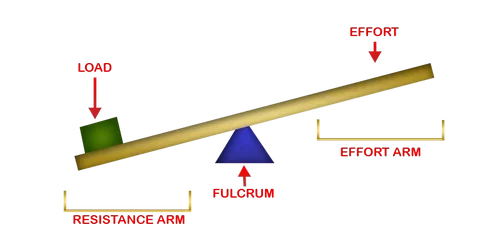
People use levers, but they do not know the type of lever or how to determine the type of any lever. The levers are classified according to the location of the effort force, the resistance force, and the fulcrum.
There are three types of levers.
Types of levers
-
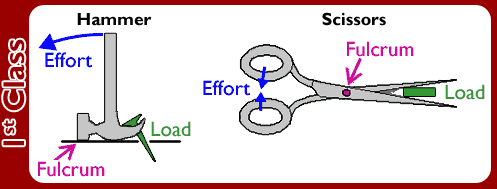
The First-class levers: In our daily life, the first-class levers are considered the most popular type of levers.
In first-class levers, the fulcrum is between the effort force and the resistance.
Examples of first-class levers: The pincer, the pliers, the paddle, the scissors, the seesaw, the crowbar, the hammer claw, the suction, the pump, the nail clipper and the balance.

First-class levers
The hammer claw and the scissors are from the first-class levers
Each of the scissors, the pincer, the pliers and the nail clipper is composed of two first-class levers.
-
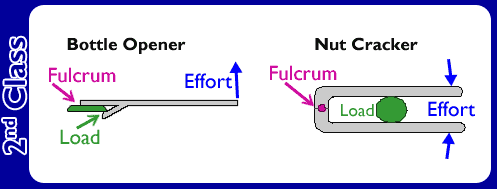
The Second class levers: In the second class levers, the resistance force is between the effort force and the fulcrum.
Examples of second-class levers: bottle opener, stapler, wheelbarrow and Nutcracker.

Second-class levers
The bottle opener and the nutcracker are from the second class of levers -
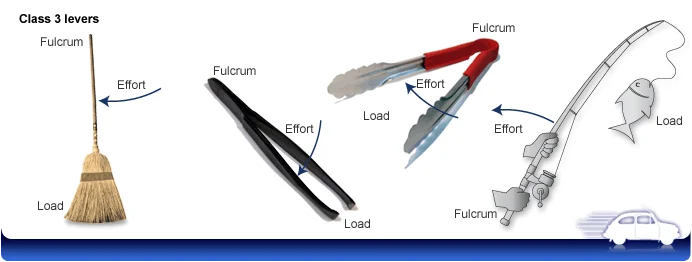
The Third class levers: In the third class levers, the effort force is between the resistance force and the fulcrum.
Examples of third-class levers: The Hockey bat, the manual broom, the tweezers, the fishing tool (the fishing hook), the ice or the sweet holder, and the cool tongs (the cool holder).

Third-class levers
A manual broom, Tweezers, cool tongs, and fishing hock are from the third-class levers The Nutcracker is composed of two levers of the second class levers, and the tweezers are composed of two levers of the third class levers.
Do you know that you can determine the type of any lever in our daily life?
-
First, imagine and think of the way the lever works.
-
Then, you should determine the position of the effort force, the resistance force, and the fulcrum.
-
You should identify the midpoint of the lever.
-
Finally, if the midpoint of the lever is the fulcrum, So, it is a first-class levers.
If the midpoint of the lever is the resistance force, So, it is from the second-class levers.
If the midpoint of the lever is the effort force, So, it is from the third-class levers.
Importance of levers
Levers are simple machines that play a crucial role in making work easier by amplifying force, changing direction, or increasing speed.
- Mechanical Advantage: Levers allow a small input force to produce a larger output force, reducing the effort required to lift or move objects. Example: A crowbar helps to lift heavy objects with less effort.
- Everyday Applications: Household Tools: Scissors, bottle openers, pliers. Sports: Baseball bats, golf clubs, hockey sticks—medical Field: Tweezers, forceps.
- Industrial & Construction Use: Cranes, wheelbarrows, and pulleys use lever principles to handle heavy loads efficiently.
- Human Body: Our bones and muscles function as levers to facilitate movement. Example: The forearm acts as a lever when lifting an object.
- Engineering & Physics: Understanding levers helps design efficient machines, bridges, and vehicles.
- Agriculture: Tools like hoes and shovels use lever mechanics to reduce labor effort.
Levers are fundamental in science, engineering, and daily life, making tasks easier and more efficient.
FAQ about Types and Importance of Levers
1. What is a lever?
A lever is a simple machine that helps us move or lift heavy objects with less effort. It consists of a rigid bar that rotates around a fixed point called the fulcrum. Levers make work easier by changing the direction or magnitude of force.
2. What are the main parts of a lever?
A lever has three main parts:
- Fulcrum: The fixed point where the lever rotates.
- Effort: The force applied to move the object.
- Load (Resistance): The object or weight being moved.
3. How many types of levers are there?
There are three main types of levers based on the positions of the fulcrum, effort, and load:
- First-class lever.
- Second-class lever.
- Third-class lever.
4. What is a first-class lever?
A first-class lever has the fulcrum between the effort and the load.
Examples:
- Seesaw.
- Scissors.
- Crowbar.
- Pliers.
Importance:
- Changes the direction of force.
- Can increase or decrease the applied force.
- Widely used in tools for cutting, lifting, and balancing.
5. What is a second-class lever?
In a second-class lever, the load is located between the fulcrum and the effort.
Examples:
- Wheelbarrow.
- Nutcracker.
- Bottle opener.
Importance:
- Multiplies the applied force, making it easier to lift heavy objects.
- Very useful in transporting heavy loads.
- Reduces the amount of effort needed.
6. What is a third-class lever?
A third-class lever has the effort placed between the fulcrum and the load.
Examples:
- Human forearm (biceps).
- Tweezers.
- Fishing rod.
- Tongs.
Importance:
- Increases speed and distance of movement.
- Allows precise control of movement.
- Commonly found in the human body and sports equipment.
7. Why are levers important in everyday life?
Levers are important because they:
- Make lifting and moving heavy objects easier.
- Reduce the effort required to perform tasks.
- Improve efficiency in tools and machines.
- Help perform many daily activities, from cutting to opening containers.
8. How are levers used in the human body?
Many bones and joints work like third-class levers. Muscles apply effort, joints act as fulcrums, and the body parts act as loads. This allows humans to move quickly and perform complex movements such as lifting, running, and throwing.
9. What is the mechanical advantage of a lever?
Mechanical advantage is the amount by which a lever multiplies the applied force. A lever with a higher mechanical advantage allows a person to lift heavier loads with less effort.
10. How do levers help in technology and engineering?
Levers are used in many machines and tools, such as:
- Construction equipment.
- Hand tools (pliers, cutters).
- Medical instruments.
- Mechanical systems in vehicles.
They are fundamental in mechanical engineering and design because they help improve efficiency and reduce human effort.
You can follow Science Online on YouTube from this link: Science Online
This website is ever helpful to people who don’t know what this is.
Thank you very much
Good