
10 Powerful Facts About Hardness of Materials and Life Applications You Should Know
Hardness of materials is one of the most important mechanical properties that determines a material’s ability to resist scratching, indentation, abrasion, and wear. Engineers rely on hardness measurements when selecting materials for buildings, machines, tools, vehicles, and medical equipment because hardness directly affects durability, strength, and service life.
Hardness of materials

Hardness of Materials
Some solid substances are soft at room temperature, such as rubber, and some solid substances need heat to become soft and easy to shape, such as metals, and some solid substances can’t be softened by heating, such as coal and sulphur.
The hardness of materials has been assessed by the materials’ resistance to cutting, scratching, or bending, and it is measured by the resistance that a smooth surface offers to abrasion.
The degree of hardness is determined by observing the comparative ease or difficulty with which one mineral is scratched by another. Hardness is the property of a material that enables it to resist plastic deformation by penetration.
Hardness is the resistance of a material to deformation, indentation, or penetration by drilling, abrasion, impact, or scratching. Hardness is measured by hardness tests such as Brinell, Rockwell, Knoop, or Vickers tests, and there is no standard hardness scale.
The hardness of an alloy is the diameter of the dent an alloy measured when 1 kg of weight is dropped onto it. The smaller the diameter of the dent formed on the alloy, the harder the alloy.
The hardness tests serve an important need in the industry; these tests are based on experiments and observation. They are able to detect certain differences between the materials.
The importance of hardness testing has to do with the relationship between the hardness and other properties of the material, and the hardness test is preferred because it is simple, easy, and relatively nondestructive.
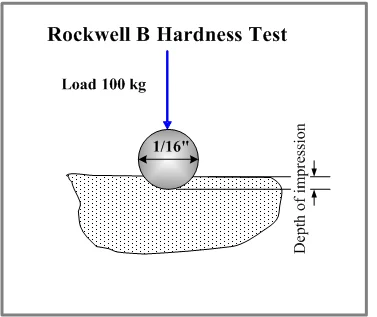
Rockwell hardness test
Life application of hardness
The screwdrivers are made of steel iron because it is very hard, and the rods used in building houses concrete are made of iron, not copper, because the hardness of iron is more than that of copper.
Hardness of Materials and Life Applications
Hardness is the property of a material that enables it to resist permanent surface deformation caused by scratching, cutting, indentation, or abrasion. It is an essential mechanical property used in material science, manufacturing, construction, automotive engineering, aerospace, mining, and many other industries.
Materials with high hardness generally have better wear resistance, making them suitable for cutting tools, gears, bearings, and industrial machinery. Softer materials are easier to machine and form but may wear more quickly during service.
Hardness should not be confused with strength or toughness. A material may be extremely hard but brittle, while another material may be softer yet capable of absorbing much greater impact energy.
Why is Hardness important?
Hardness is important because it helps engineers:
- Select suitable materials for specific applications.
- Improve wear resistance.
- Increase product lifespan.
- Reduce maintenance costs.
- Enhance manufacturing quality.
- Predict resistance to deformation.
- Improve safety in engineering structures.
Types of Hardness
Scratch Hardness
Measures resistance to scratching.
Example:
- Diamond scratches glass.
- Glass scratches steel.
The Mohs Hardness Scale is commonly used for minerals.
Indentation Hardness
Measures resistance to permanent indentation under a load. Common industrial hardness tests include:
- Brinell Hardness Test.
- Rockwell Hardness Test.
- Vickers Hardness Test.
- Knoop Hardness Test.
Rebound Hardness
Measures the elasticity of a material by observing the rebound height of an impact object.
Commonly used for:
- Steel structures.
- Large machinery.
- Bridges.
Common Hardness Tests
Mohs Hardness Scale
The Mohs scale ranks minerals from 1 to 10.
- Talc: 1.
- Gypsum: 2.
- Calcite: 3.
- Fluorite: 4.
- Apatite: 5.
- Feldspar: 6.
- Quartz: 7.
- Topaz: 8.
- Corundum: 9.
- Diamond: 10.
Diamond is the hardest naturally occurring material on the Mohs scale.
Brinell Hardness Test
The Brinell test uses a hardened steel or tungsten carbide ball pressed into the material under a known load.
Applications:
- Cast iron.
- Aluminum alloys.
- Forged steel.
- Large metal parts.
Rockwell Hardness Test
Rockwell testing measures the depth of penetration under a standard load.
Advantages:
- Fast.
- Simple.
- Highly accurate.
- Suitable for mass production.
Widely used for:
- Automotive parts.
- Industrial machinery.
- Manufacturing.
Vickers Hardness Test
Uses a diamond pyramid indenter.
Suitable for:
- Thin materials.
- Coatings.
- Small components.
- High-precision laboratory testing.
Factors Affecting Hardness
Several factors influence hardness:
- Chemical composition.
- Heat treatment.
- Alloying elements.
- Grain size.
- Cold working.
- Surface treatment.
- Cooling rate.
- Manufacturing process.
Advantages of Hard Materials
- Excellent wear resistance.
- Longer service life.
- Better scratch resistance.
- Improved cutting performance.
- Reduced maintenance.
- High-dimensional stability.
- Better abrasion resistance.
Disadvantages of Extremely Hard Materials
- Higher manufacturing cost.
- Difficult machining.
- Increased brittleness.
- More expensive tooling.
- Risk of cracking under impact.
Life Applications of Hardness of Materials
Construction
Concrete, steel reinforcement, and structural materials require suitable hardness to withstand heavy loads and environmental wear.
Automotive Industry
Hardness is essential for:
- Engine components.
- Gears.
- Bearings.
- Brake discs.
- Transmission shafts.
Proper hardness increases vehicle reliability and durability.
Aerospace
Aircraft components require carefully controlled hardness to achieve high performance while minimizing weight.
Examples include:
- Landing gear.
- Turbine blades.
- Aircraft fasteners.
Manufacturing
Industrial tools such as:
- Drills.
- Milling cutters.
- Cutting inserts.
- Dies.
- Punches.
must possess high hardness for efficient machining.
Medical Industry
Hard materials are used in:
- Surgical instruments.
- Dental tools.
- Artificial joints.
- Orthopedic implants.
Mining Industry
Mining equipment experiences severe abrasion.
Examples:
- Excavator teeth.
- Crushers.
- Conveyor parts.
- Rock drilling tools.
Electronics
Hard coatings protect:
- Smartphone screens.
- Semiconductor components.
- Precision instruments.
Household Products
Daily examples include:
- Kitchen knives.
- Scissors.
- Watches.
- Glass windows.
- Ceramic tiles.
Jewelry
Diamond, sapphire, and other hard gemstones resist scratching and maintain their appearance for many years.
Sports Equipment
Hard materials improve the performance and durability of:
- Golf clubs.
- Bicycle gears.
- Ice skates.
- Protective helmets.
Difference Between Hardness, Strength, and Toughness
Although hardness, strength, and toughness are all important mechanical properties of materials, they describe different behaviors under applied forces. Understanding these differences helps engineers choose the most suitable material for a particular application.
Hardness
Hardness is the ability of a material to resist surface deformation, such as scratching, indentation, abrasion, or wear. A hard material maintains its surface integrity when subjected to friction or contact with other objects. Hardness is commonly measured using tests such as the Mohs, Brinell, Rockwell, and Vickers hardness tests. Materials with high hardness, such as hardened steel and ceramics, are widely used for cutting tools, gears, bearings, and wear-resistant components.
Strength
Strength is the ability of a material to withstand applied forces or loads without breaking or undergoing permanent deformation. It indicates how much stress a material can bear before it fails. Strength is measured through mechanical tests such as tensile, compressive, and shear tests. High-strength materials, including structural steel and titanium alloys, are commonly used in buildings, bridges, automobiles, aircraft, and heavy machinery where they must safely support large loads.
Toughness
Toughness is the ability of a material to absorb energy and deform plastically before fracturing. A tough material can withstand sudden impacts, shocks, and repeated loading without cracking or breaking. Toughness is often evaluated using impact tests, such as the Charpy or Izod test. Materials like structural steel and certain engineering plastics combine good strength with high toughness, making them ideal for safety-critical applications, including vehicle frames, protective equipment, pipelines, and construction materials.
Key Differences
The main difference is that hardness measures resistance to surface damage, strength measures resistance to applied loads, and toughness measures resistance to fracture under impact or sudden loading. A material can be extremely hard but brittle, such as glass or ceramic, meaning it resists scratching but can shatter under impact. Conversely, a material can be very tough but not exceptionally hard, allowing it to absorb significant energy without breaking. In engineering design, the best material is often one that provides the right balance of hardness, strength, and toughness for its intended application.
Conclusion
Hardness is a fundamental mechanical property that determines how well a material resists scratching, indentation, abrasion, and wear. From buildings and automobiles to medical devices and smartphones, hardness plays a crucial role in selecting the right material for long-lasting performance. Engineers use various hardness tests—including Mohs, Brinell, Rockwell, and Vickers—to ensure materials meet the required durability and reliability for specific applications.
Frequently Asked Questions (FAQs) about hardness
1. What is the hardness of materials?
Hardness is the ability of a material to resist scratching, indentation, abrasion, or permanent surface deformation.
2. Why is hardness important in engineering?
It helps engineers choose materials with the appropriate wear resistance, durability, and service life for different applications.
3. What is the hardest natural material?
Diamond is the hardest naturally occurring material, with a Mohs hardness of 10.
4. What is the difference between hardness and strength?
Hardness measures resistance to surface deformation, while strength measures a material’s ability to withstand applied loads without failure.
5. Which hardness test is most commonly used in industries?
The Rockwell hardness test is widely used because it is fast, accurate, and suitable for production environments.
6. Where is hardness testing used?
Hardness testing is used in manufacturing, automotive, aerospace, mining, construction, electronics, and medical industries.
7. Can heat treatment increase hardness?
Yes. Processes such as quenching and tempering can significantly increase the hardness of many metals.
8. Which materials generally have the highest hardness?
Diamonds, ceramics, carbides, hardened steels, and some advanced composites exhibit very high hardness.
9. Does higher hardness always mean better material performance?
No. Extremely hard materials may be brittle, so engineers must balance hardness with toughness and strength based on the application.
10. Which hardness test is best for thin materials?
The Vickers hardness test is preferred for thin materials, coatings, and small precision components.
You can follow science online on YouTube from this link: Science online
Matter, Properties & Kinds of molecules, Melting process & Vaporization process
Atomic structure of matter, Energy levels, Electronic distribution & chemical activity