
Structure and the importance of the levers, Why are levers considered simple machines?
The levers are the most common simple machines that help man to perform heavy tasks easily. They were first described in 260 B.C, The liver is affected by an effort force and a resistance force, and it is a rigid bar (straight or curved) that rotates around a fixed point called the fulcrum.
Structure of the lever
The liver consists of:
- A resistance force is a force that results from the weight of the body that we want to move.
- An effort force is a force that is exerted by a person to equilibrate the resistance.
- The fulcrum is a fixed point, around which the bar rotates.
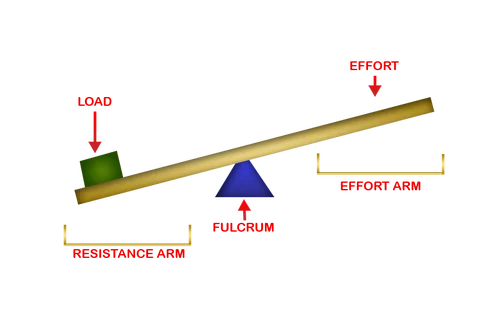 Lever structure |
Examples of levers
Stapler, Manual broom, Crowbar, Seesaw, Scissors, Bottle opener, Nutcracker, Ice or Sweet Holder, and Wheelbarrow.
Importance of levers
-
The levers increase the force because they save the exerted effort by using a small force to make a great effort as moving a heavy load. Examples: crowbar, bottle (soda water) opener, Nutcracker & wheelbarrow.
-
They increase the distance, where some levers allow the exerting force for a small distance to move an object for a longer distance. Examples: The manual broom. If your hand moves a small distance at the upper part of the manual broom, the lower part will move a longer distance.
- They avoid dangers as they are used to pick up hot, cold, and poisonous materials. Examples: Ice holder and coal holder (coal tongs).
-
They increase the speed of the objects that we affect. Examples: Hockey bat.
-
They move the force from one place to another. Examples: The force of your hand on the manual broom moves from one place to another to collect the garbage without bending.
-
They have accuracy in performance as they are used to pick up a tiny object. Example: Tweezers.
Examples of first, second, and third-class levers
Levers are classified into three types based on the arrangement of the fulcrum (pivot), effort (force applied), and load (resistance):
1. First-Class Lever (Fulcrum in the Middle)
- Structure: Effort — Fulcrum — Load.
- The fulcrum is in the center, with effort applied on one side and the load on the other.
- Examples: Crowbar, Scissors, Pliers, Balance scale, and Seesaw.
2. Second-Class Lever (Load in the Middle)
- Structure: Effort — Load — Fulcrum.
- Example: Wheelbarrow.
- The wheel (fulcrum) is at one end, the load is in the middle, and effort is applied at the handles.
- Other Examples: Bottle opener, Nutcracker, and Door (hinge as fulcrum, effort applied at handle).
3. Third-Class Lever (Effort in the Middle)
- Structure: Fulcrum — Effort — Load
- Example: Tweezers.
- The fulcrum is at one end, the effort is applied in the middle, and the load is at the opposite end.
- Other Examples: Fishing rod, Broom, and Human arm (lifting a weight using biceps).
Each type of lever is used in different applications to maximize efficiency depending on the task.
FAQ about Levers
1. What is a lever?
A lever is a simple machine consisting of a rigid bar that rotates around a fixed point called the fulcrum. It is used to move or lift loads with less effort by multiplying the applied force.
2. What are the main parts of a lever?
A lever has three main components:
- Fulcrum: The fixed point where the lever pivots or rotates.
- Effort: The force applied to move the lever.
- Load (Resistance): The object or weight that is being moved or lifted.
These parts work together to reduce the effort required to perform work.
3. What are the types of levers?
Levers are classified into three types depending on the position of the fulcrum, effort, and load:
- First-class lever: The fulcrum is between the effort and the load (e.g., seesaw, scissors).
- Second-class lever: The load is between the fulcrum and the effort (e.g., wheelbarrow, nutcracker).
- Third-class lever: The effort is between the fulcrum and the load (e.g., tweezers, fishing rod).
4. How does a lever make work easier?
A lever increases the mechanical advantage, which means it allows a small effort force to move a larger load. By increasing the distance from the fulcrum where the effort is applied, the required force becomes smaller.
5. What is the mechanical advantage of a lever?
The mechanical advantage (MA) of a lever is the ratio of the load force to the effort force. It can also be calculated using the lengths of the effort arm and load arm. Formula: Mechanical Advantage = Effort arm length ÷ Load arm length
6. Why are levers important in daily life?
Levers are important because they help people perform tasks more efficiently. They are used in many everyday tools and machines to reduce effort and increase force.
7. Where are levers used in everyday life?
Levers are used in many tools and devices, such as:
- Scissors.
- Pliers.
- Crowbars.
- Wheelbarrows.
- Bottle openers.
- Fishing rods.
These tools rely on lever principles to make work easier.
8. Are levers used in the human body?
Yes, the human body contains many levers. Bones act as rigid bars, joints act as fulcrums, and muscles provide the effort to move body parts. For example, the forearm and elbow joint function as a third-class lever.
9. What is the structure of a lever system?
The structure of a lever system includes:
- A rigid bar.
- A fixed pivot point (fulcrum).
- An effort force applied at one point.
- A load or resistance at another point.
The arrangement of these elements determines the type and function of the lever.
10. Why are levers considered simple machines?
Levers are considered simple machines because they change the magnitude or direction of force, making physical work easier without using complex mechanisms.
You can follow Science Online on YouTube from this link: Science Online