
Artemis II: NASA’s First Crewed Lunar Flyby in 50 Years, Will astronauts land on the Moon?
Artemis II is the first crewed mission of the Artemis program led by NASA. It is designed as a lunar flyby mission, meaning astronauts will travel around the Moon without landing, then return safely to Earth. It marks the first time humans will travel beyond low Earth orbit since the Apollo era (1972).
Artemis II
Artemis II is the first crewed deep-space mission of the Artemis program led by NASA. It is designed to send astronauts beyond Earth orbit for the first time in over 50 years, test the Orion spacecraft systems with humans onboard, and perform a lunar flyby to prepare for future Moon landings. Artemis II is a test mission with astronauts that goes around the Moon, not onto it.
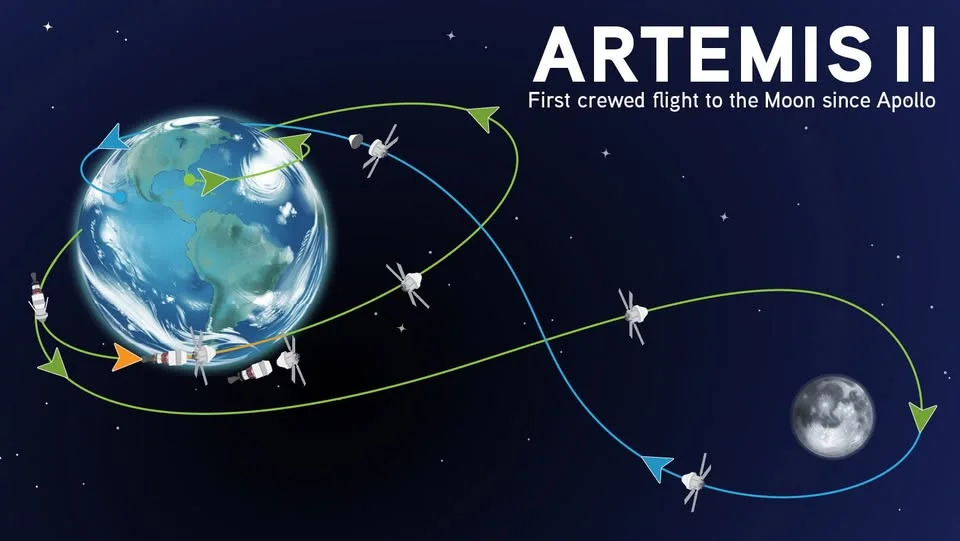
Artemis II: NASA’s First Crewed Lunar Flyby in 50 Years
Mission Overview
- Mission Type: Crewed lunar flyby.
- Launch Date: April 2026 (planned).
- Duration: ~10 days.
- Crew Size: 4 astronauts.
- Spacecraft: Orion.
- Rocket: Space Launch System (SLS).
Crew Members
- Reid Wiseman (Commander).
- Victor Glover (Pilot).
- Christina Koch (Mission Specialist).
- Jeremy Hansen (Mission Specialist).
What Will Artemis II Do?
Artemis II is mainly a test mission, but it performs critical functions: It can test life-support systems for astronauts in deep space. It can validate navigation, communication, and propulsion systems. It can study the effects of deep space on humans. It can perform a “free-return trajectory” around the Moon. It can prepare for future Moon landings (Artemis III and beyond).
How the Mission Works
Artemis II can launch from Kennedy Space Center. It can enter Earth orbit and perform system checks. It can travel toward the Moon (translunar injection). It can fly around the Moon. It can return to Earth using the Moon’s gravity, and it can re-enter the atmosphere and splash down in the Pacific Ocean.
Advantages of Artemis II
- Technological Advancement: Tests next-generation spacecraft and deep-space systems.
- International Collaboration: Artemis II includes astronauts from the U.S. and Canada.
- Historic Milestones: First woman and first person of color to travel near the Moon.
- Gateway to Future Missions: Essential step toward Moon landing and Mars missions.
- Scientific Research: Artemis II provides valuable data on human survival in deep space.
Disadvantages of Artemis II
- High Cost: Billions of dollars invested in development and launch.
- Technical Risks: Heat shield and reentry risks are still under evaluation.
- Delays: The mission timeline has experienced multiple postponements.
- No Landing: Artemis II does not land on the Moon (only flyby mission).
Artemis II vs Apollo Missions
- Uses modern technology (SLS & Orion vs Saturn V).
- Focuses on long-term exploration instead of short missions.
- More diverse astronaut crew.
- Advanced communication systems (including laser-based tech).
FAQ about Artemis II
1. What is the main goal of Artemis II?
To test systems for safely sending humans into deep space and around the Moon.
2. Will astronauts land on the Moon?
No, it is only a flyby mission.
3. How long will the mission last?
About 10 days.
4. Why is Artemis II important?
It prepares for future missions like Artemis III, which aims to land astronauts on the Moon.
5. What spacecraft is used?
The Orion spacecraft.
6. Who is organizing the mission?
NASA, with international partners.
7. Is it dangerous?
Like all space missions, it carries risks, especially during reentry.
8. Will Artemis II land on the Moon?
No — Artemis II will NOT land on the Moon. It is a lunar flyby mission, meaning astronauts will:
- Travel from Earth to the Moon.
- Orbit around it once.
- Then return to Earth.
The mission uses a “free-return trajectory”, allowing the spacecraft to loop around the Moon and come back safely without landing. The actual Moon landing is planned for Artemis III, which will come after Artemis II.
9. Why NASA chose not to land in Artemis II
NASA didn’t plan a Moon landing for Artemis II on purpose—it’s a strategic step, not a limitation. Here’s why:
1. It’s a “test-before-risk” mission: Artemis II is the first crewed flight of the Orion spacecraft and Space Launch System (SLS). Before attempting a landing, NASA needs to make sure:
- Life-support systems work perfectly.
- Navigation and communication are reliable.
- Astronauts can safely travel in deep space.
Skipping the landing reduces risk while testing the most critical systems.
2. Human safety comes first: Landing on the Moon is much more complex and dangerous than flying around it:
- Requires precise descent and landing systems.
- Needs a safe way to take off again from the Moon.
- Adds multiple failure points.
NASA chose to validate crew safety in deep space first, then move to landing in the next mission.
3. The lunar lander isn’t ready yet: The spacecraft that will actually land astronauts on the Moon is being developed separately: The Human Landing System (HLS), led by SpaceX. During Artemis II, this lander will not yet be fully tested or certified for humans.
4. Step-by-step mission architecture: NASA is following a gradual plan:
- Artemis I: Uncrewed test around the Moon.
- Artemis II: Crewed flyby (test with humans).
- Artemis III: Actual Moon landing.
This approach reduces risk and increases mission success.
5. Testing the “free-return trajectory.” Artemis II uses a path that naturally brings the crew back to Earth if something goes wrong.
This is much safer than a landing mission, where abort options are limited.
6. Managing cost and complexity: Adding a landing to Artemis II would:
- Increase mission cost significantly.
- Require more hardware and coordination.
- Raise the chance of delays or failure.
NASA prefers to separate testing from landing to keep each mission focused.
NASA didn’t skip the landing because it couldn’t. It skipped it because it’s the smartest and safest way to return humans to the Moon after 50+ years. Artemis II is essentially: “Prove we can safely take humans to the Moon and back… then land next time.”
Artemis II is not just a mission—it is a turning point in human space exploration. While it doesn’t land on the Moon, its importance lies in testing the technologies and human endurance needed for future exploration. It bridges the gap between the historic Apollo missions and the future of sustained lunar presence and Mars exploration.
You can follow Science Online on YouTube from this link: Science online
Mars Colony Design: How Will a Mars Colony Look Like?, How will Mars colony get water and oxygen