What Are the Factors Affecting the Weight? 10 Essential and Powerful Factors Explained
What are the factors affecting the weight? Discover the 10 essential factors that influence an object’s weight, including gravity, mass, altitude, and location. Learn how weight changes in different environments with simple explanations and real-life examples.
What are the factors affecting the weight?
Weight
The reason objects fall downward to the Earth is a type of force called the weight (the gravitational force), and you can feel this force when you carry an object or try lifting it. The weight is the force with which a body is attached to the Earth, or it is the gravitational force by which a body is attached to the Earth.
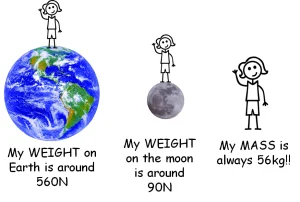
The weight on the Earth and the moon
The weight
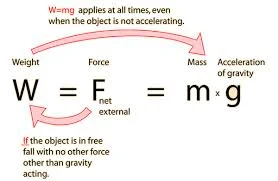
It is the force exerted on an object due to gravity. Weight (W) is calculated using the formula: W = m⋅g, where: W = weight (in newtons, N), m = mass (in kilograms, kg), g = acceleration due to gravity (approximately 9.81 m/s29.81m/s2 on Earth).
The effect of the weight is always directed towards the center of the Earth. On Earth, all the objects have weight, but in space, all the objects are in a state of weightlessness. The weight of any object can be measured by the spring scale by determining the extension of its spring.
Everything seems weightless inside the spacecraft, which revolves around the Earth. Newton is the measuring unit of weight, and it is almost equal to the weight of an object on the Earth’s surface whose mass is 100 grams.
In physics, weight is the force with which gravity pulls on an object’s mass. It is not the same as mass — they are related but distinct concepts. Weight is a force, so it’s often drawn as a downward arrow in force diagrams. When we say “weightlessness” in space, it means there is no normal force, even though gravity might still be present.
Factors affecting weight
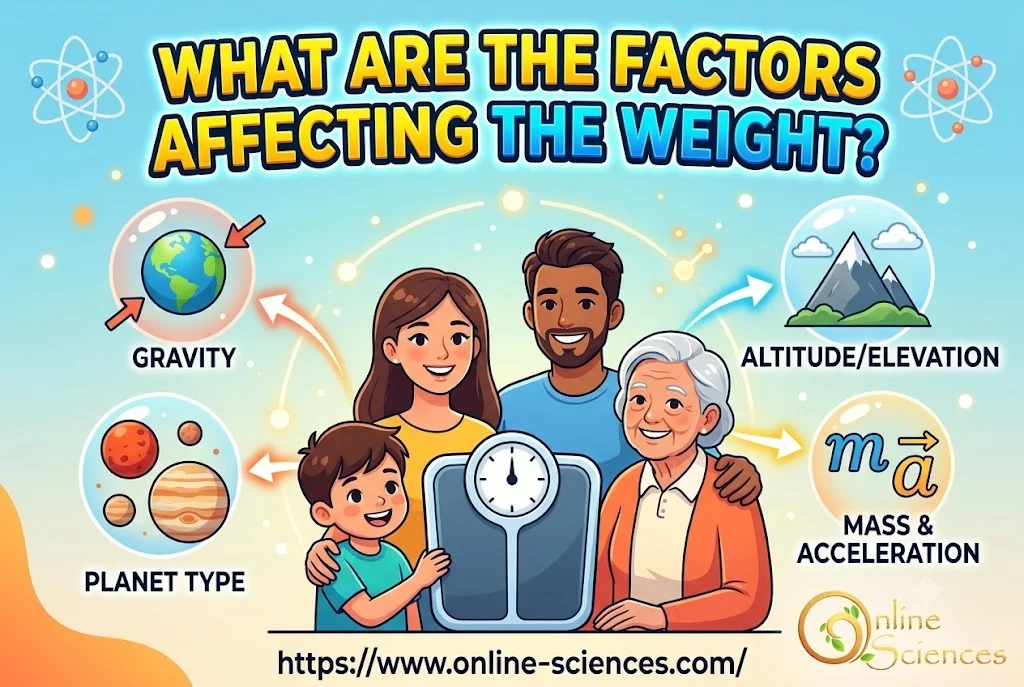
The weight of any object is affected by three factors, which are the object’s mass, the planet (the place) where the object exists, and the distance between the object and the center of the planet.
The weight of any object on the Earth’s surface increases by increasing the object’s mass. The weight of an object differs according to the planet (or the moon) where the object exists.
The weight of any object on the Earth’s surface increases with increasing mass
As the mass of the planet (place) increases. The gravitational force for an object increases, so the weight of the object increases.
The weight of the object on the moon’s surface equals one-sixth of its weight on the Earth’s surface because the Earth has greater mass and gravitational force than the moon.
The weight of anybody decreases when the distance between the body and the center of the planet increases because the gravitational force decreases.
The more mass an object has, the more it weighs. Mass is a scalar quantity and does not change with location (e.g., same on Earth or the Moon). Gravitational Acceleration (gg) varies depending on location: Earth’s surface: ~9.81 m/s², Moon: ~1.62 m/s² (so your weight is less on the Moon), Other planets: Each has a different gravity value.
Gravity slightly decreases with height above Earth’s surface. Gravity is slightly weaker at the equator due to Earth’s rotation and bulging shape. In certain contexts, apparent weight can change due to external forces:
- Elevators: Accelerating up increases apparent weight; accelerating down decreases it.
- Free fall: In free fall (e.g., skydiving before the parachute opens), weightlessness occurs because the normal force is zero.
- Rotating systems: Centripetal force can alter apparent weight, like on a spinning space station.
FAQ about weight
1. What are the factors affecting the weight?
The main factors affecting weight are an object’s mass and the gravitational force acting on it. Changes in gravity due to location or altitude can also affect weight.
2. Does weight change from one planet to another?
Yes. Weight changes because each planet has a different gravitational pull. For example, an object weighs much less on the Moon than on Earth.
3. Is weight the same as mass?
No. Mass is the amount of matter in an object and remains constant, while weight depends on gravity and can change from place to place.
4. Why does gravity affect weight?
Gravity pulls objects toward the center of a planet. The stronger the gravitational force, the greater the object’s weight.
5. Does altitude affect weight?
Yes. As altitude increases, gravity becomes slightly weaker, causing a very small decrease in weight.
6. How is weight calculated?
Weight is calculated using the formula: Weight = Mass × Gravitational Acceleration (W = m × g)
where g is approximately 9.8 m/s² on Earth.
7. Why do astronauts feel weightless in space?
Astronauts appear weightless because they are in continuous free fall while orbiting Earth, creating the sensation of weightlessness.
8. Can weight change without changing mass?
Yes. If gravitational acceleration changes, weight changes even though the object’s mass remains the same.
You can subscribe to Science Online on YouTube from this link: Science Online
The gravity and the weightlessness in the solar system
The properties and the measuring devices of the mass
The scalar physical quantity and the vector physical quantity
The types of speed and the factors necessary for the description of motion