Force Review 2026: The Effect of Force and Amazing Technological Applications in Motion
Force is one of the most important concepts in physics because it affects the motion of objects everywhere around us. From cars and airplanes to robots and satellites, many technological applications depend on the effect of force to create movement, change direction, increase speed, or stop motion. Understanding force helps explain how modern machines and transportation systems work efficiently in everyday life.
The force
The force is the effect that changes the state of the object. The measuring unit of the force is “Newton”, related to the scientist “Isaac Newton”. The motion of any object and its stopping need an effect, which is the force. The motion increases by increasing the force.
At normal conditions, some objects are at rest. The object needs an effect to change its state from rest to motion and also from motion to rest; this effect is called the force.
The lever is a simple method to raise an object by the effect of the force. The weight acts as a force. So, when you hang a weight on a spring, you observe that the length of the spring increases as the weight increases.
Force review
Technological applications depend on their motion on the effect of the force
A lot of home equipment that depends on motor pushing force in motion, such as the blender (mixer), the electric fan, the washing machine, and the electric sewing machine. Some means of transport that depend on hand pushing force in motion, such as the wheelbarrow.
Technological applications depend on the effect of the force in rising heavy objects
The crane, the escalator (a movable electric ladder), the fishing tool (pulleys), and the electric lift contain the pulleys that make the motion easy and the gears that transfer the motion.
Force Review
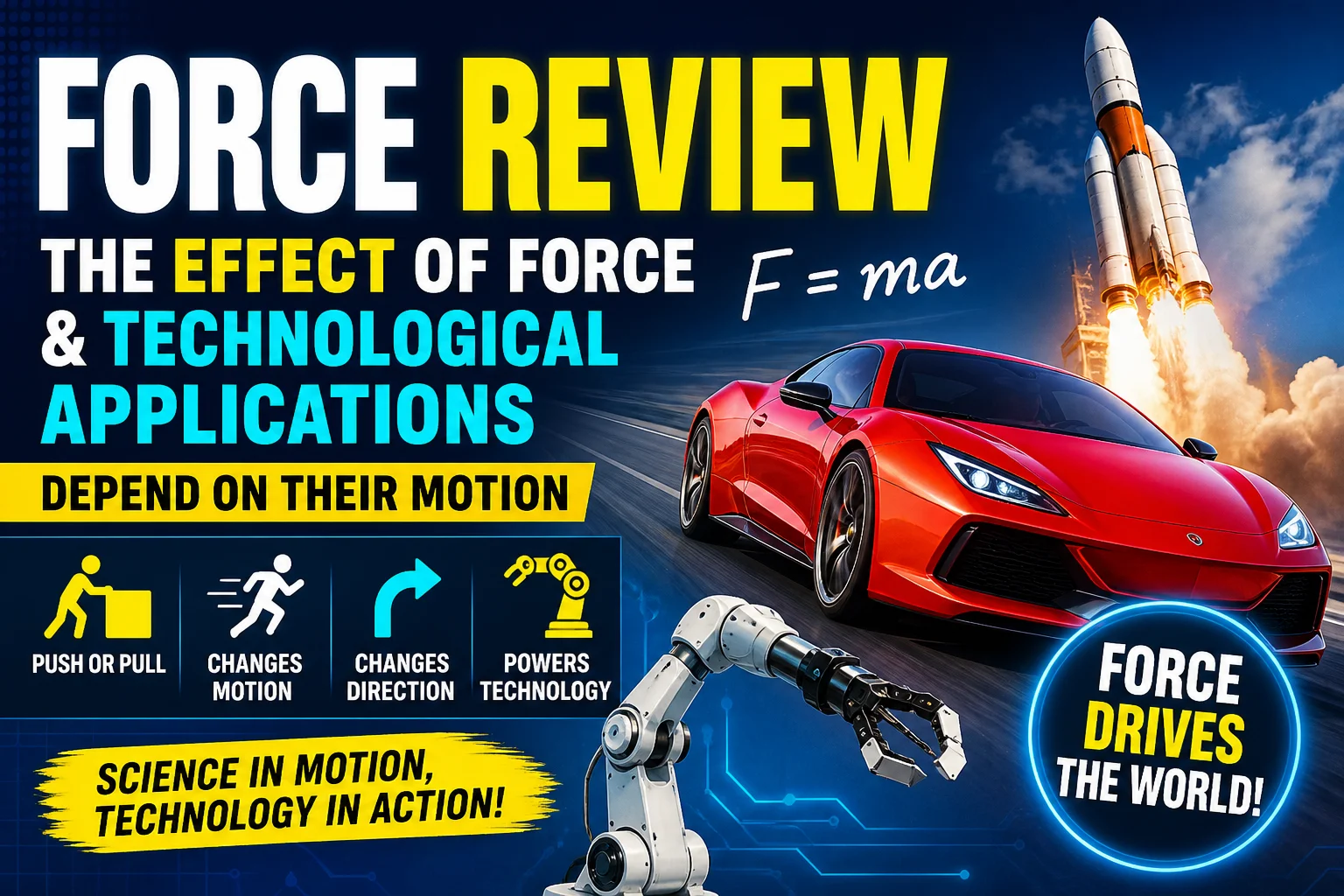
Force is a push or pull acting on an object that can change its state of motion. In physics, force can make a stationary object move, stop a moving object, increase or decrease speed, or change direction. The SI unit of force is the Newton (N), named after Isaac Newton, who developed the famous laws of motion.
One of the most important effects of force is changing motion. When a force acts on an object, acceleration may occur depending on the object’s mass and the strength of the force. This principle explains how vehicles move, rockets launch into space, and machines operate in factories.
Many technological systems depend on force and motion to function properly. Elevators use mechanical force to move upward and downward, airplanes rely on thrust and lift forces to fly, and electric motors convert electrical energy into mechanical motion. Modern robotics also depends heavily on forces to control movement with precision and efficiency.
Technological Applications Depending on Force
Transportation technology is one of the clearest examples of force applications. Cars depend on engine force and friction between tires and roads for movement and braking. High-speed trains use magnetic and mechanical forces to reduce friction and travel rapidly across long distances.
In space technology, rockets use powerful thrust forces produced by burning fuel to overcome Earth’s gravity. Satellites remain in orbit because of the balance between gravitational force and their forward motion. These applications show how understanding force is essential for modern scientific advancement.
Industrial machines and robots also depend on force to perform tasks accurately. Robotic arms apply controlled force to lift heavy objects, assemble electronics, and assist in surgeries. Engineers study force carefully to design safe machines, bridges, buildings, and transportation systems capable of withstanding different pressures and movements.
Common Effects of Force
- Moving stationary objects.
- Stopping moving objects.
- Changing speed.
- Changing direction.
- Changing the shape or size of objects.
- Producing rotation or vibration.
FAQ About Force and Technological Applications
1. What is force in physics?
Force is a push or pull that can change the motion, speed, direction, or shape of an object.
2. What is the SI unit of force?
The SI unit of force is the Newton (N).
3. What are the main effects of force?
Force can start motion, stop motion, change speed, change direction, or deform objects.
4. How does force affect motion?
When a force acts on an object, it can cause acceleration or deceleration depending on the mass and strength of the force.
5. What technological applications depend on force?
Cars, airplanes, rockets, elevators, robots, cranes, and industrial machines all depend on force.
6. How do rockets use force?
Rockets generate thrust force by expelling gases at high speed to move upward against gravity.
7. Why is friction important in transportation?
Friction allows vehicles to move safely, stop effectively, and maintain control on roads.
8. What is Newton’s second law?
Newton’s second law states that force equals mass multiplied by acceleration. F=ma
9. How do robots use force?
Robots use controlled mechanical forces to move objects, perform tasks, and interact with their environment.
10. Why is studying force important?
Studying force helps scientists and engineers design safer vehicles, machines, buildings, and modern technologies.
You can follow science online on YouTube from this link: Science online
Factors that affect work & The effect of the angle between force and displacement on work