
Xiaomi CyberDog review, features, advantages, disadvantages, What does a cyber dog do?
The Xiaomi CyberDog is a bio-inspired quadruped robot developed by Xiaomi, designed to look and move like a dog. CyberDog can walk, run, jump, avoid obstacles, follow its owner, recognize faces, and perform tricks. It also supports voice commands, remote/app control, and developer customization through open-source software and hardware ports.
Xiaomi CyberDog
Xiaomi’s CyberDog is designed as a quadruped “robot dog” with agility, AI vision, and developer-friendly tools. It combines robotics, AI, and smart sensors to achieve lifelike motion, environmental awareness, and human–robot interaction. The robot runs on NVIDIA’s Jetson Xavier NX AI platform and is equipped with multiple cameras, depth sensors, microphones, GPS, and touch sensors.
Xiaomi CyberDog is a research/development platform for robotics enthusiasts, as well as a consumer-friendly robotic companion that showcases Xiaomi’s capabilities in AI, motion control, and smart hardware. CyberDog can walk, run, flip, follow, recognize people, avoid obstacles, map spaces, and be customized by developers for many new tasks.
What can Xiaomi CyberDog do?
Mobility & Movement: Xiaomi CyberDog can walk, trot, and run at speeds up to ~3.2 m/s (≈11.5 km/h). It can perform agile motions like jumps, flips, rolls, and leaning forward/back. It can carry small loads (up to ~3 kg). It can traverse uneven terrain with stability using its servo motors and sensors.
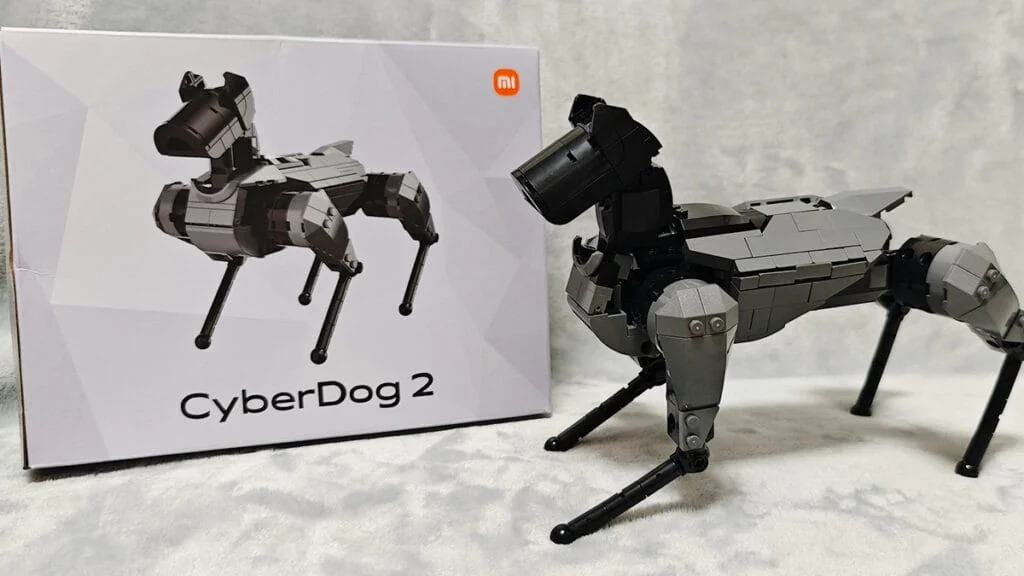
Xiaomi CyberDog
Perception & Navigation: Xiaomi CyberDog can see and map its environment using multiple cameras (wide-angle, AI interactive, depth camera). It can avoid obstacles and plan paths in real time. It can use SLAM (simultaneous localization and mapping) to navigate indoor spaces. It can recognize faces and postures, allowing it to follow its owner or specific people.
Interaction & Control: Voice commands via built-in microphones and wake words. Xiaomi CyberDog is controlled through a smartphone app or a dedicated remote controller. It can respond to gestures and physical touch via onboard sensors.
Intelligence & Learning: Xiaomi CyberDog runs on NVIDIA Jetson Xavier NX, capable of real-time AI computing. It supports reinforcement learning and AI development for custom behaviors. An open platform lets developers program new functions, motions, and interactions.
Connectivity & Expandability: Xiaomi CyberDog is equipped with USB-C and HDMI ports for hardware add-ons (extra cameras, LIDAR, lights, etc.). It integrates with Xiaomi’s smart home ecosystem, potentially controlling or interacting with IoT devices.
Practical / Experimental Uses:
- Companion or entertainment robot (follows, performs tricks, interacts).
- Research & education platform for robotics, AI, and motion algorithms.
- Surveillance or inspection tool (using cameras and sensors).
- Potential use in rescue or hazardous environments, carrying small tools or sensors.
Xiaomi CyberDog features
- Processing / Hardware Brain: Xiaomi CyberDog is powered by the NVIDIA Jetson Xavier NX platform (AI supercomputer for embedded/edge systems).
- Compute Specs: Xiaomi CyberDog includes 384 CUDA cores, 48 Tensor cores, a 6-core Carmel ARM CPU, plus 2 dedicated deep learning/accelerator engines.
- Storage: 128 GB SSD storage.
- Sensors ~11 high-precision sensors, including: Cameras (AI interactive, binocular ultra-wide angle fisheye), Intel RealSense D450 depth sensor module, Ultrasonic sensors, Touch sensors, GPS module, and Microphones (for voice control).
- Mobility / Actuation: Custom servo motors developed in-house; maximum torque ~32 Nm, max rotational speed ~220 rpm.
- Speed & Payload: Xiaomi CyberDog can run at up to ~3.2 m/s (≈11.5 km/h); can carry up to ~3 kg payload.
- Movement Capabilities: Backflips, jumps/rolls, leaning forward/back, turning; ability to do dynamic, agile motions.
- Autonomy / Navigation: Obstacle detection and avoidance at near-centimetre resolution; real-time environmental analysis; mapping (SLAM) to plan paths; face & posture recognition; ability to follow its owner/person.
- Control / Interface: Multiple control methods: voice (wake words etc.), a remote, smartphone app.
- Connectivity / Expandability: Three USB-C ports + one HDMI port for external connections/attachments (lights, extra sensors, etc.).
- Open-Source / Developer Friendly: Software, SDK, parts of design intended for developers; encourages modifications, custom add-ons.
- Price & Availability (Initial): Priced around ¥9,999 (~US$1,500-1,600) for the first 1,000 units aimed at “fans, engineers, robotics enthusiasts.”
CyberDog 2 Features
- Lighter design: approx 8.9 kg, which is about 40% lighter than the original.
- More / improved motion: Xiaomi CyberDog uses 12 self-developed micromotors and enhanced motion control algorithms.
- Higher torque density: Peak torque density is ~37.85 Nm/kg.
- More sensors: 19 sensors (multi-modal perception) for richer environment awareness.
- AI learning: Reinforcement learning platform; trained via simulation with many AI “dog” models to refine movement, improve natural, lifelike behavior.
- Improved voice/hearing: Multiple microphones (4 sets), better voice recognition, etc.
Xiaomi CyberDog advantages
- Open source & developer-friendly: Xiaomi made CyberDog fairly open, allowing developers/enthusiasts to modify software, add sensors or hardware via USB-C / HDMI ports, so you can customize behavior.
- Powerful hardware/sensors: Xiaomi CyberDog runs on the NVIDIA Jetson Xavier NX platform.
- Many sensors: touch sensors, ultrasonic, GPS, RealSense depth camera, cameras for vision, etc. Xiaomi CyberDog is capable of recognizing faces, posture, obstacle avoidance, and mapping its environment.
- Agility and mobility: Max speed ~ 3.2 m/s (≈ 11.5 km/h). Xiaomi CyberDog can do backflips, jumps, etc. Payload capacity ~ 3 kg (so it can carry small loads).
- Relatively affordable (for what it is): Compared to high-end quadruped robots, it is much cheaper. The initial CyberDog was priced around $1,500-$1,600 in China for early units.
- Multiple control modes: Xiaomi CyberDog can be controlled by voice, apps, and remote control. There’s also integration with Xiaomi’s smart-home / IoT environment.
- Strong potential use cases: Beyond just being a novelty or “toy”, potential applications include: surveillance, rescue missions, dangerous environment exploration, research, and educational uses.
Disadvantages of Xiaomi CyberDog
- Limited practical usefulness/novelty factor: While its capabilities are impressive, for many users, it’s more of a technology showcase or gadget rather than a tool solving everyday problems. For tasks like pet companionship, real pets provide emotional value that a robot can’t fully replicate.
- Cost and accessibility: Even “cheaper” compared to premium robots, $1,500+ is still expensive for most consumers. Initially, only limited units (1,000) were released in China, so availability is constrained. Also, importing, shipping, and maintenance could add cost, especially outside China.
- Power/battery life: Reports are unclear or limited about how long it runs on battery under heavy use. With lots of sensors, motion, and AI processing, power consumption is likely high. Frequent charging or limited operation time could be a constraint. (This is a typical trade-off in such robots; I didn’t find a confirmed long runtime.)
- Durability/robustness: Performing dynamic motions (backflips, moving fast) and dealing with rough terrain or uneven surfaces can stress mechanical parts. Wear and tear on motors, joints, sensors; also risk if bumped, water/dust exposure, etc. Probably less rugged than industrial robots.
- Software/language/region limitations: Some users report app or voice command/control being limited to specific languages (often Chinese) or certain phone models. Also, remote control/app support might be limited depending on the region.
- Privacy & ethical concerns: Because it has cameras, microphones, sensors, and tracking features (face recognition, posture tracking etc.), there are concerns about misuse and data privacy. Also, surveillance uses might raise ethical questions.
- Regulation, safety, reliability: As with many advanced robots, there could be issues around ensuring safety in human environments: avoiding collisions, safe behavior, and liability if something goes wrong. Also, regulatory frameworks (for robots with sensors, cameras, and voice control) are still developing in many countries.
- Emotional/social limitations: It may follow commands or recognize faces, but it’s not a living being. For many people, the emotional bond, unpredictability, companionship, etc., of a real pet are missing. Also, where robot-pets are used as replacements, there may be psychological or social effects. (Less capability for empathy, comfort, etc.) Some of this is more philosophical than technical, though.
You can follow Science Online on YouTube from this link: Science online
Aibo robotic dog review, features, advantages and disadvantages
Go2 robot dog review, types, advantages, disadvantages and features
Python Programming Language features, advantages and disadvantages
Importance and uses of Educational robotics for students
Unitree Go2 Robot Dog Quadruped Robotics for Adults, What does the Unitree robot dog do?