Toyota Unveils Third-Generation Humanoid Robot T-HR3, What can the Toyota T-HR3 do?
The Toyota T-HR3 is a third-generation humanoid robot developed by Toyota to act as a remote-controlled partner robot that can safely assist humans in various environments. It is designed to mimic human movements with high precision using a Master Maneuvering System, allowing an operator to control the robot’s motions in real time as if using their own body.
What is the Toyota T-HR3 Robot?
The T-HR3 is a third-generation humanoid robot developed by Toyota’s Partner Robot Division. It’s designed to be a “partner robot” — not just for industrial tasks, but also to assist humans in environments such as homes, medical facilities, disaster sites, construction zones, and potentially even in space.
The robot is remotely controlled via a system called the Master Maneuvering System. An operator wears controls that map their hand, arm, and foot movements to the robot, and gets a video feed from the robot’s “eyes” using a head-mounted display. It uses Torque Servo Modules in its joints, which combine motors, gears, and torque sensors. These modules enable the robot to sense the amount of force it’s using and provide force feedback to the operator.
The T-HR3 has 32 axes of motion (i.e., numerous joints) and 10 fingers, providing it with a high degree of dexterity. It is capable of “whole-body coordination and balance control,” which helps it maintain stability even when bumped or when moving, making its motion more human-like. Through its design, Toyota aims for it to be safe in physical interactions: the force control means it can touch or move things gently and react to external forces.
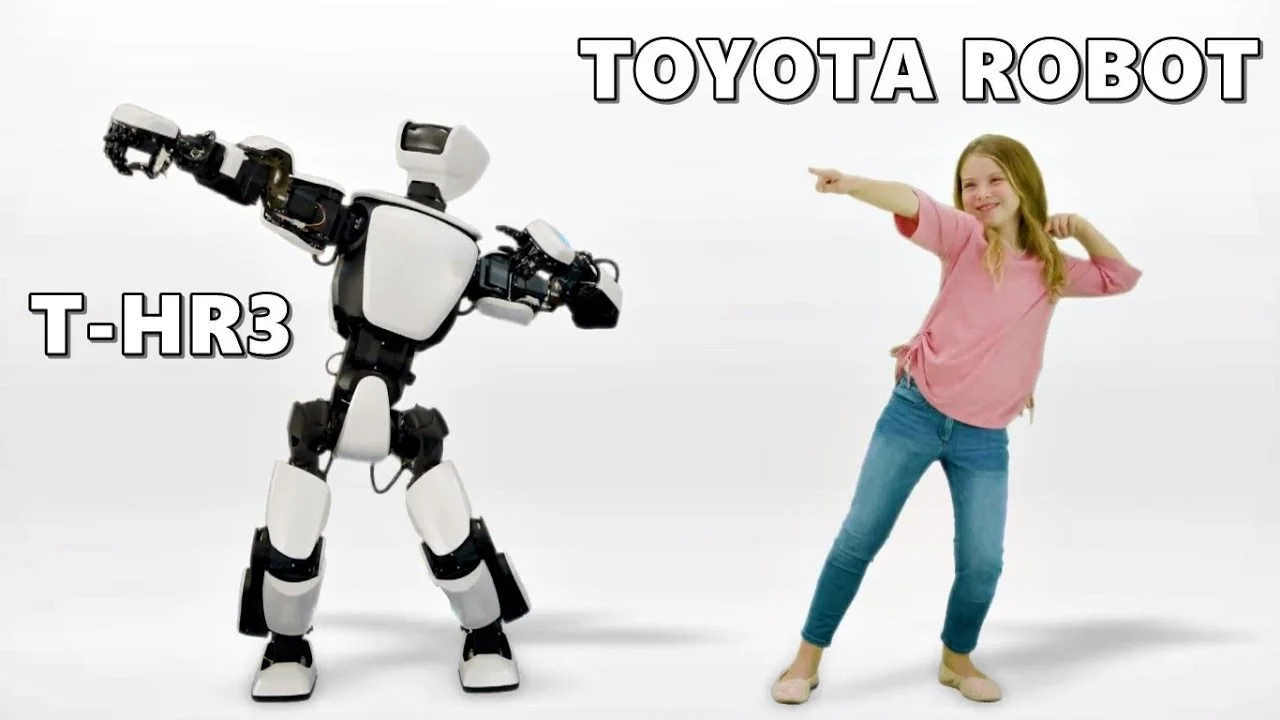
Toyota T-HR3
The robot represents Toyota’s vision of robots that coexist with humans, helping in day-to-day tasks and augmenting human mobility or capability. The T-HR3 focuses on mobility, balance, and human-safe interaction, making it suitable for tasks in homes, medical facilities, construction sites, disaster response, and even space environments. It has a very safe, precise control, human-like motion. It is great for tasks that require fine manipulation, good for human environments, and operator-driven learning.
Features of Toyota T-HR3
- Master Maneuvering System: The T-HR3 is controlled remotely through a wearable Master Maneuvering System. The operator wears controls that map their hand, arm, and foot movements to the robot. It includes a head-mounted display so the operator can “see” from the robot’s perspective. The system also has a “master foot” that lets the operator walk in place to move the robot forward or laterally. There is “Self-interference Prevention Technology” to prevent the operator’s movements from interfering with the robot and vice versa.
- Torque Servo Module: Each joint of the robot uses a “Torque Servo Module,” which combines a motor, reduction gear, and a torque sensor. This module allows the robot to sense force and provide feedback (force-feedback) to the operator. The T-HR3 helps in controlling how much force the robot applies when touching or interacting with objects or humans (“Flexible Joint Control”).
- Balance and Coordination Control: The T-HR3 has Whole-body Coordination and Balance Control to maintain stability. The robot is capable of recovering from collisions or physical disturbances without falling over.
- Real Remote Maneuvering: The real-time mirroring system lets the human operator’s movements be reproduced very precisely by the robot. Because of the feedback and responsive control, the operation feels “seamless and intuitive.”
- Degrees of Freedom / Articulation: T-HR3 has 32 axes of motion (joints), giving it very high flexibility. It also has 10 fingers, enabling fine manipulation and dexterity. According to Toyota, it uses “redundant degrees of freedom,” meaning even if some joints fail or are blocked, it can still perform tasks by re-routing movement.
- Safety Design: Because of its force sensing (torque sensors), it can adjust its contact force to be safe around humans. Its human-like shape (humanoid form) makes it more intuitive to control and interact with, plus it helps it operate in human environments.
- Applications / Use-Cases: Toyota envisions T-HR3 is used in homes, medical facilities, construction sites, disaster response, and even outer space. Because of its balance and control, it could help with tasks that require delicate human-level manipulation.
- Technical Specs:
- Height: ~1,540 mm (1.54 m) .
- Weight: ~75 kg.
- The Master Maneuvering System (the operator’s control rig) is quite large: about 850 mm (W) × 1500 mm (D) × 1450 mm (H).
- The MMS system weighs around 170 kg.
Why These Features Matter
- Safety: The torque sensors + force feedback help ensure the robot doesn’t apply dangerous force when interacting with humans or fragile objects.
- Control Precision: High articulation (32 axes, 10 fingers) + real-time remote control gives the robot very fine-grained manipulation capability.
- Intuitive Operation: Using a human operator (via the Master Maneuvering System) means less need for complex programming for every task — the operator is the “brain + body” in many ways.
- Versatility: The robot’s design makes it suited for a wide variety of environments — not just industrial settings but also home care, medical support, or risky places.
What can the Toyota T-HR3 do?
- Mimic human movements in real time: The T-HR3 robot can mirror the operator’s arm, leg, head, and hand motions exactly. Movements are transmitted through the Master Maneuvering System, allowing extremely natural, human-like actions.
- Perform delicate and precise tasks: Its joints have torque sensors and force-feedback control, enabling the robot to handle fragile objects. It can gently pick up items, grasp tools, or interact with people safely.
- Maintain balance and stability: T-HR3 can stand, bend, rotate, and remain stable even if pushed or disturbed. It uses whole-body coordination control to avoid falling or colliding with obstacles.
- Walk, turn, and move around smoothly: It can walk forward, sideways, and rotate its body with stable foot placement. Movements are synchronized with the operator’s walking in place.
- Recover from bumps or impacts: The T-HR3 robot can detect contact and adjust its posture to regain balance. This makes it suitable for crowded or unpredictable environments.
- Interact safely with humans: Its force-controlled joints prevent excessive pressure when it touches people. This enables safe use in caregiving, assistance, or collaborative tasks.
- Handle objects with human-like dexterity: With 10 fingers and 32 joints, it can hold tools, twist knobs, carry items, and perform hand-intensive tasks such as assembling or positioning parts.
- Operate in environments too dangerous for humans: Because it is teleoperated, the T-HR3 can work in locations such as disaster zones, construction sites, hazardous or contaminated areas, and outer space (a future goal Toyota has stated).
- Provide remote presence: The operator sees through the robot’s cameras via a head-mounted display. This allows remote inspection, remote caregiving, assisting people from far away, and acting as a remote avatar.
- Act as a partner robot for home or medical use: Toyota designed it for future applications, such as helping elderly people, assisting with household tasks, supporting medical staff, and handling rehabilitation assistance (future direction).
Advantages of the T-HR3
- Precise Force Control: Thanks to its Torque Servo Modules, T-HR3 can sense how much force it’s applying through its joints. This makes its contact with objects (or humans) safer and more controlled.
- Real-Time, Intuitive Control: The Master Maneuvering System (MMS) allows a human operator to control the robot’s body by wearing a control rig. The operator sees from the robot’s “eyes” via a head-mounted display, making the control more natural and immersive. There’s “self-interference prevention” so the operator’s movements don’t conflict with the robot’s.
- Balance and Stability: The robot has “whole-body coordination and balance control” that helps it maintain balance even if it collides with something. It can handle disturbances, which is crucial for operating in real-world, cluttered environments.
- Human-Like Mobility and Dexterity: With 32 joints and 10 fingers, T-HR3 is quite dexterous. Its human-shaped form means it can use tools or navigate spaces designed for humans.
- Safety in Human Environments: Because it can control the contact force precisely, it’s safer to use around humans (in homes, hospitals, etc.). The design is intended for “partner robot” roles — working alongside or helping people, rather than just doing industrial tasks.
- Redundancy / Robustness: It has what Toyota calls “redundant degrees of freedom,” meaning even if some joints are blocked or fail, it can still reconfigure to complete tasks. This increases reliability and flexibility in unpredictable environments.
- Wide Range of Potential Applications: Toyota envisions it helping in homes, medical facilities, disaster zones, construction, and even space. In particular, it has strong promise in elderly care and physical assistance, according to Toyota.
- Learning by Demonstration: Because a human directly operates it, T-HR3 could be used as a “teaching” tool: the robot may learn from human actions (via the master system) to replicate tasks later.
Disadvantages / Limitations of the T-HR3
- High Complexity and Cost: The Master Maneuvering System is large, complex, and presumably very expensive. The torque-sensor-based actuators (Torque Servo Modules) add mechanical complexity.
- Operator Dependency: It is not fully autonomous; it requires a human operator to control it in real time. Because of this, scalability (many robots working independently) is limited unless more autonomous capability is developed.
- Latency / Communication Risk: Remote control systems can suffer from latency or communication issues, which could affect performance or safety in critical tasks (though Toyota’s system is designed to be very responsive). If the control link is interrupted, the robot’s behavior could be unpredictable.
- Weight and Bulk: The Master Maneuvering System itself weighs 170 kg. This makes the control setup non-portable and may limit where the operator can meaningfully control the robot from.
- Energy Efficiency: Because it’s humanoid and has many degrees of freedom, operating the T-HR3 likely consumes a lot of power (actuators, sensors, feedback systems), making long-duration operation challenging (though Toyota hasn’t publicly detailed full power consumption).
- Safety in Unforeseen Scenarios: While the robot has force sensing and balance control, in truly chaotic or unpredictable environments (extreme disasters), there’s still risk. Also, since it mirrors human movement, any mistake by the operator could propagate to the robot.
- Limited Autonomy: Because the T-HR3 currently relies on a human operator, its ability to operate independently (without constant supervision) is limited. This is a disadvantage compared to autonomous robots in certain use cases. For some tasks, a fully autonomous robot may be more efficient than a teleoperated humanoid.
- Practical Deployment Challenges: Deploying such robots in real-world scenarios (hospitals, homes, disaster zones) requires infrastructure, trained operators, and maintenance. The cost of scaling (both hardware and human operators) may be a significant barrier.
- Regulatory / Ethical Concerns: Using humanoid robots in sensitive environments (healthcare, private homes) raises ethical, privacy, and safety questions. There may be regulatory hurdles for wide use, especially in medical or caregiving roles.
You can follow Science Online on YouTube from this link: Science online
BTECH Humanoid Robot Walker review, advantages, disadvantages and features
Importance of Eilik, Are Eilik robots worth it? And what can Eilik the robot do?
Emo robot review, advantages, disadvantages, features and What can Emo do?
Fun Facts about Eilik robots, What is Eilik robot for? and can Eilik robot talk?
Top trending topics on Emo robots and What can Emo do?
Eilik Desktop Companion Robot structure, features, use, advantages & disadvantages
Trending topics about Eilik robots in Education, Healthcare, Customer Service and Workplace
Top Trends on Eilik and Emo robots, Emo vs Eilik, who is the best?
Eilik DQ robots review, advantages, disadvantages and specifications