
Huawei MatePad 11.5 vs. Redmi Pad Pro: Powerful 2026 Comparison, Review, Performance & Which One Should You Buy?
Huawei MatePad 11.5 vs. Redmi Pad Pro is a comparison between two excellent mid-range tablets designed for productivity, entertainment, and everyday use. While the Huawei MatePad 11.5 offers a lightweight design, premium build, and a capable Snapdragon 7 Gen 1 processor, the Redmi Pad Pro stands out with its larger 12.1-inch display, longer battery life, expandable storage, and full Google services support, making it the better all-around choice for most users.
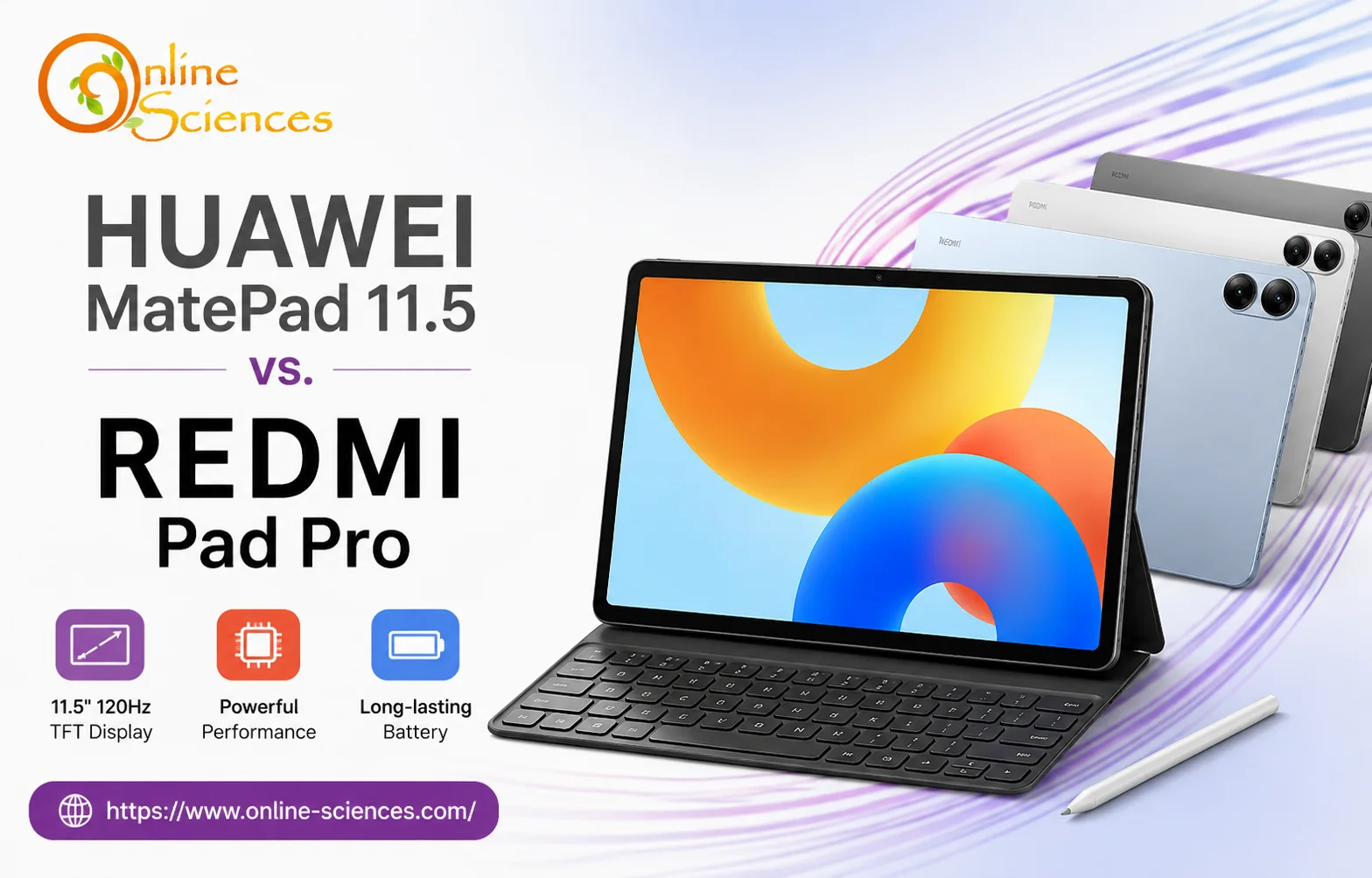
Huawei MatePad 11.5 vs. Redmi Pad Pro
Huawei MatePad 11.5 vs. Redmi Pad Pro
Choosing between the Huawei MatePad 11.5 and the Redmi Pad Pro depends on your priorities. Huawei focuses on productivity, lightweight design, and premium build quality, while Xiaomi offers a larger display, longer battery life, expandable storage, and excellent value at a lower price. Both tablets use efficient Snapdragon chipsets and feature smooth 120Hz displays, making them excellent choices for work, entertainment, and education.
Huawei MatePad 11.5 Overview
Huawei MatePad 11.5 was released in July 2023 and remains one of Huawei’s best mid-range productivity tablets. It combines a premium aluminum body with a lightweight design and a Snapdragon 7 Gen 1 processor capable of handling multitasking, office work, video streaming, and moderate gaming.
Key Specifications
- 11.5-inch TFT LCD.
- 120Hz refresh rate.
- 1440 × 2200 resolution.
- Snapdragon 7 Gen 1 (4nm).
- Adreno 644 GPU.
- HarmonyOS 3.1.
- Up to 256GB storage.
- Up to 8GB RAM.
- 13MP rear camera.
- 8MP ultra-wide front camera.
- 7700mAh battery.
- 22.5W fast charging.
- Weight: 499g.
Redmi Pad Pro Overview
Released in April 2024, the Redmi Pad Pro is one of the best-value large-screen Android tablets. It features a huge 12.1-inch display, Snapdragon 7s Gen 2 chipset, Android 14 with HyperOS, and a massive 10,000mAh battery, making it ideal for students and multimedia users.
Key Specifications
- 12.1-inch IPS LCD.
- 120Hz refresh rate.
- Dolby Vision.
- Gorilla Glass 3.
- Snapdragon 7s Gen 2.
- Adreno 710 GPU.
- Android 14 with HyperOS.
- microSD expansion.
- 10,000mAh battery.
- 33W fast charging.
- 3.5mm headphone jack.
- Four stereo speakers.
Design and Build Quality
Huawei MatePad 11.5 is noticeably thinner and lighter, measuring only 6.9mm thick and weighing 499g. It feels premium thanks to its aluminum construction and is comfortable to hold during long reading or work sessions. Redmi Pad Pro is larger and heavier at 571g but offers Gorilla Glass 3 protection, making it more durable against scratches. Its larger footprint is better suited for watching movies and multitasking.
Winner: Huawei MatePad 11.5 for portability.
Display Comparison
Huawei offers an excellent 11.5-inch 120Hz LCD with a productivity-friendly 3:2 aspect ratio. Redmi Pad Pro features a larger 12.1-inch IPS LCD with:
- Dolby Vision.
- Higher resolution.
- Better pixel density.
- Up to 600 nits brightness.
- Gorilla Glass protection.
The Redmi display provides a more immersive viewing experience for videos, games, and split-screen multitasking.
Winner: Redmi Pad Pro.
Huawei MatePad 11.5 vs. Redmi Pad Pro Performance
Both tablets use Qualcomm’s efficient 4nm processors, but they target slightly different users.
Huawei MatePad 11.5 Performance
Huawei’s Snapdragon 7 Gen 1, paired with the Adreno 644 GPU, delivers smooth daily performance. Apps launch quickly, multitasking is fluid, and productivity applications such as document editing and note-taking run effortlessly. Gaming performance is also respectable, with games like PUBG Mobile, Call of Duty Mobile, and Asphalt 9 running comfortably at medium to high graphics settings.
Redmi Pad Pro Performance
Redmi Pad Pro uses the newer Snapdragon 7s Gen 2 alongside the Adreno 710 GPU.
Benchmark results:
- AnTuTu: 589,889.
- GeekBench 6: 2,840.
- 3DMark Wildlife Extreme: 786.
It offers slightly stronger graphics performance and improved efficiency, making it better suited for gaming and heavy multitasking.
Winner: Redmi Pad Pro.
Software Experience
Huawei runs HarmonyOS 3.1.
Advantages:
- Smooth interface.
- Excellent multitasking.
- Multi-window support.
- Huawei ecosystem integration.
Limitations:
No native Google Mobile Services.
Redmi Pad Pro runs:
- Android 14.
- HyperOS.
- Full Google Play Store support.
- Regular Android ecosystem compatibility.
For most international users, Redmi provides an easier software experience.
Winner: Redmi Pad Pro.
Audio Quality
Both tablets include:
- Four stereo speakers.
- Excellent multimedia performance.
However, Redmi adds:
- Hi-Res Audio support.
- 3.5mm headphone jack.
Huawei removes the headphone jack entirely.
Winner: Redmi Pad Pro.
Camera Comparison
Huawei MatePad
- Rear camera: 13MP.
- Front camera: 8MP ultra-wide.
Huawei offers a better rear camera, while the wider selfie lens is useful for video meetings.
Redmi Pad Pro
- Rear: 8MP.
- Front: 8MP.
Camera quality is perfectly adequate for online classes and video conferencing, but is less versatile.
Winner: Huawei MatePad 11.5.
Battery Life
Huawei:
- 7700mAh.
- 22.5W charging.
Redmi:
- 10,000mAh.
- 33W charging.
Around 9.5 hours of active use. The significantly larger battery allows Redmi Pad Pro to last longer during streaming, gaming, and productivity sessions.
Winner: Redmi Pad Pro.
Connectivity
Huawei MatePad
Redmi Pad Pro
Redmi offers more connectivity options.
Winner: Redmi Pad Pro.
Storage
Huawei:
- 128GB.
- 256GB.
No microSD expansion.
Redmi:
- 128GB.
- 256GB.
Dedicated microSD slot. Expandable storage is a major advantage for media libraries.
Winner: Redmi Pad Pro.
Huawei MatePad 11.5 Pros
- Lightweight.
- Premium build.
- Good performance.
- Better camera.
- Smooth 120Hz display.
Huawei MatePad 11.5 Cons
- No Google Mobile Services.
- No microSD.
- Smaller battery.
- No headphone jack.
Redmi Pad Pro Pros
- Excellent value.
- Huge display.
- Powerful Snapdragon 7s Gen 2.
- Massive battery.
- Expandable storage.
- Dolby Vision.
- Headphone jack.
Redmi Pad Pro Cons
- Heavier.
- Average cameras.
Frequently Asked Questions (FAQ)
1. Is the Huawei MatePad 11.5 better than the Redmi Pad Pro?
Huawei is better for portability and cameras, while Redmi Pad Pro offers better battery life, software compatibility, gaming performance, and overall value.
2. Which tablet is faster?
Redmi Pad Pro is slightly faster thanks to the Snapdragon 7s Gen 2 chipset and Adreno 710 GPU.
3. Does Huawei MatePad 11.5 support Google apps?
It does not include native Google Mobile Services, although some apps can be accessed through alternative methods.
4. Which tablet has the better display?
Redmi Pad Pro features a larger, sharper display with Dolby Vision support and higher brightness.
5. Which tablet is better for students?
Redmi Pad Pro is generally the better choice due to its larger screen, longer battery life, expandable storage, and full Android ecosystem.
6. Which tablet is better for gaming?
Redmi Pad Pro provides slightly better gaming performance because of its newer GPU and larger battery for extended gaming sessions.
Huawei MatePad 11.5 vs. Redmi Pad Pro Specifications
The Huawei MatePad 11.5 features an 11.5-inch TFT LCD display with a 1440 × 2200 resolution, a 120Hz refresh rate, and a 3:2 aspect ratio that is particularly well-suited for reading documents, web browsing, and productivity tasks. In comparison, the Redmi Pad Pro comes with a larger 12.1-inch IPS LCD display offering a sharper 1600 × 2560 resolution, 120Hz refresh rate, Dolby Vision support, up to 600 nits of brightness, and Corning Gorilla Glass 3 protection, making it the better option for entertainment and multimedia.
In terms of performance, the Huawei MatePad 11.5 is powered by the Qualcomm Snapdragon 7 Gen 1 chipset paired with the Adreno 644 GPU, delivering smooth multitasking and reliable gaming performance. The Redmi Pad Pro uses the newer Snapdragon 7s Gen 2 processor with the Adreno 710 GPU, providing slightly better graphics performance, improved power efficiency, and faster overall responsiveness for demanding applications and games.
Regarding memory and storage, both tablets are available with 6GB or 8GB of RAM and 128GB or 256GB of internal storage. However, the Redmi Pad Pro offers a significant advantage with its dedicated microSD card slot, allowing users to expand storage for large media libraries, while the Huawei MatePad 11.5 does not support expandable storage.
The software experience differs considerably between the two devices. The Huawei MatePad 11.5 runs HarmonyOS 3.1, which offers excellent multitasking features and seamless integration with other Huawei devices but lacks native Google Mobile Services. Meanwhile, the Redmi Pad Pro runs Android 14 with HyperOS, providing full access to the Google Play Store, Google apps, and a wider ecosystem of Android applications.
For photography and video calls, the Huawei MatePad 11.5 features a 13MP rear camera capable of recording 1080p videos, along with an 8MP ultra-wide front camera that captures a wider field of view during video conferencing. The Redmi Pad Pro includes an 8MP rear camera with LED flash and an 8MP front camera, both also supporting 1080p video recording. Huawei offers a better rear camera, while both tablets are suitable for online meetings.
Audio performance is impressive on both models, as each includes quad stereo speakers that deliver clear and immersive sound. However, the Redmi Pad Pro adds support for Hi-Res Audio and retains a 3.5mm headphone jack, giving users greater flexibility when using wired headphones or external speakers. The Huawei MatePad 11.5 does not include a headphone jack.
Battery life is another area where the Redmi Pad Pro stands out. The Huawei MatePad 11.5 is equipped with a 7,700mAh battery supporting 22.5W wired charging, which comfortably lasts through a full day of regular use. In contrast, the Redmi Pad Pro packs a much larger 10,000mAh battery with 33W fast charging, allowing for longer usage between charges and faster recharging times.
The build quality of both tablets is excellent, featuring aluminum frames and backs that provide a premium feel. The Huawei MatePad 11.5 is noticeably thinner and lighter at 6.9mm thick and 499g, making it easier to carry and hold for extended periods. The Redmi Pad Pro measures 7.5mm thick and weighs 571g, but its larger display and Gorilla Glass 3 protection contribute to a more durable design.
Overall, while both tablets deliver strong mid-range performance and premium construction, the Huawei MatePad 11.5 is better suited for users who prioritize portability and productivity, whereas the Redmi Pad Pro offers a larger display, longer battery life, expandable storage, superior multimedia features, and better overall value for most buyers.
Which Tablet is Better?
Choose Huawei MatePad 11.5 if you want:
- Lightweight design.
- Better rear camera.
- Comfortable productivity tablet.
- Premium aluminum construction.
- Huawei ecosystem features.
Choose Redmi Pad Pro if you want:
- Bigger display.
- Better gaming performance.
- Longer battery life.
- Google services.
- Expandable storage.
- Better overall value.
- Lower purchase price.
Overall, Redmi Pad Pro wins thanks to its excellent price-to-performance ratio, superior battery, larger display, and full Android experience.
Conclusion
The Huawei MatePad 11.5 vs. Redmi Pad Pro comparison highlights two capable mid-range tablets with different strengths. Huawei excels in portability, premium construction, and productivity, while Redmi Pad Pro delivers a larger display, stronger battery life, expandable storage, better multimedia features, and broader app compatibility. Considering its lower price and more complete feature set, the Redmi Pad Pro stands out as the better overall tablet for most users in 2026.
You can subscribe to Science Online on YouTube from this link: Science Online