
Powerful Uses of Concave Mirrors and Convex Mirrors in Daily Life 2026
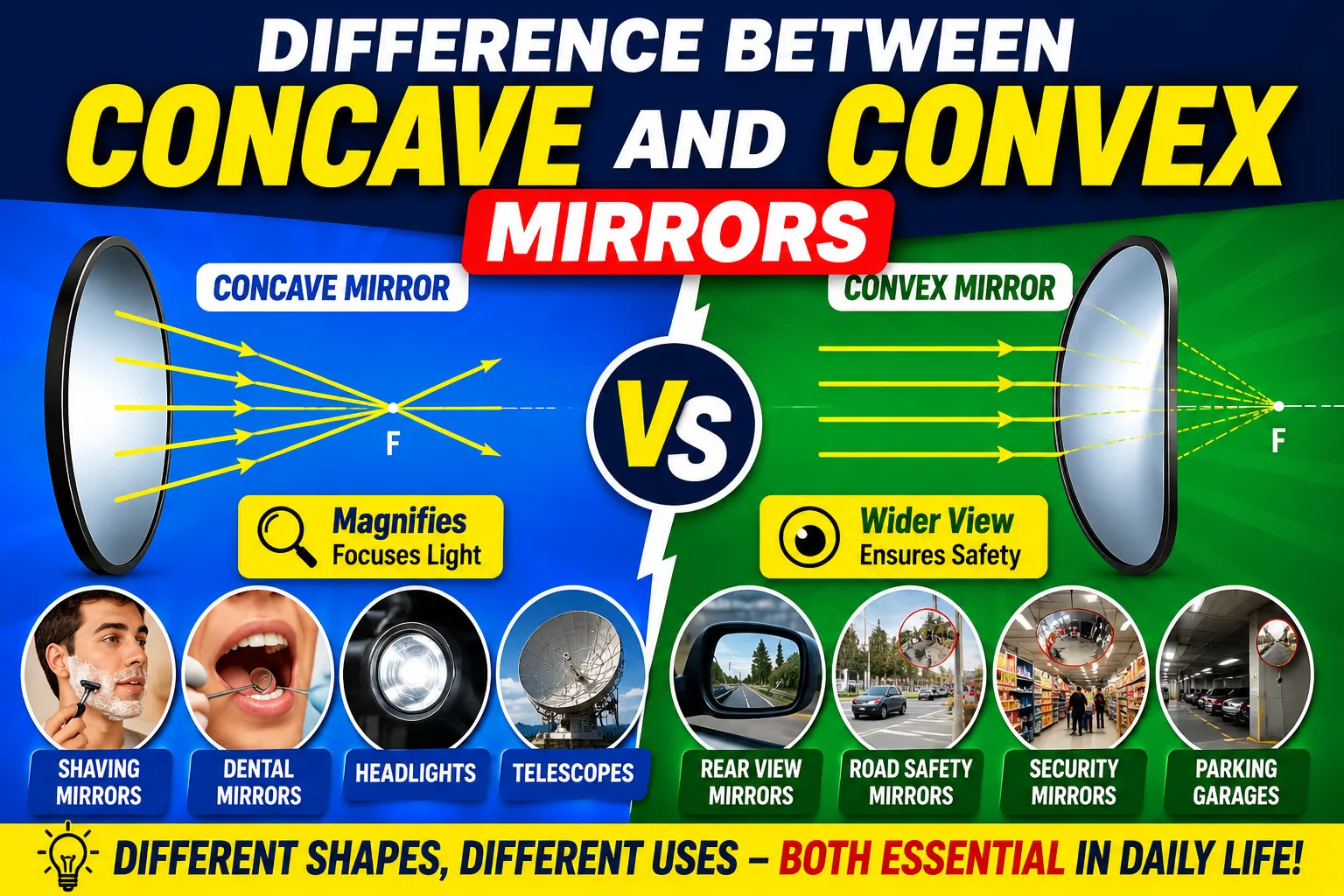
Mirrors play a major role in our everyday lives, especially concave mirrors and convex mirrors that are widely used in science, transportation, medicine, beauty, and security systems. These special curved mirrors work differently from flat mirrors because they can either magnify objects or provide a wider field of view. Concave mirrors curve inward like the inside of a spoon, while convex mirrors curve outward. Their unique shapes make them useful in many modern technologies and practical daily applications.
Concave Mirrors and Convex Mirrors
Concave vs convex mirrors
Concave mirror is a converging mirror that is used for many purposes. It is used as a torch to reflect light. It is used in aircraft landing at airports to guide the aeroplanes. It is used in shaving to get an enlarged and erect image of the face. Convex mirrors are used in security and surveillance systems because they provide a wide field of view. This makes them ideal for monitoring large areas, such as parking lots, stores, and public spaces.
Uses of concave mirrors
Concave mirrors are often used where magnification is needed, such as in shaving mirrors, makeup mirrors, and microscopes. They can also be used to focus light, as in headlights and searchlights.
Concave mirror is used in front lights of cars to reflect the light. It is used in marine lighthouses that are found at marine ports and at airports to guide the ships. Concave mirrors are used in medical devices such as laser surgery devices.
Concave mirror is used in solar ovens and solar furnaces to collect a large amount of solar energy in the focus of the mirror for cooking food, heating water, recharging power backups, or melting metals, respectively. You can use a concave mirror to focus sunlight onto a piece of paper and start a fire.
Convex mirrors and Concave mirrors
Concave mirrors are used in satellite dishes. They are used in telescopes and microscopes to magnify distant objects and tiny objects, respectively. Concave mirrors are used in electron microscopes and magnifying glasses. They are used in visual bomb detectors, and they are used in the flashlight mirror of the camera.
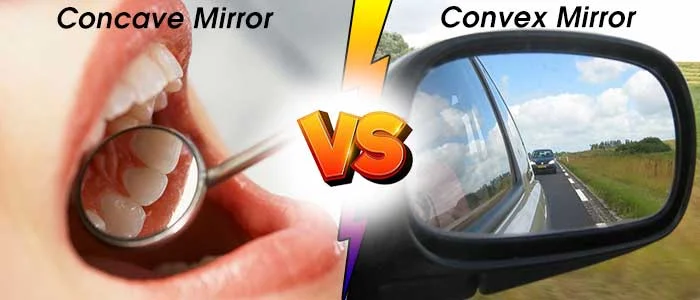
Dentists and ENT doctors use them to obtain a larger image than the original of the teeth, ear, skin, etc. Concave mirrors are used by dentists to magnify their patients’ teeth, making it easier to examine and treat them. Concave mirrors are used in medical devices, such as ophthalmoscopes, and laryngoscopes, to allow doctors to examine the inside of the eye and throat.
Concave mirrors are often used in shaving mirrors and magnifying glasses. This is because they can magnify the image of your face, making it easier to see what you are doing. You can take funny photos of yourself with a distorted face in a concave mirror, or of tiny objects magnified under a magnifying glass.
You can use a concave mirror to make an object appear larger than it is, or to create a reflection that is upside down or backwards. You can use this to your advantage to take unique and creative photos. You could take a photo of a small toy car that looks like a real car in the reflection.
You can use a concave mirror to create a reflection that is upside down or backwards. You can use convex and concave mirrors together to create optical illusions. You could place a convex mirror in front of a concave mirror to create a reflection that is infinitely repeated.
You can place a concave mirror in your backyard and use it to reflect sunlight onto a tree to create a shadow. You could place the mirror on the ground and stand over it to make your legs look longer. The ancient Egyptians invented the first concave mirror.
Concave mirrors are used in headlights and flashlights to focus the light beam, making it brighter and more visible. Concave mirrors are used in makeup mirrors to magnify the user’s face, making it easier to apply makeup. Concave mirrors are used in security systems to provide a magnified view of a specific area.
Concave mirrors reflect light in a parallel beam, which helps to illuminate the road ahead. Concave mirrors can be used to concentrate sunlight onto solar panels, making them more efficient at generating electricity.
Real image and Virtual image
The real image is formed as a result of the intersection of the reflected light rays. It can be received on a screen, and it is always inverted.
The virtual image is formed as a result of the intersection of the extensions of the reflected light rays. It can not be received on a screen, and it is always erect (upright).
The focus of the concave mirror
The focus of the concave mirror is produced due to the collection of the reflected rays emitted from a far object, such as the sun. The rays, after being reflected, collect in one lit point, which is called the focus of the mirror, and can be received on the screen.
The distance between the focus of the mirror and the pole of the mirror = ½ the radius of the mirror curvature, and it is called the focal length of the mirror.
When the incident light ray is parallel to the principal axis, it reflects passing through the focus. When the incident light ray passes through the focus, it reflects parallel to the principal axis. When the incident light ray passes through the center of curvature, it reflects back on itself.
Cases of formation of the images by the concave mirror
When the position of the object is very far, the position of the image is at the focus. The image is real and very tiny (dot).
The object is at a distance greater than the radius of curvature (after the center of curvature). The image is at a distance greater than the focal length but less than twice the focal length (between the focus and the curvature). The image is real, inverted, and diminished (small).
When the object is at the center of curvature (at a distance equal to the radius of curvature), the image will be at the center of curvature. The image will be real, inverted, and equal to the object.
When the object is between the center of curvature and the focus (at a distance more than the focal length but less than the radius of curvature), the image is after the center of curvature (at a distance greater than the radius of curvature). The image is real, inverted, and enlarged (magnified).
When the object is between the focus and the pole (at a distance less than the focal length, the image is behind the mirror), the image is virtual, upright ( erect ), and magnified.
When the object is at the focus, no image is formed. The image is at infinity, where the rays penetrate as parallel.
Uses of the convex mirror
Convex mirrors are often used where a wide field of view is needed, such as in rear-view mirrors and security mirrors. They also produce diminished images, which can be useful for seeing large areas in a small space.
Convex mirror is used as a side-view mirror on the passenger’s side of a car because it forms an erect and smaller image of the way behind the car. Convex mirrors provide a wider field of view than flat mirrors, making them safer for driving. You can take fun photos of yourself and your passengers in the convex mirror, or of the cars and scenery behind you.
Convex mirrors are suitable for convenience shops, big supermarkets, and any other corner that needs anti-thief, It is used in turning off the road and parking. Convex mirrors are also used in security mirrors in stores to deter shoplifting by giving employees a wider view of the store and helping prevent theft.
Convex mirrors are used inside buildings. They are also used in making the lenses of sunglasses. They are used in a magnifying glass. They are used in security applications, and they are used in telescopes.
They can be used as street light reflectors because they can spread the light over a bigger area. They are put on the corners of roads so that you can see any cars coming to avoid collisions, and they are used as ceiling dome mirrors. Convex mirrors help drivers see oncoming traffic from around corners or other blind spots.
Convex mirrors are spherical mirrors; they give a virtual and erect image, and the image by a convex mirror can’t be captured on a screen. Side-view mirrors in vehicles and driveways use a convex mirror. Convex mirrors are used at intersections and other dangerous areas of the road to help drivers see oncoming traffic.
Convex mirrors are used in amusement parks to create fun and distorted images. Convex mirrors are used in vending machines to allow customers to see the products inside without having to open the machine. Convex mirrors are used in art galleries to allow visitors to see a larger area of the gallery without having to move around as much.
Properties of the formed image by the convex mirror
Wherever the position of the object in front of the convex mirror, the image is smaller than the object. It is upright (erect). It is virtual (not received on a screen).
What is a Concave Mirror?
A concave mirror is a curved mirror that bends inward toward the center. It can focus light rays to a single point, making objects appear larger when viewed closely. This mirror formula explains how image distance, object distance, and focal length are related in curved mirrors.
Incredible Uses of Concave Mirrors in Daily Life
- Shaving and Makeup Mirrors: Concave mirrors are commonly used as shaving and makeup mirrors because they produce enlarged and clearer images when the face is close to the mirror. This helps people apply makeup accurately and shave more precisely.
- Dental Mirrors: Dentists use concave mirrors to see enlarged images of teeth and gums. The mirror helps doctors inspect areas inside the mouth more clearly during dental treatments.
- Reflectors in Vehicle Headlights: Concave mirrors are used inside car headlights, flashlights, and searchlights because they focus light into strong parallel beams that travel long distances.
- Solar Furnaces: Large concave mirrors are used in solar furnaces to concentrate sunlight into a single point, generating high temperatures for industrial and scientific purposes.
- Telescopes: Astronomical telescopes use concave mirrors to collect and focus light from distant stars and planets, producing brighter and clearer images.
- Medical Equipment: Many medical instruments use concave mirrors for better illumination and magnification during examinations and surgeries.
What is a Convex Mirror?
A convex mirror curves outward and spreads light rays outward. It always forms smaller virtual images but provides a wide viewing angle.
Powerful Uses of Convex Mirrors in Daily Life
- Rear View Mirrors in Cars: Convex mirrors are widely used as rear-view and side mirrors in vehicles because they provide a wider field of view, helping drivers see more traffic and reduce blind spots.
- Security Mirrors in Shops: Stores and supermarkets use convex mirrors for surveillance and security monitoring. These mirrors allow employees to observe large areas and reduce theft.
- Road Safety Mirrors: Convex mirrors are installed at sharp road corners, parking garages, and intersections to help drivers see approaching vehicles and avoid accidents.
- ATM and Elevator Safety Mirrors: Banks, elevators, and public buildings use convex mirrors to improve visibility and increase safety in confined spaces.
- Warehouse Monitoring: Factories and warehouses use convex mirrors to monitor machinery movement and improve worker safety.
Importance of Mirrors in Modern Technology
Modern industries depend heavily on curved mirrors for:
- Transportation safety.
- Medical diagnostics.
- Scientific research.
- Renewable energy systems.
- Security monitoring.
Advanced optical systems continue to improve the efficiency and applications of both concave and convex mirrors in 2026.
Difference Between Concave and Convex Mirrors
Concave and convex mirrors are two important types of curved mirrors that differ in shape, image formation, and applications. A concave mirror curves inward like the inside surface of a spoon, while a convex mirror curves outward. Because of their different shapes, they reflect light differently and are used for different purposes in daily life, science, and technology.
A concave mirror can focus light rays to a single point called the focus. When an object is placed close to the mirror, it forms a larger and clearer image. This is why concave mirrors are commonly used in shaving mirrors, makeup mirrors, dental instruments, headlights, and telescopes. Concave mirrors can produce both real and virtual images depending on the position of the object.
In contrast, a convex mirror spreads light rays outward and always forms a smaller virtual image. Although the image appears reduced in size, convex mirrors provide a much wider field of view. This makes them ideal for vehicle side mirrors, road safety mirrors, parking garages, supermarkets, and security systems where observing a larger area is important.
Another major difference is image size and visibility. Concave mirrors can magnify objects, making them useful when detailed viewing is needed. Convex mirrors, however, reduce image size but improve visibility over wide spaces. Because of this, convex mirrors are mainly used for safety and surveillance purposes.
Both mirrors play essential roles in modern life. Concave mirrors are valuable for focusing and magnifying light, while convex mirrors are important for wide-angle viewing and safety monitoring. Their unique optical properties make them useful in transportation, medicine, astronomy, security, and many other fields.
FAQ About Uses of Concave Mirrors and Convex Mirrors
1. What are concave mirrors used for?
Concave mirrors are used in makeup mirrors, dental mirrors, headlights, telescopes, and solar furnaces.
2. Why are convex mirrors used in vehicles?
Convex mirrors provide a wider field of view, helping drivers reduce blind spots.
3. Which mirror produces enlarged images?
Concave mirrors produce enlarged images when objects are close to the mirror.
4. Are convex mirrors used for security?
Yes, convex mirrors are widely used in shops, warehouses, and parking areas for surveillance.
5. What is the main difference between concave and convex mirrors?
Concave mirrors focus light inward, while convex mirrors spread light outward.
6. Why do dentists use concave mirrors?
Dentists use them because they create enlarged images of teeth for better examination.
7. Can concave mirrors focus sunlight?
Yes, concave mirrors can concentrate sunlight to produce high temperatures.
8. Which mirror is used in road safety?
Convex mirrors are commonly used at road intersections and sharp corners for better visibility.
Conclusion
Concave and convex mirrors are essential tools in modern life. Concave mirrors help magnify and focus light, making them useful in medical equipment, beauty mirrors, headlights, and telescopes. Convex mirrors provide wider visibility, making them ideal for vehicle mirrors, security systems, and road safety applications. Their practical uses continue to grow with technological advancements, proving how important curved mirrors are in everyday activities and scientific developments.
You can subscribe to Science Online on YouTube from this link: Science Online
Lenses use, types, Convex lens, Concave lens, Vision defects, Contact lenses & Cataract
Properties of the formed images by the convex lens and concave lens
Laws of light reflection, Plane mirrors, Spherical mirrors, Concave mirror & Convex mirror
Spherical mirror use, Properties of Images formed by Concave mirror & Convex mirror







Not bad
Thank you very much
please add some defination to it
There are many definition in these articles , You can read them
The properties of the image formed by a plane mirror
What are the spherical mirrors ?
tnq very much it helped me very well thank you!!!!
You are welcome
Thank you very much for your comment
pretty legit bruh im awesome
Thank you for your comment
this was used at my school
good stuff
Thank you very much
Nice
Thank you very much
Thx u guyz..
You are welcome
Thank you very much for your comment
Thankuu u so much because of u without spending my time I easily got uses of mirrors
You are welcome
Do your best to be the best
Thank you very much for your comment
Thank you
You are welcome
Thanx
You are welcome
Thank you for your comment
Very useful!
Thank you very much for your comment
thanks alot
Good explanation
Thank you very much for your comment
Thnks for helping me?. Gud explanation.?
You are welcome
Thank you very much for your comment
thanks for Help me
You are welcome
Thank you very much for your comment
very helpful for me…. nice explaination
Thank you very much for your comment
thanks it helped me
You are welcome
Thank you for your comment
Thanks for helping me out of the canfusion ????????????
You are welcome
Thank you very much for your comment
good
Very very good to education thank u for giving this information
You are welcome
Thank you very much for your comment
thanks for this information
You are welcome
Thank very much for your comment
it is helpful
Thank you very much
Excellent article…very useful too.
Thank you very much
thanks,this was my home work
You are welcome
very nice! can you tell about spherical lenses too?
it will be very useful for my homework
Thank you very much , you can read this article about What are the spherical mirrors? & Some concepts related to spherical mirrors
Thanks
You are welcome
Thanks
You are welcome
Not really clear, but it was useful in some way. Thank you
It was the matter I was searching for thanks for providing this😊
You are welcome
It is useful thank you
You are welcome
it is good
Thank you!!!
You are welcome
IT HELPED ME A LOT THANK YOU VERY MUCH
You are welcome
Thank you
You are welcome
Thank you so much for the answers
You are welcome
Not bad
Thanks a lot madam / sir
You are welcome
Thank you for your comment
Impressive Stuff.
Keep it up!
Thank you very much for your comment
keep it up, thank you