
Atmospheric pressure maps and Instruments of measuring atmospheric pressure
The Earth is surrounded by a gaseous envelope known as the atmospheric air or the atmospheric envelope, which is a gaseous envelope rotating with the Earth around its axis, and it extends about 1000 km above the sea level.
Atmospheric envelope of the Earth
The atmospheric air causes pressure on all living organisms and non-living things on the Earth’s surface. This pressure is known as atmospheric pressure.
Atmospheric pressure
The atmospheric pressure is the weight of the air column of an atmosphere height on a unit area, and it is measured by a unit called a bar or millibar. The normal atmospheric pressure is the atmospheric pressure at sea level, and it equals 1013.25 mb.
The atmospheric pressure differs from one place to another according to some effects, and the change in height from the sea level is one of these effects.
50 % of the mass of the atmospheric air is present in the area between the sea level and 3 km height, and 90 % of the mass of the atmospheric air is present up to 16 km height above the sea level. The density of the air decreases by increasing elevation above sea level.
Atmospheric pressure instruments
The atmospheric pressure is measured by barometers. One of these barometers is Aneroid which is a type of the barometers that is used to determine the possible weather for the day.
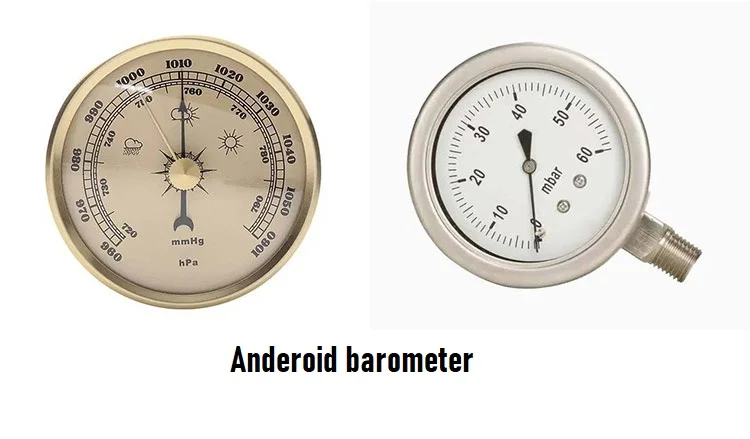 Anderoid barometer |
| Anderoid is used to determine the possible day weather |
The Altimeter is an instrument that is used by pilots in airplanes to measure the elevation above sea level based on atmospheric pressure.
Atmospheric pressure maps
There are curved lines that join the points of equal pressure in the atmospheric pressure maps, which is known as isobars. The wind moves from the areas of high atmospheric pressure to the areas of low atmospheric pressure.
FAQ about Atmospheric Pressure
1. What is atmospheric pressure?
Atmospheric pressure is the force exerted by the weight of the air on the Earth’s surface. It results from the gravity pulling air molecules toward the Earth.
2. What are atmospheric pressure maps?
Atmospheric pressure maps are weather maps that show how air pressure is distributed across different regions of the Earth. They are used by meteorologists to analyze and predict weather conditions.
3. What are isobars?
Isobars are lines drawn on atmospheric pressure maps that connect places with equal atmospheric pressure. They help scientists easily identify pressure patterns.
4. What information can we get from atmospheric pressure maps?
From these maps, we can:
- Identify high-pressure and low-pressure areas.
- Understand wind direction and strength.
- Predict weather changes, such as storms or clear skies.
5. What does a high-pressure area mean on a weather map?
A high-pressure area indicates that the air is descending and stable, which usually leads to clear skies and calm weather.
6. What does a low-pressure area mean on a weather map?
A low-pressure area means that the air is rising, which often causes cloud formation, wind, and sometimes rain or storms.
7. What is the main instrument used to measure atmospheric pressure?
The main instrument used is the barometer, which measures the pressure exerted by the atmosphere.
8. What are the types of barometers?
The two main types are:
- Mercury barometer.
- Aneroid barometer.
9. How does a mercury barometer work?
A mercury barometer uses a glass tube filled with mercury placed upside down in a container of mercury. Atmospheric pressure pushes on the mercury in the container, causing the level in the tube to rise or fall.
10. How does an aneroid barometer work?
An aneroid barometer contains a small flexible metal box (aneroid cell). When atmospheric pressure changes, the box expands or contracts, moving a needle on a dial to show the pressure reading.
11. Why are instruments for measuring atmospheric pressure important?
These instruments help meteorologists monitor atmospheric conditions, predict weather changes, and study climate patterns.
12. In what units is atmospheric pressure usually measured?
Atmospheric pressure is commonly measured in millibars (mb) or hectopascals (hPa), and sometimes in millimeters of mercury (mmHg).
You can subscribe to Science Online on YouTube from this link: Science Online
Atmospheric layers & pressure, Troposphere, Stratosphere, Mesosphere, and Thermosphere
Negative effects of the global warming phenomenon and how to overcome it
The weather factors and the importance of the weather prediction
The characteristics and the importance of the thermosphere layer