
Domain Name System (DNS) uses, features, advantages and disadvantages
DNS translates internet domain & host names to IP addresses and vice versa, It can convert the names of domain we type in our web browser address bar to IP addresses of web servers hosting those sites, Larger corporations use DNS to manage their own company, Home networks use DNS when accessing the internet but do not use it for managing the names of home computers.
DNS (Domain Name System)
DNS stands for Domain Name Service. It acts as a look-up table that allows the correct servers to be contacted when the user enters the URL into the web browser. This transparent service offers the other features that are commonly used by webmasters to organize their data infrastructure.
DNS runs on DNS servers, When the user enters the URL, such as www.google.com, into the Web browser, The request is not directly sent to the Google servers, Instead, the request goes to the DNS server, that uses a look-up table to determine several pieces of information, IP address of the website that is being requested, Then it forwards this request to the proper servers & returns the information requested to the user’s web browser.
DNS is a hierarchical naming system for computer systems, the services, or any resources participating in the Internet. Much information about domain names is assigned to each of the participants. It can translate the names of the domain into the binary identifiers that are associated with the equipment of the network to locate & address these devices.
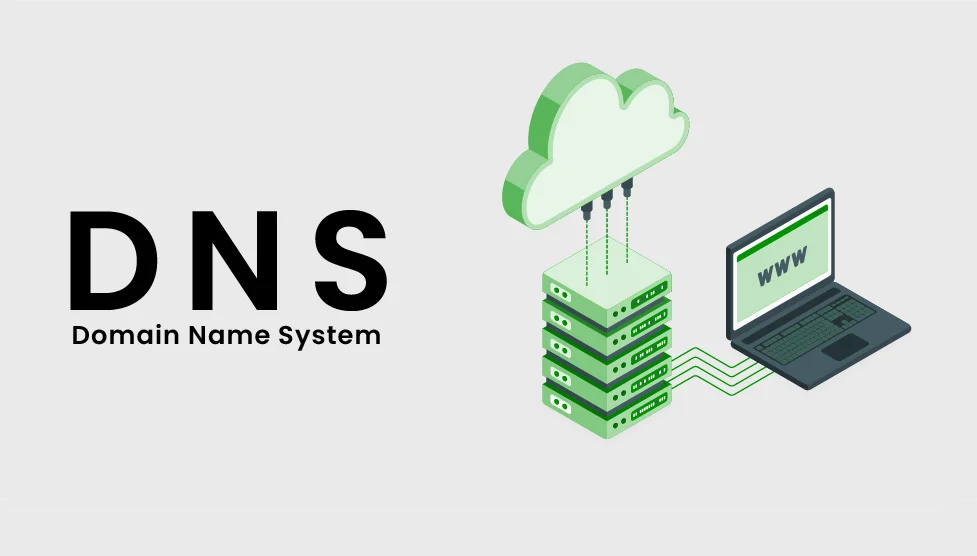
Domain Name System
A DNS server is a computer server that contains the database of public IP addresses and their associated hostnames. It translates those common names to IP addresses as requested. DNS servers run special software and communicate with each other using special protocols.
Domain name system servers are the computers that host domain names and website information. So, when you type the website into your internet webpage, you are linking to another computer that holds all the information of the website you are looking for.
The servers link into the root computers across the world, then collate internet websites & they allow the internet to run effectively. The other names for the DNS server include the name server & domain name system server.
DNS servers help standard Internet users to use Internet resources without having to remember port numbers & IP addresses. Even similar services, such as different areas of the website, may be hosted at different IP addresses for security reasons.
There are two DNS servers, which are the primary and the secondary server. They are automatically configured on your computer when connecting to your ISP via DHCP. You can use two DNS servers; if one of them fails, So, the device will use the secondary server.
How DNS works
DNS is a client/server network communication systems, DNS clients send the requests to and receive the responses from DNS servers, The requests containing the name, which result in an IP address being returned from the server, they are called forward DNS lookups, The requests containing IP address and resulting in the names that are called the reverse DNS lookups.
DNS contains support for caching the requests and for redundancy. Most network operating systems support configuration of primary, secondary, and tertiary DNS servers, each of which can service initial requests from clients & it was designed to avoid a single large central database.
DNS advantages
Domain Name System (DNS) is a centralized mechanism for resolving/giving the IP addresses for a given domain name, It is the system that helps you to find the website using your internet browser, When you click on your internet browser (Internet Explorer, Safari, Firefox etc.), You will be able to type the name of the website.
It is the only system of its kind that will allow you to browse and use the internet. Its use is necessary for most companies and people across the world. Without this system, it would be impossible for people to access the internet, and the internet has become an essential part of our society.
You do not need to memorize numbers. The domain names make/give a kind of sense to hyper the links when the name is given instead of a string of numbers. It is easy to categorize, archive, and help the search engines.
DNS enables you to specify the technical functionality of the database service. It can define the DNS protocol, the detailed specification of the data structures, and the data communication exchanges used in the DNS. DNS is used as a form of load balancing or an additional layer of security.
Host-names and IP addresses are not required to match in a one-to-one relationship, Multiple host-names may correspond to a single IP address, that is useful in virtual hosting, in which many web sites are served from a single host, a single host-name may resolve to many IP addresses to facilitate fault tolerance and load distribution to multiple server instances across an enterprise or the global Internet.
DNS can enhance the security of your DNS infrastructure, It can allow the dynamic secure updates, It is more reliable, It can deliver the messages to the users with zero downtime, It is faster, It is connected well at intersections of internet, It enables the requests to be answered to the next closest node in the case of maintenance or downtime, It is smarter and it offers automatic corrections of typos.
DNS disadvantages
The hierarchical and centralized which breaks down the main objective of the Internet, is designed to be a decentralized system. ICANN can control the DNS root registry, which is a non-profit private organization with ties to one specific nation & challenges the concept of net neutrality.
Breakdown of the Domain Name System will crash the World Wide Web, although many root servers and backup servers are targeting DNS servers at particular key locations will do a lot of harm. Spoofing DNS will lead to a lot of crucial/private data ending up in the wrong hands.
If the server or computer breaks, then the webpage hosted by the server or computer cannot run. DNS issues can be difficult to troubleshoot due to their geographical & distributed nature. The clients can not connect to their local network when DNS is broken, and they will be unable to reach the remote devices by their names.
DNS queries do not carry any information about the client that triggered the name resolution. The service-side DNS server knows only the network address of the DNS server that asks about the service location.
When the DNS server can not find the correct IP address, the website will not load. As the computers communicate via IP addresses and not hostnames, the computer doesn’t know what you’re trying to reach unless it can use an IP address.
If the malware changed your DNS server settings, entering the same URL might take you to a completely different website or to a website that looks like your bank website but really isn’t. It may record your username and password, giving the scammers all the information they need to access your bank account.
Malware hijacks some DNS servers to redirect popular websites to ones that are full of advertisements or fake virus websites that make you think you have to buy the program to clean the infected computer.
You should install an antivirus program so that malicious programs are caught before they can do any damage. You have to be aware of how the website looks, or you’re getting an invalid certificate message in your browser; it might be a sign that you’re on an imitation website.
You can follow Science Online on YouTube from this link: Science online