Uses of fluorescent lamps and their structure
There are different types of electric lamps, but the most popular of these lamps are fluorescent lamps and light bulbs. The fluorescent lamps are a type of lighting lamp known as neon lamps, but the inert neon gas is not used inside their glass tubes.
Uses of fluorescent lamps
- The fluorescent lamps are used in lighting houses, shops, offices & the underground metro.
- They are used in decorating commercial stores.
- They are used in commercial advertisements.
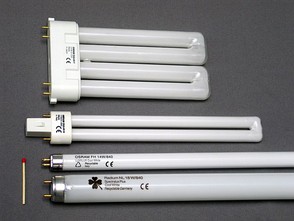
The fluorescent lamps
Structure of fluorescent lamps
-
A glass tube is a vacuumed glass tube that contains inert argon gas and a little mercury. The inner surface of the glass tube is covered with a phosphoric material.
-
Two filaments of tungsten are found at the two tips of the lamp from inside, where each tip contains a filament of tungsten.
Two points of connection at each tip of the lamp, They connect the fluorescent lamp to the electricity.
Combined fluorescent lamps
They are a type of fluorescent lamp that consumes less electric current than light bulbs. They stay longer than ordinary electric bulbs, from 8 to 18 times. Their working time is from 8000 to 15000 hours, while the working time of light bulbs is from 750 to 1000 hours.
FAQ about Fluorescent Lamps
1. What is a fluorescent lamp?
A fluorescent lamp is a type of electric lamp that produces light by passing an electric current through mercury vapor. This creates ultraviolet (UV) light, which then strikes a phosphor coating inside the tube, causing it to glow and emit visible light. It is more energy-efficient than traditional incandescent bulbs.
2. What is the structure of a fluorescent lamp?
A typical fluorescent lamp consists of:
- Glass Tube – Filled with low-pressure mercury vapor and an inert gas (like argon).
- Electrodes (Filaments) – Located at both ends of the tube; they emit electrons when heated.
- Phosphor Coating – Lines the inside of the tube; converts UV light into visible light.
- Mercury Vapor – Produces ultraviolet radiation when electricity passes through it.
- Starter – Helps initiate the current flow (in older models).
- Ballast – Regulates and controls the electric current to prevent overheating.
3. How does a fluorescent lamp work?
- Electricity flows through the electrodes.
- Electrons collide with mercury atoms inside the tube.
- Mercury emits ultraviolet (UV) light.
- UV light hits the phosphor coating.
- The phosphor converts UV light into visible white light.
4. What are the uses of fluorescent lamps?
Fluorescent lamps are widely used in:
- Homes (kitchens, garages, basements).
- Schools and universities.
- Hospitals.
- Offices.
- Factories.
- Supermarkets.
- Street lighting (some applications).
They are especially useful in large areas that require bright, uniform lighting.
5. Why are fluorescent lamps popular?
- Energy-efficient (uses less electricity than incandescent bulbs).
- Longer lifespan (typically 7,000–15,000 hours).
- Produce less heat.
- Provide bright and even lighting.
- Available in different sizes and colors.
6. What are the disadvantages of fluorescent lamps?
- Contain small amounts of mercury (hazardous if broken).
- May flicker or hum (especially older models).
- Not ideal for very cold environments.
- Require a ballast.
7. What is the difference between fluorescent lamps and LED lamps?
Fluorescent lamps produce light by passing an electric current through mercury vapor, which creates ultraviolet (UV) light that is converted into visible light by a phosphor coating inside the tube. In contrast, LED lamps produce light by allowing an electric current to pass through a semiconductor material, which directly emits visible light.
Fluorescent lamps contain a small amount of mercury, while LED lamps do not contain mercury, making LEDs safer and more environmentally friendly. LED lamps are more energy-efficient than fluorescent lamps because they use less electricity to produce the same amount of light. They also last much longer, often up to 25,000–50,000 hours, compared to 7,000–15,000 hours for fluorescent lamps.
Fluorescent lamps may flicker or take a short time to reach full brightness, whereas LED lamps turn on instantly without flickering. In addition, LED lamps are more durable and resistant to shock, while fluorescent lamps are more fragile due to their glass tubes.
8. What gas is used inside fluorescent lamps?
They contain:
- A small amount of mercury vapor.
- An inert gas such as argon (sometimes neon or krypton).
9. Are fluorescent lamps safe?
Yes, when used properly. However:
- Avoid breaking them.
- Recycle properly due to mercury content.
- Ensure proper ventilation if one breaks.
10. What are compact fluorescent lamps (CFL)?
Compact Fluorescent Lamps (CFLs) are smaller, spiral-shaped versions of fluorescent lamps designed to fit standard bulb sockets. They are commonly used in homes as replacements for incandescent bulbs.
You can follow Science Online on YouTube from this link: Science Online
The electric circuits and the methods of connecting the electric lamps in the electric circuits
Properties of Electric current, Simple electric circuit, Current intensity & Potential difference
Electrical current, Potential difference, Electric resistance, and Ohm’s law
Resistances connection (series & parallel), Electric energy and Electric power