The camel is the desert ship and some features of adaptation in it
The camel is an animal that can survive well in its surroundings. It is known as the ship of the desert. It is a herbivorous animal that has aided men in crossing vast desert lands with ease because of its remarkable adaptations to the hot and harsh surroundings.
Adaptation in the camel
The camel glides across the desert sand just like the ship, and it can stay without food or water for weeks, even when it is carrying heavy loads or transporting men.
The camel is an example of all the sorts of adaptation (the structural, the functional, and the behavioural) that helped it to live in the difficult conditions of the desert. So, it is considered one of the most adapted animals to live in the deserts.
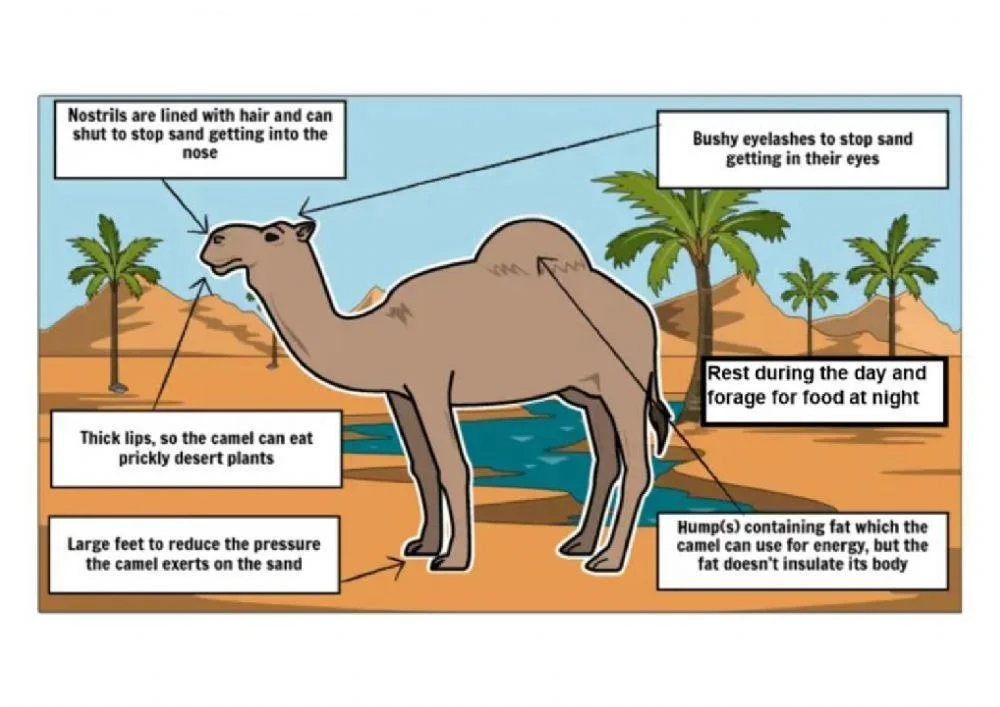
The camel has a plentiful number of lachrymal glands and it has two rows of long eyelashes that protect its eyes from the dispersing sand at the time of the sandstorms.
Camel adaptation
The camels control the opening and closing of their nostrils to prevent the entrance of sand particles inside the nose during sandstorms. The camel has a forked upper lip and strong enamel on its teeth to enable it to eat the spiny and dry desert plants without harming itself.
The ears of the camel are small, and they are covered from the inside with dense hair that obstructs the dust and the sand. The legs of the camel end in a broad pad to prevent their diving into the smooth sand, and its legs have thick skin to protect them from the high temperature of the soil.
The body fur thickness of the camel differs in the different body regions to protect from the extreme cold at night. It is a little dense over the other regions to ease heat loss by radiation during daylight.
The blood temperature of the camel is not constant, as in other mammals. It changes from 34 degrees Celsius in the morning to 41 degrees Celsius during the daylight hours, So, The camel does not need to sweat.
The sweat glands of the camel do not start sweating unless the blood temperature reaches 40 degrees Celsius. It stores the fats in its hump to keep it for 3 – 4 months without eating any food, and it can drink 100 liters of water for 10 minutes only without affecting its blood composition.
The camels can lose 25 % of their body weight when water and food are not available, and their blood composition remains constant. This rate exceeds that of other mammals’ ability by twice nearly.
The pyramidal shape of the camel’s hump makes the area that is exposed to the thermal sun rays smaller than possible during daylight, so, this decreases the amount of absorbed heat, and also decreases the amount of lost heat by radiation during the night.
The camel is a very beneficial animal for man, It is used in performing a lot of difficult tasks, Man can ride it and use it for carrying baggage from one place to another, It can carry from 150 to 300 kilograms, It is still used in some army and police forces, The quick and agile camels are also used in the camel races.
FAQ about Camel adaptation
Why is the camel called the “ship of the desert”?
Because camels are the main means of transport in deserts, just like ships in the sea. They can carry people and goods for long distances across hot, sandy areas without getting tired easily.
What does “adaptation” mean in animals؟
Adaptation means special body features or behaviors that help an animal survive in its environment. Camels have many adaptations that help them live in hot deserts.
How is the camel adapted to live in the desert?
- Humps (fat storage): The hump stores fat, which can be used as energy when food is scarce. This helps the camel survive long journeys without eating much.
- Long legs: Keep the body away from the hot sand, reducing heat from the ground.
- Broad, padded feet: Spread body weight so the camel doesn’t sink into soft sand. Make walking on dunes easier.
- Long eyelashes & closable nostrils: Protect eyes and nose from sand and dust during storms.
- Thick lips: Allow camels to eat thorny desert plants without getting hurt.
- Water-saving body: Camels can go many days without drinking. When water is available, they can drink large amounts at once.
- Thick coat: Insulates the body from daytime heat and nighttime cold in the desert.
Can camels really store water in their humps?
No. This is a common myth. Camels store fat in their humps, not water. Their bodies are just very good at conserving water.
How do camels help people in deserts?
- Transport people and goods.
- Provide milk, meat, and wool.
- Help in trade and travel across deserts.
How long can a camel live without water?
A healthy camel can survive several days (and sometimes over a week) without water, depending on temperature and activity. When it finds water, it can drink very quickly to rehydrate.
Why is the camel best suited for desert life?
Because it has humps, padded feet, long eyelashes, and strong water-saving abilities.
What is the function of a camel’s hump?
To store fat for energy when food is scarce.
How do camel feet help in the desert?
Broad, padded feet prevent sinking into sand.
What protects a camel from sandstorms
Long eyelashes and closable nostrils.
What do camels eat in the desert?
Dry grasses and thorny plants.
You can follow Science online on YouTube from this link: Science online
Adaptation in insectivorous & birds, Hibernation, Aestivation, Birds migration and Camouflage
Adaptation reasons, types, diversity of living organisms & motion in mammals
The types and reasons of adaptation of the living organisms
The adaptation and continuity of life by hibernation and the aestivation