Mechanical waves and some technological applications of sound mechanical waves
Mechanical waves are the waves that propagate through a material medium (the solid, the liquid, or the gas) at a wave speed that depends on the properties of that medium. The mechanical waves need a medium to travel through. They do not travel through free space (the vacuum).
The mechanical waves
The mechanical wave is the wave that is an oscillation of matter, and therefore it transfers energy through the medium, while the waves can move over long distances.
The movement of the medium of the transmission, the material is limited, So The oscillating material does not move far from its initial equilibrium position.
Mechanical waves transport the energy that propagates in the same direction as the wave. Any kind of wave (mechanical or electromagnetic) has a certain energy. They can be produced only in media that possess elasticity and inertia.
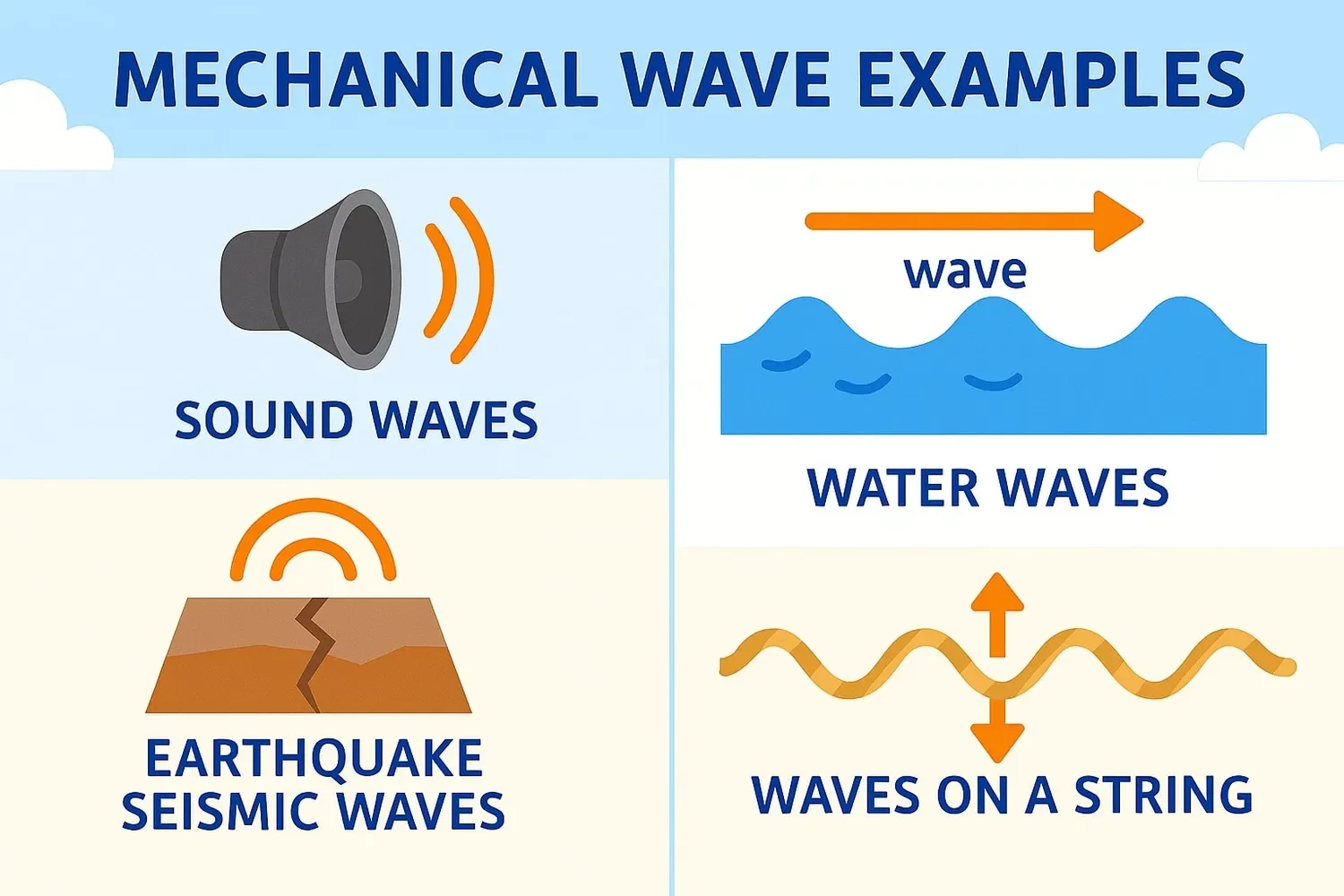
Mechanical waves examples
Mechanical waves differ from electromagnetic waves because the energy is transferred through another medium, like the metal in a slinky, rather than through a vacuum, such as light through outer space.
The mechanical waves act as the propagation of the disturbance through the material medium due to the repeated periodic motion of the particles of the medium.
The water waves and the sound waves are examples of mechanical waves. There are three types of mechanical waves: transverse waves, longitudinal waves, and surface waves.
The mechanical waves are characterized by:
- The vibration of the medium particles produces mechanical waves.
- Their speed is relatively low (The speed of sound is about 340 m / s).
- They need a medium (such as liquids, gases, and solids) to transfer through.
Applications of sound mechanical waves
-
The sound waves (Ultrasonic waves) are used in examining and curing the sets of the human body.
-
The musical instruments: The stringed musical instruments (which contain strings) are the violin, the lute, and the guitar. The sound waves are very important in pneumatic musical instruments such as the flute and the reed pipe.
-
The sound waves are used in amplifiers and sets to distribute and control the sound in broadcasting studios.
FAQ about Mechanical Waves and Applications of Sound Mechanical Waves
1. What are mechanical waves?
Mechanical waves are waves that require a material medium (solid, liquid, or gas) to travel through. They transfer energy from one place to another without transferring matter permanently.
Examples: Sound waves, Water waves, and Seismic waves.
2. What are the main types of mechanical waves?
- Transverse waves: Particles vibrate perpendicular to the direction of wave motion. Example: Water surface waves.
- Longitudinal waves: Particles vibrate parallel to the direction of wave motion. Example: Sound waves in air.
3. What are the characteristics of mechanical waves?
- Wavelength (λ) – Distance between two similar points (crest to crest).
- Frequency (f) – Number of waves per second (measured in Hertz).
- Amplitude – Maximum displacement from the rest position.
- Wave speed (v) – Speed at which the wave travels.
- Wave equation: v = f λ
4. Do mechanical waves travel in a vacuum?
No. Mechanical waves cannot travel in a vacuum because they need particles to transmit energy.
5. What is a sound wave?
Sound is a longitudinal mechanical wave produced by vibrating objects and transmitted through a medium like air, water, or solids.
6. What are the properties of sound?
- Pitch → Depends on frequency
- Loudness → Depends on amplitude
- Quality (Timbre) → Distinguishes different sounds
Technological Applications of Sound Mechanical Waves
1. Medical Ultrasound
What is it?
Ultrasound uses high-frequency sound waves (above 20,000 Hz) to create images of internal organs.
Uses:
- Monitoring pregnancy.
- Detecting tumors.
- Examining internal organs.
- Breaking kidney stones (lithotripsy).
2. SONAR (Sound Navigation and Ranging)
What is it?
SONAR uses reflected sound waves underwater to detect objects.
Uses:
- Detecting submarines.
- Measuring ocean depth.
- Locating underwater objects.
- Fish finding.
3. Industrial Ultrasonic Testing
Uses:
- Detecting cracks in metals.
- Testing pipelines.
- Quality control in manufacturing.
- Non-destructive testing (NDT).
4. Echolocation
What is it?
Echolocation is the use of reflected sound waves to determine object location.
Examples: Bats, Dolphins. It inspired human technologies like SONAR.
5. Musical Instruments
Sound waves are used to produce music through vibrating strings, air columns, or membranes.
Examples: Guitar, Piano, Drum, and Flute.
Why are sound mechanical waves important?
- Used in medicine
- Essential in communication systems
- Important in the industry
- Used in navigation and defense
- Help in scientific research
Frequently Asked Questions
1. What is the difference between mechanical and electromagnetic waves?
Mechanical waves need a medium; electromagnetic waves (like light) do not.
2. What is an ultrasound?
Sound waves with a frequency higher than 20,000 Hz (above human hearing range).
3. What affects the speed of sound?
- Type of medium.
- Temperature.
- Density.
4. Can sound travel faster in solids or gases?
Sound travels faster in solids, slower in gases.
5. Is sound energy?
Yes. Sound transfers energy through particle vibrations.
You can follow Science Online on YouTube from this link: Science Online