
Types of sound waves, audible sounds, non-audible sounds and applications of ultrasonic waves
There are two types of sound waves, which are audible sounds and non-audible sounds. The audible sounds, such as the sonic waves, and the non-audible sounds, such as the ultrasonic waves and the infrasonic waves.
Audible sounds
The sonic waves are the sound waves of frequencies from 20 to 20000 Hz. The human ear transmits the effect of such waves to the brain, which translates them into sound and audible tones.
Non-audible sounds
The infrasonic waves are sound waves of frequencies less than 20 Hz. The human ear can not hear the infrasonic waves, and these waves accompany the blowing of the storms that precede the rainfall.
The ultrasonic waves are the sound waves of frequencies higher than 20000 Hz. The human ear can not hear the ultrasonic waves, and some animals, such as bats, dogs, and dolphins, can hear them.
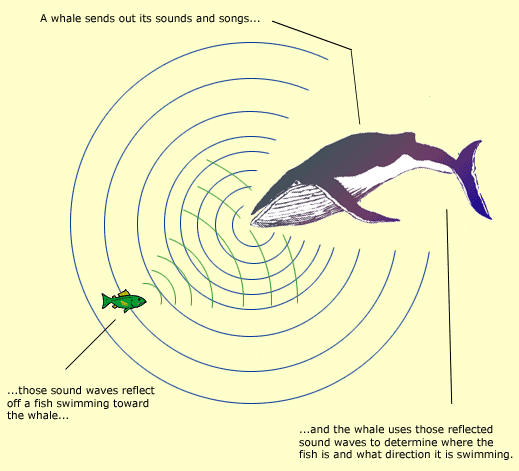 |
| whales can hear ultrasonic waves |
The human ear can hear the sounds of frequencies ranging from 20 to 20000 Hz as the ear transmits the effect of these waves to the brain, which translates them into sound and audible tones.
Some sound waves can not be heard as the frequencies of these waves are lower than 20 Hz or more than 20000 Hz, so the human ear can not hear them, as the effect of such waves can not be translated by the brain into audible tones.
Applications of ultrasonic waves
The ultrasonic waves are used in the military field to detect landmines. The ultrasonic waves are used in the industrial field in the sterilization of food, water, and milk, as they are characterized by their high ability to kill some types of bacteria and stop the action of some viruses.
 |
| Ultrasonic waves are used in Sonar |
The ultrasonic waves are used in the medical field to break down the kidney and the ureter’s stones without any surgical intervention, they are used in discovering the malignant tumors, and they are used in the diagnosis of the male prostate gland tumors and their effect on the bladder.
FAQ about Types of Sound Waves
1. What are the main types of sound waves?
Sound waves are mainly classified into longitudinal waves (the most common) and transverse waves (which can occur in special conditions, like on surfaces).
2. What are longitudinal sound waves?
They are waves where particles vibrate parallel to the direction of wave propagation, which is how sound travels in air and most media.
3. What are transverse sound waves?
They are waves where particles vibrate perpendicular to the direction of wave movement, typically seen in solids or on liquid surfaces.
4. Are all sound waves the same?
No, they differ in frequency, wavelength, and amplitude, which affect how we hear and perceive them.
FAQ about Audible Sounds
1. What is meant by audible sound?
Audible sound refers to sounds that the human ear can detect, typically in the range of 20 Hz to 20,000 Hz.
2. Why is there a limit to what humans can hear?
The human ear is biologically designed to respond only to a specific frequency range due to the structure of the inner ear.
3. Does hearing ability change with age?
Yes, older people often lose the ability to hear higher frequencies.
4. What affects how we hear sound?
Factors include frequency (pitch), amplitude (loudness), and the health of the ear.
FAQ about Non-Audible Sounds
1. What are non-audible sounds?
They are sounds that humans cannot hear because their frequencies are outside the audible range.
2. What are infrasonic waves?
Infrasonic waves have frequencies below 20 Hz and can be produced by natural events like earthquakes and volcanoes.
3. What are ultrasonic waves?
Ultrasonic waves have frequencies above 20,000 Hz and are widely used in technology and medicine.
4. Can animals hear non-audible sounds?
Yes, many animals like dogs can hear ultrasonic sounds, while elephants can detect infrasonic waves.
FAQ about Applications of Ultrasonic Waves
1. What are ultrasonic waves used for?
Ultrasonic waves are used in medical imaging, cleaning, industrial testing, and navigation systems.
2. How are ultrasonic waves used in medicine?
They are used in ultrasound imaging to view internal organs and monitor pregnancy, based on the principle of Ultrasound Imaging.
3. What is ultrasonic cleaning?
It is a process that uses high-frequency sound waves to remove dirt from delicate objects like jewelry and electronic parts.
4. How are ultrasonic waves used in industry?
They help detect cracks in materials and measure thickness without damaging the object.
5. What is SONAR?
SONAR (Sound Navigation and Ranging) uses ultrasonic waves to detect objects underwater and measure distances.
6. Are ultrasonic waves safe?
Yes, they are generally safe when used properly, especially in medical and industrial applications.
You can subscribe to Science Online on YouTube from this link: Science Online
Audible sounds, Doppler’s effect, Savart’s wheel importance, Sound properties & velocity
Sound intensity, Factors affecting Sound intensity & Applications of ultrasonic waves
The importance of ultrasonic waves in medical diagnosis
The advantages and disadvantages of ultrasonic waves in detecting industrial defects
The concentration of sound and importance of echo (sound reflection) in our life