
Turing Machine: 7 Powerful Facts, How It Works, Examples & Alan Turing
Turing machine is one of the most important ideas in the history of computer science. Although it is a theoretical mathematical model rather than a modern computer, it explains how a machine can process information by following a precise set of rules. But how can a simple tape, a reading head, and a few instructions describe the foundations of modern computing? Let’s explore what a Turing machine is, how it works, its purpose, famous examples, and why Alan Turing invented it.
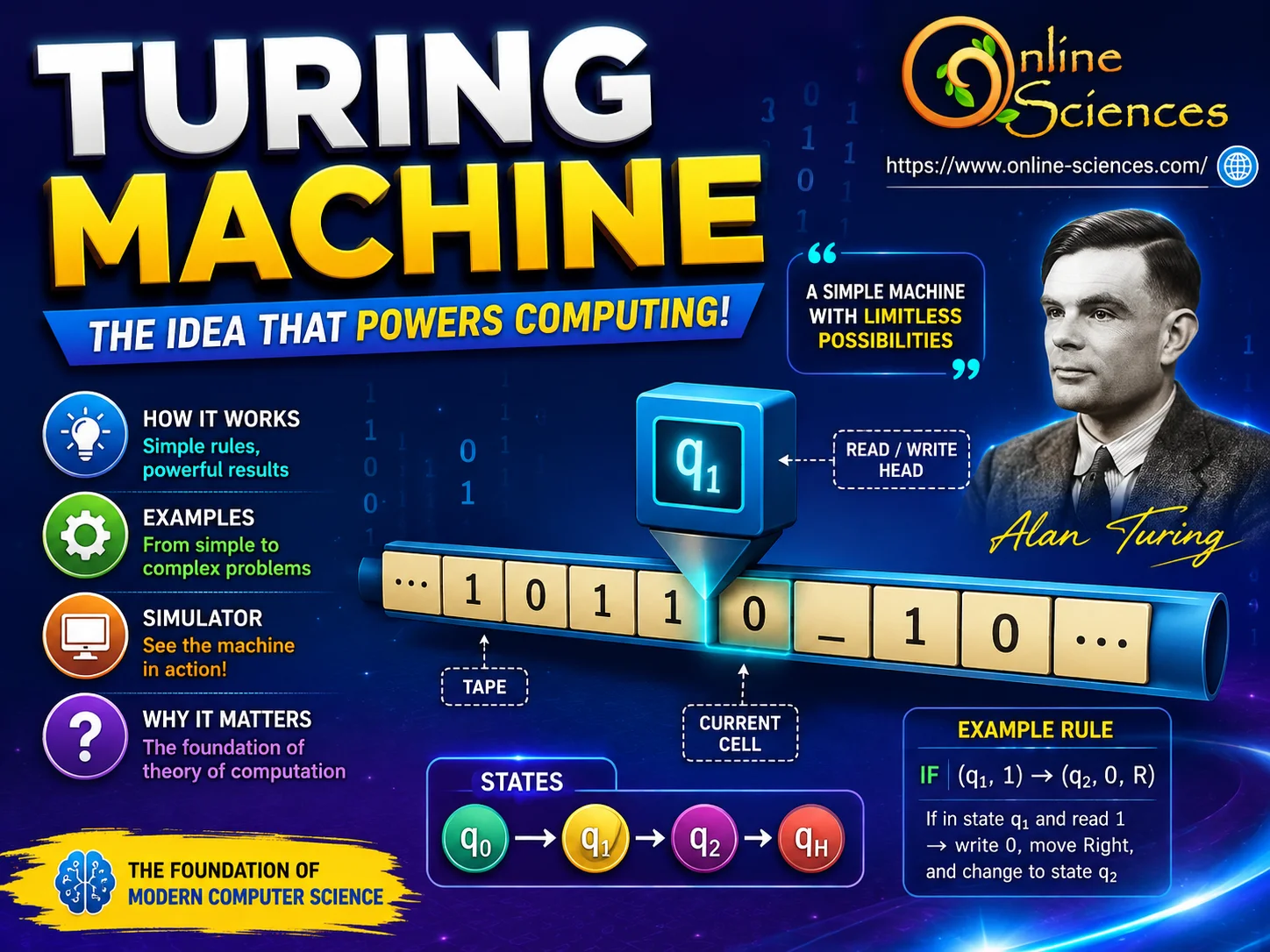
Turing Machine
What is a Turing Machine?
A Turing machine is a theoretical model of computation proposed by British mathematician and computer scientist Alan Turing in 1936. It is designed to represent how a machine can perform calculations and solve problems by following a sequence of precisely defined instructions. Despite its simple appearance, the Turing machine became a foundation for understanding:
- Algorithms.
- Computation.
- Computer programs.
- Decidability.
- Computability.
- Theoretical computer science.
- The limitations of computers.
A basic Turing machine consists of an infinite tape, a read/write head, a set of states, and a collection of rules or transition instructions. The machine reads a symbol from the tape, determines what action to take, writes a symbol if necessary, moves the head, and changes its state.
What is a Turing Machine in Simple Terms?
In simple terms, imagine a robot sitting in front of a very long strip of paper divided into squares. Each square can contain a symbol such as: 0, 1, or blank.
The robot has a set of instructions telling it: “If you see this symbol while you are in this state, write this symbol, move left or right, and change to another state.” The robot repeatedly follows these instructions. That’s essentially the idea behind a Turing machine.
For example: Read → Decide → Write → Move → Repeat
This simple process can represent surprisingly complex computations.
How Does a Turing Machine Work?
A Turing machine normally has four major components.
1. Tape
The tape is divided into individual cells. Each cell can contain a symbol. The tape is considered unlimited in the theoretical model, allowing the machine to use as much memory as necessary.
2. Read/Write Head
The head examines the symbol currently under it.
It can:
- Read a symbol.
- Replace the symbol.
- Move left.
- Move right.
3. States
The machine has a finite number of internal states. A state represents the machine’s current situation while processing information.
For example:
- State A.
- State B.
- State C.
- Halt.
4. Transition Rules
These rules determine what the machine does next. A rule can essentially say: If the machine is in State A and reads 0 → write 1, move right, and enter State B. The machine continues following its rules until it reaches a stopping condition.
Turing Machine Diagram
A simplified Turing machine diagram can be represented like this:
Read/Write Head
↓
Tape: | 0 | 1 | 1 | 0 | 0 | _ | _ | _ |
↑
Current Cell
│
▼
┌─────────────┐
│ State │
│ Controller │
└──────┬──────┘
│
Transition
Rules
│
▼
Move Left / Right
Write a New Symbol
Change State
The key idea is that the head interacts with the tape according to a set of rules.
Turing Machine Example
Consider a very simple machine that changes every 0 it encounters into 1.
Suppose the tape begins as:
0 0 0 0 _
The machine reads the first 0.
Its rule could be:
Read 0
↓
Write 1
↓
Move Right
↓
Stay in the same state
The tape gradually becomes:
1 0 0 0 _
Then:
1 1 0 0 _
Then:
1 1 1 0 _
And finally:
1 1 1 1 _
This is a very simple example, but more sophisticated Turing machines can perform complicated computations.
What is the Purpose of a Turing Machine?
The purpose of a Turing machine is not primarily to build a practical computer. Instead, it provides a mathematical model for computation. Researchers can use it to ask fundamental questions such as:
- What can a computer calculate?
- What problems can algorithms solve?
- Are there problems no computer can solve?
- What does it mean for a function to be computable?
- How much memory does a computation require?
- How long can an algorithm take?
This makes Turing machines extremely important in theoretical computer science.
Why did Alan Turing invent the Turing Machine?
Alan Turing introduced the concept while investigating a fundamental mathematical question: what does it mean for a problem to be mechanically computable?
In his 1936 paper, Turing developed an abstract machine capable of following simple rules to perform computations. His goal was not to design a modern electronic computer.
Instead, he wanted to establish a precise mathematical description of what could be computed by a mechanical procedure or algorithm. This work helped establish the foundations of the modern theory of computation.
What is a Turing Machine Used For?
Turing machines are primarily used in theoretical computer science and mathematics.
Major applications include:
- Studying algorithms: Turing machines provide a formal way to describe algorithms.
- Understanding computability: They help determine whether an algorithm can theoretically solve a problem.
- Studying undecidable problems: Some problems cannot be solved by any algorithm, regardless of how powerful the computer is.
- Teaching automata theory: Turing machines are an important part of formal language and automata courses.
- Understanding computer limitations: They demonstrate that computation has fundamental limits.
- Complexity theory: Variants of Turing machines can be used to analyze computational resources such as time and memory.
Turing Machine in Automata Theory
A Turing machine in Automata Theory represents a more powerful computational model than simpler machines such as finite automata.
A simplified hierarchy is often presented as: Finite Automaton → Pushdown Automaton → Turing Machine
Finite automata have limited memory. Pushdown automata have a stack that provides additional memory. Turing machines have a theoretically unlimited tape and can perform much more general computations. This makes the Turing machine one of the most powerful classical models studied in automata theory.
Turing Machine in TOC
TOC, or Theory of Computation, studies the mathematical foundations and limitations of computation. Turing machines are central to TOC because they provide a formal computational model.
Important topics involving Turing machines include:
- Decidable languages.
- Recognizable languages.
- Recursive functions.
- Undecidable problems.
- The Halting Problem.
- Universal computation.
- Computational complexity.
Understanding Turing machines is therefore extremely useful for students studying computer science, mathematics, algorithms, and automata theory.
Universal Turing Machine
One of Turing’s most powerful ideas was the concept of a Universal Turing Machine. Instead of building a separate machine for every individual computation, a universal machine can simulate other Turing machines when given their descriptions as input.
This idea is remarkably similar to the concept behind modern programmable computers. A modern computer can execute different programs without requiring a completely different physical machine for every task. The program provides the instructions, while the computer provides the computational platform.
Turing Machine vs. Finite Automaton
A Turing machine is much more powerful than a finite automaton because it has access to a theoretically unlimited tape that it can read from, write to, and move across. A finite automaton, in contrast, has only a limited number of internal states and does not have an expandable memory structure.
Finite automata are therefore well suited to recognizing simple patterns and regular languages, while Turing machines can represent general computation and solve a much wider range of problems. In Automata Theory, the comparison highlights the increasing computational power from finite automata to more advanced models such as Turing machines.
Turing Machine vs. Modern Computer
A Turing machine and a modern computer are fundamentally different in purpose, although they share important ideas about computation. A Turing machine is an abstract mathematical model designed to study what can theoretically be computed, using a tape, read/write head, states, and transition rules.
A modern computer is a physical electronic device with processors, RAM, storage, operating systems, and input/output hardware designed to perform practical tasks efficiently. While a Turing machine assumes an unlimited tape and operates through abstract rules, a real computer has finite physical resources.
Nevertheless, general-purpose computers can simulate Turing machines, which is why the Turing machine remains an important theoretical foundation for understanding modern computing. The important point is that a Turing machine is not simply an old-fashioned computer. It is an abstract mathematical model used to understand computation itself.
Turing Machine Simulator
A Turing machine simulator allows students and researchers to experiment with Turing machines without manually tracking every transition.
A simulator typically lets you:
- Define the machine’s states.
- Create transition rules.
- Enter an initial tape.
- Start the computation.
- Watch the head move across the tape.
- Observe symbols being changed.
- Follow the machine’s state transitions.
Simulators are especially useful for students learning Automata Theory and Theory of Computation. A visual simulator can make an abstract concept much easier to understand because you can actually watch the computation happen step by step.
Turing Machine Board Game
The phrase Turing Machine board game can refer to a modern deduction game inspired by the idea of machines, algorithms, and logical reasoning.
The board game Turing Machine is a deduction game in which players use logic and carefully selected questions to identify a hidden code.
Although it is not an implementation of Alan Turing’s theoretical machine, its name and logical gameplay are inspired by the broader world of computation and Turing’s legacy.
This is an interesting example of how the name Turing Machine has moved beyond theoretical computer science into popular culture and entertainment.
Turing Machine Movie
The term “Turing machine movie” is sometimes used in searches for films about Alan Turing and his life. The most famous example is The Imitation Game, a 2014 historical drama about Alan Turing. The film focuses on Turing’s work during World War II, particularly his role in British codebreaking.
However, it is important to distinguish between Turing’s theoretical machine and the machines used for wartime cryptanalysis. The movie can help introduce viewers to Turing’s historical importance, but it should not be treated as a technical explanation of the Turing machine.
Turing Machine and the Halting Problem
One of the most famous ideas associated with Turing machines is the Halting Problem. The question is: Can we create one universal algorithm that can always determine whether any given program will eventually stop or continue running forever?
Turing demonstrated that, in general, no such algorithm exists. This is known as the undecidability of the Halting Problem. The result is extremely important because it demonstrates a fundamental limitation of computation. Some questions cannot be answered by an algorithm for every possible input.
Why is the Turing Machine So Important?
The Turing machine is important because it changed how mathematicians and scientists think about computation. Before the development of modern computers, Turing’s work helped provide a formal answer to the question:
What can be computed?
Its influence extends into:
- Computer science.
- Artificial intelligence.
- Algorithms.
- Software engineering.
- Mathematics.
- Cryptography.
- Automata theory.
- Complexity theory.
- Programming languages.
The concept also helped establish the intellectual foundations on which modern computing developed.
Is a Turing Machine Possible?
Yes, in principle. A physical machine can be built that implements the basic operations of a Turing machine. However, the theoretical version assumes an unlimited tape, which cannot physically exist in the real world. Therefore, a real implementation can only approximate a Turing machine using finite memory.
Modern computers can simulate Turing machines, and a sufficiently general computer can simulate the computation performed by a Turing machine. So the Turing machine is best understood as an abstract mathematical model rather than an infinitely large physical machine.
Turing Machine vs. Algorithm
An algorithm is a sequence of instructions designed to solve a problem. A Turing machine is a formal mathematical model that can execute such instructions.
For example:
Algorithm:
- Read a number.
- Add 1.
- Output the result.
A Turing machine can theoretically represent the operations required to perform this process using symbols, states, and transition rules. This gives researchers a precise way to analyze algorithms.
Turing Machine vs. Finite Automaton
Both are computational models, but they have very different capabilities. A finite automaton has only a finite amount of internal memory. A Turing machine has access to a theoretically unlimited tape. Therefore, Turing machines can solve a much broader class of computational problems.
Interesting Facts About Turing Machines
- Alan Turing introduced the concept in 1936.
- A Turing machine is a theoretical model of computation.
- It uses a tape, head, states, and transition rules.
- It can read and write symbols.
- The head can move left or right.
- Turing machines are fundamental to the Theory of Computation.
- The Universal Turing Machine can simulate other Turing machines.
- The Halting Problem demonstrates a fundamental limit of computation.
- Modern computers can simulate Turing machines.
- Turing machines helped establish the foundations of theoretical computer science.
Turing Machine: The Big Idea
The most fascinating aspect of the Turing machine is its simplicity. It does not require a modern processor, graphics card, operating system, or electronic circuits. Instead, it needs only:
Symbols + Tape + Head + States + Rules
From these simple ingredients, we can build a mathematical model capable of representing general computation. That is why the Turing machine remains one of the most influential concepts in computer science nearly a century after its introduction.
Frequently Asked Questions About Turing Machines
What is a Turing machine in simple terms?
A Turing machine is a theoretical computer model that reads and writes symbols on a tape while following a fixed set of rules. It provides a simple mathematical way to represent computation.
What is the purpose of a Turing machine?
Its main purpose is to provide a formal model for studying computation, algorithms, computability, and the limits of what computers can solve.
Why did Alan Turing invent the Turing machine?
Alan Turing developed the model to formally investigate what it means for a mathematical problem to be solved by a mechanical procedure or algorithm.
Is a Turing machine possible?
Yes. A physical machine can implement the basic operations, but the theoretical model assumes an unlimited tape, which is impossible to construct physically.
What is a Turing machine used for?
Turing machines are used mainly in theoretical computer science, automata theory, computability theory, complexity theory, and the study of undecidable problems.
What is a Turing machine example?
A simple example is a machine that reads 0 on a tape, replaces it with 1, moves right, and repeats the process until it reaches a blank cell.
What is a Turing machine diagram?
A Turing machine diagram typically shows the tape, read/write head, machine states, and transition rules describing how the machine changes from one state to another.
What is a Turing machine simulator?
A Turing machine simulator is software that lets users create transition rules and watch a simulated Turing machine execute its instructions step by step.
What is a Turing machine in Automata Theory?
In Automata Theory, a Turing machine is a computational model with theoretically unlimited tape that can represent general algorithmic computation.
What is a Turing machine in TOC?
In Theory of Computation, Turing machines are used to study computability, decidability, undecidability, algorithms, and computational complexity.
What is the Turing Machine board game?
Turing Machine is also the name of a deduction board game inspired by logic, algorithms, and the concept of a machine. It is separate from Alan Turing’s theoretical computational model.
Is The Imitation Game about a Turing machine?
The Imitation Game is a film about Alan Turing and his codebreaking work during World War II. It is related to Turing’s historical legacy but is not a technical movie specifically about the theoretical Turing machine.
What is the Universal Turing Machine?
A Universal Turing Machine is a theoretical machine capable of simulating other Turing machines when their descriptions and inputs are provided to it.
What is the Halting Problem?
The Halting Problem asks whether an algorithm can always determine whether another program will eventually stop. Turing showed that no general algorithm can solve this problem for every possible program and input.
You can follow Science Online on YouTube from this link: Science Online
Electric Laser Welding Machine Review 2026: Features, Pros, Cons, Price & Buying Guide
Industrial robot ( Auto industry ) uses, advantages and disadvantages
Laser Metal Deposition uses, types, advantages and disadvantages
Health risks of laser & Safety precautions to avoid biological hazards of laser radiation
Laser Metal Deposition uses, types, advantages and disadvantages
The importance of lasers in communication and advantages of fiber optics cables