
Microwave Motion Detector (Microwave sensor) uses, features, cons & pros
Microwave Sensor
It is also called Doppler Radar , It is sensitive to the reflect microwave from the objects , without interference from temperature , It has the advantages of low power consumption , constant/pulse wave operation mode , There are three kinds of microwave sensors which are planar Micro-strip , Wave-guide & Coaxial .
Microwave motion sensors emit the continuously of microwave and receive the reflect microwave to detect the moving object , They are among others that relay signals to the alarms when they detect the motion and they emit microwave energy to detect a movement .
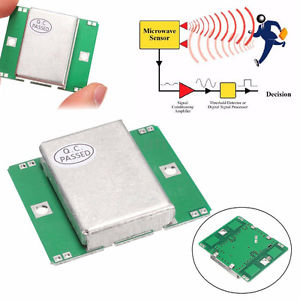
Microwave Motion Detector
Microwave Sensor advantages
Microwaves are the electro-magnetic radiations whose frequency ranges from 0.3 GHz to 300 GHz , These waves are mostly used for the non-broadcasting issues , Microwave motion detectors emit microwaves into the specific region and they detect any intrusion by analyzing the received microwaves frequency after the reflection from the intruder .
Unlike other waves , these waves have narrow beam that imparts it with the characteristic features like broad Bandwidth and high data transmission rate , These waves are used in the space crafts , the communication satellites and various other fields like TV , telephone communications and security systems .
Microwaves are used in the operation of various security devices , Microwave motion detectors are one of the motion sensors that detect the intruder’s motion into the specific portion and the triggers alarm as a consequence .
The main guiding principle for almost all of these sensors has been the Doppler’s Effect , The microwave motion detector circuit mainly comprises of components which are the transmitter , the receiver and the alarm/related circuit .
The transmitter sends off the microwaves into the area , These waves have a specific frequency , as they strike with the intruder moving with a velocity , frequency and consequently , the phase of the wave signal gets altered .
When these reflected waves are received by the receiver , Its phase analysis is done and consequently , The alarm is triggered on if the analysis depicts some change in the phase of the wave signals .
Unlike other detectors , The Microwave sensors can be used in the harsh environment where the heat cycles are not regular , the microwave radiations can easily penetrate through the walls and holes , so , they can be used to impart security across the boundary/closings .
Microwave motion detectors are combined with PIR technology ( passive infrared detectors ) to reduce the false alarms which we usually called as dual technology detection method .
The microwave is the wave which can not be interfered by the temperature , It can overcome the disadvantage of passive infrared detection technology , Microwave can penetrate the objects and it can prevent the damage of detector .
Microwave motion detectors disadvantages
Microwave motion detectors suffer from false alarms that occur due to the slight vibrations of objects such as curtain and swinging signs , They do not operate continuously , they work in intervals , So , there are large chances of any intrusion .
To combat this problem , The improved detector has been designed that contains all the components of a normal sensor along with two receiver/mixer diodes , Some of the detectors contain diodes that enable the detector to sense if the intruder is moving towards or away from the detector .
The detectors are helpful in sensing and differentiating between the ordinary movement and the intruder movement , This feature of such sensors make them highly reliable .
The special properties of microwave beams allow them to penetrate most types of surfaces in the area of detection shield ,however metal is not among them ,So , the sensor may detect the motion where detection is not desirable and not detect motion where it is desirable .
Although these sensors detect the motion through wood and most building materials , microwaves do not penetrate metals , Metal objects act as a shield that creates shadows or dead zones behind them , The areas where the sensor cannot detect the motion .
On the other hand , because the beam can penetrate the walls , the sensor will detect the motion behind the walls , even if such motion is normal , As the sensors are extremely sensitive to the motion .
They are also prone to the other false alarms , Everyday movements such as the objects blowing in wind may trigger false alarms , Even fluorescent lighting that emits detectable light particles , They can activate the sensor erroneously and they may trigger a false alarm .
Uses of microwave motion detector
Microwave motion detectors are used to detect the heartbeats and breathing rate of a human , They are used in monitoring the light system of a house or a building , They are used in the elevator shaft-way , They are used in the security issues and traffic law enforcement .
Since the development of microwave technology , The microwave sensors are used in the industry , traffic , the civilian electronic devices such as the speed measure of vehicle , the liquid level measure , the automation door , the automation light , the alarm system , reversing radar…etc .
Compared to conventional PIR motion detector , the motion detector with microwave sensor combination can provide more reliable performance , Microwave motion detectors are used for special guard places like Prison , Bank , Military warehouse , Museum , Transformer substation…etc .