Sophia robot emotions 2026: 7 Amazing Human-Like Emotions Revealed
Sophia robot emotions are one of the most fascinating features of Hanson Robotics’ humanoid robot. Sophia can display facial expressions such as happiness, sadness, surprise, and anger, making her interactions feel surprisingly human-like. But how does Sophia recognize and express emotions, and how realistic are her responses?
Sophia robot emotions 2026
Sophia Robot
Sophia, Hanson Robotics’ human-like AI robot, is one of the most recognizable humanoid robots in the world. Her ability to communicate with people and display realistic facial expressions has made her a fascinating example of how artificial intelligence and robotics are becoming more human-like. But what happens when you actually ask Sophia to show different emotions? From happiness and surprise to sadness and anger, her expressive face demonstrates the impressive technology behind modern social robots.
Sophia robot emotions
Sophia emotions combine artificial intelligence, computer vision, natural-language processing, and robotic facial movements to create convincing human-like interactions. Although Sophia can appear happy, sad, surprised, or thoughtful, these expressions are simulated by AI rather than proof that Sophia experiences emotions like a human.
Asking Sophia to Show Her Range of Emotions
Imagine standing in front of a humanoid robot and simply asking, “Sophia, can you show me your emotions?” Instead of remaining completely expressionless, Sophia can respond with facial movements designed to represent different emotional states. This is one of the features that makes Sophia particularly interesting compared with traditional industrial robots.
Developed by Hanson Robotics, Sophia was designed to interact with people through conversation, facial expressions, gestures, and other forms of social communication. Her appearance is intentionally human-like, while sophisticated mechanical systems allow her face to move in ways that resemble human expressions.
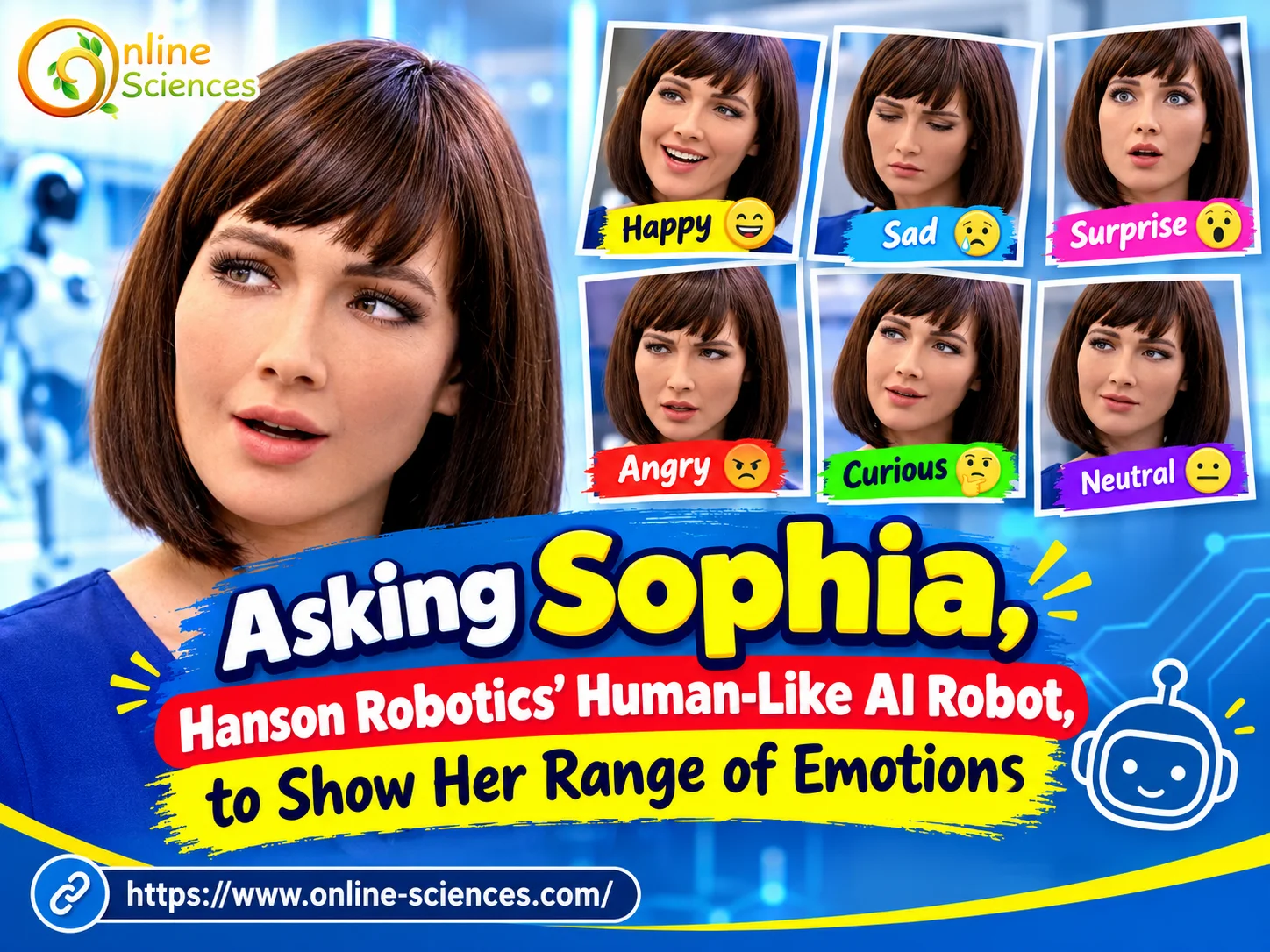
When Sophia is asked to demonstrate different emotions, the experience can be surprisingly realistic. Her eyes, eyebrows, mouth, and other facial features can change to create expressions associated with emotions such as happiness, sadness, surprise, anger, fear, or curiosity.
Of course, there is an important distinction between displaying an emotion and actually feeling an emotion. Sophia‘s expressions are generated by programmed robotic systems and artificial intelligence rather than human consciousness. She can produce an expression that looks happy, but this does not mean that Sophia experiences happiness in the same biological sense as a person.
How Does Sophia Create Human-Like Expressions?
The secret behind Sophia‘s expressive face is a combination of robotics, artificial intelligence, mechanical components, cameras, sensors, and software.
Her face contains numerous moving components that allow her to create different expressions. These movements can be coordinated to make the robot appear more natural during conversations. For example, changing the position of the eyebrows and mouth while adjusting the eyes can create a recognizable facial expression.
Sophia can also use visual information and conversational context to support her interaction with people. This combination of AI and facial animation helps create the impression that the robot is responding socially rather than simply producing predetermined mechanical movements.
This is an important area of research because robots that work around humans need more than the ability to move from one location to another. Social robots may need to communicate information, recognize people, understand spoken language, and provide appropriate responses.
Sophia’s Happy Expression
One of the easiest emotions for Sophia to demonstrate is happiness. A smile can dramatically change the appearance of a human face, and robotic designers can reproduce some of the same visual characteristics.
Sophia can move her mouth and other facial components to create a smile-like expression. Combined with eye and eyebrow movements, the result can look surprisingly convincing.
This capability helps make Sophia more approachable. A robot with a completely rigid face may appear cold or intimidating, while an expressive robot can create a more natural social interaction.
Sophia Showing Surprise
Surprise is another fascinating expression to watch. Human surprise is often communicated through raised eyebrows, widened eyes, and an open mouth.
Sophia‘s facial mechanisms can reproduce several of these visual characteristics. When these movements happen together, the robot can produce an expression that humans readily recognize as surprise.
This demonstrates an important principle in social robotics: robots don’t necessarily need to experience an emotion to communicate an emotional signal. They need to reproduce recognizable cues that humans understand.
Sophia and Sadness
Sophia can also demonstrate an expression intended to represent sadness. A sad facial expression can involve changes to the eyebrows, mouth, and overall appearance of the face.
Seeing these expressions on a humanoid robot can feel unusual because people naturally tend to interpret faces socially. When a robot looks sad, viewers may instinctively respond to the expression even though the machine does not necessarily experience sadness.
This phenomenon is particularly important for researchers studying human-robot interaction. The more human-like a machine becomes, the more naturally people may respond to it.
Can Sophia Really Feel Emotions?
This is perhaps the most important question about Sophia. Sophia can simulate and display emotional expressions, but that does not establish that she experiences emotions like a human being.
Human emotions are connected to biological processes, subjective experiences, memories, hormones, nervous-system activity, and many other factors. An AI robot operates very differently.
Sophia can process information, generate responses, and control facial movements. These capabilities can create the appearance of emotion, but an expressive response should not automatically be interpreted as evidence of human-like consciousness or feelings. This distinction is essential when discussing emotional AI and humanoid robots.
Why Are Emotional Expressions Important for Robots?
At first, making a robot smile or look surprised might seem like entertainment. However, expressive robotics could have practical applications.
Humanoid robots may eventually be used in environments where communication and social interaction are important. Potential applications include education, customer service, museums, healthcare environments, research, entertainment, and public information services.
A robot that can communicate through facial expressions may be easier for people to understand and interact with. For example, if a social robot is communicating with an elderly person, a child, or a visitor in a public facility, facial expressions and gestures could complement spoken language.
However, there are also challenges. Researchers need to determine how realistic robotic expressions should be and how people interpret them. An expression that is too artificial may feel strange, while an extremely realistic robot could create unrealistic expectations about what the machine actually understands or feels.
Sophia and the Future of Humanoid Robots
Sophia represents an important step in the development of human-like robots. Her combination of artificial intelligence, conversation, facial animation, and robotics demonstrates how engineers are attempting to create machines that can interact with people in more natural ways.
Future humanoid robots could become more capable of recognizing facial expressions, understanding conversational context, responding to body language, and adapting their behavior to different situations.
The biggest question is not simply whether robots can look human. It is whether they can become genuinely useful while maintaining clear boundaries between machine simulation and human emotion.
Sophia‘s range of facial expressions gives us a fascinating look at this future. Asking her to show happiness, sadness, surprise, anger, or curiosity may look like a simple demonstration, but behind those expressions are sophisticated technologies working together.
For anyone interested in artificial intelligence, robotics, humanoid robots, and the future of technology, Sophia remains an impressive example of how machines are becoming increasingly interactive and expressive.
Frequently Asked Questions About Sophia Robot
1. What is Sophia Robot?
Sophia is a humanoid social robot developed by Hanson Robotics. She was designed to communicate and interact with people using artificial intelligence, facial expressions, speech, and robotic movement.
2. Can Sophia show emotions?
Yes. Sophia can produce facial expressions designed to represent different emotional states, including happiness, sadness, surprise, anger, and curiosity.
3. Does Sophia actually feel emotions?
There is an important difference between simulating an emotion and experiencing one. Sophia can display emotional expressions, but this does not mean that she experiences emotions in the same way humans do.
4. Who created Sophia Robot?
Sophia was created by Hanson Robotics, a company known for developing human-like social robots.
5. Why does Sophia look like a human?
Her human-like appearance is intended to support social interaction and make communication with people more natural and engaging.
6. How does Sophia move her face?
Sophia uses robotic mechanical systems and software to control facial movements, allowing different combinations of movements to create recognizable expressions.
7. Is Sophia a fully autonomous human-like robot?
Sophia combines artificial intelligence and robotic systems, but she should not be considered equivalent to a human. Her capabilities depend on software, hardware, sensors, AI systems, and programmed behaviors.
8. Why are emotional expressions useful in robots?
Emotional expressions can make human-robot interaction more natural. They may help robots communicate more effectively in educational, entertainment, research, customer-service, and other social environments.
9. Is Sophia conscious?
Sophia‘s human-like appearance and conversational abilities should not be taken as proof of human-like consciousness. Her demonstrated capabilities are based on artificial intelligence and robotics.
10. Why is Sophia important in robotics?
Sophia has helped popularize the idea of social humanoid robots and has demonstrated how AI, speech technology, facial animation, and robotics can be combined to create more engaging human-machine interactions.
You can follow Science Online on YouTube at this link: Science Online
🔥 Asking Sophia, Hanson Robotic’s human-like AI robot, to show her range of emotions 🚀
Gemini Takes Over: The End of Google Assistant in 2026! 🚀
Goodbye Google Assistant: Can Your Android Phone Actually Run Gemini? 🚀
Loona robot review, advantages, disadvantages and what can Loona do?
Sophia robot review, features, use, advantages and disadvantages
Humanoid robots use, risks, advantages, and disadvantages
Advantages and disadvantages of using robots in our life
Robot teachers use, advantages and disadvantages
Ameca robot review, features, advantages, disadvantages and what can Ameca do?
China’s AI Robot MOYA Feels Too Real: The amazing Humanoid Robot With a 92% Human-Like Gait
Boston Dynamics Atlas review, advantages and features, How does Atlas robot work?
Figure 02 robot importance and drawbacks, What can Figure 02 do?