Meet Sara: Saudi Arabia’s First Humanoid Robot 2026 🤯 – Amazing AI Technology 🤖🇸🇦
Meet Sara, Saudi Arabia’s First locally developed Humanoid Robot, a remarkable project that combines artificial intelligence, robotics, Arabic language capabilities, and Saudi cultural values. Developed by QSS AI & Robots in Riyadh, Sara represents an important step in Saudi Arabia’s growing ambitions in artificial intelligence and robotics. Unlike Sophia, the famous humanoid robot that received Saudi citizenship in 2017, Sara was designed and developed in Saudi Arabia, making her a particularly important milestone for the Kingdom’s homegrown robotics industry.
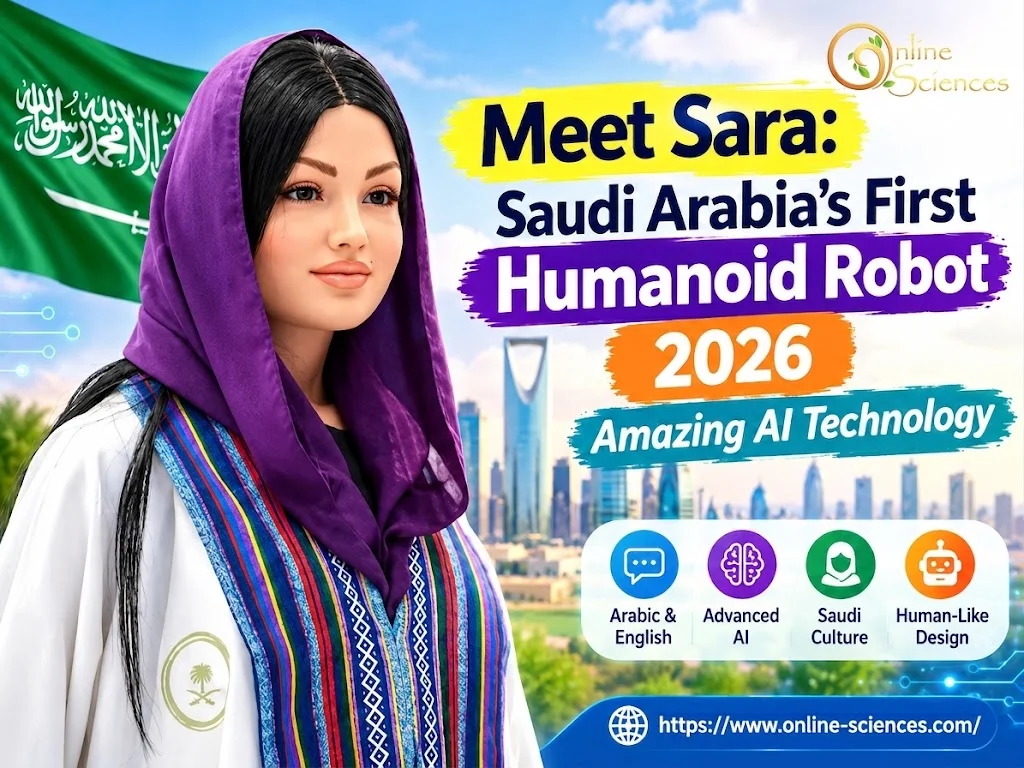
Meet Sara: Saudi Arabia’s First Humanoid Robot 2026 🤯
Saudi Arabia’s First Humanoid Robot
Saudi Arabia’s first humanoid robot, Sara, represents an exciting milestone in the Kingdom’s growing AI and robotics industry. Developed in Saudi Arabia, Sara combines a human-like appearance with artificial intelligence and the ability to communicate in Arabic and English. Her development highlights Saudi Arabia’s ambition to become a leader in advanced technology, while also creating humanoid robots that reflect local culture and future digital innovation.
Who is Sara, Saudi Arabia’s First Humanoid Robot?
Sara is a human-like AI robot developed in Saudi Arabia by QSS AI & Robots. The robot attracted international attention because she combines a humanoid appearance with conversational artificial intelligence and the ability to interact with people in both Arabic and English.
According to information published about the project, Sara was designed as a Saudi humanoid character and was presented wearing traditional Saudi clothing. Her design reflects an attempt to combine modern robotics technology with regional cultural identity.
Sara is approximately 1.62 meters tall, and her creators described her as a 25-year-old female robot. Rather than simply creating a machine that looks human, QSS designed Sara around a specific personality and conversational behavior.
This makes Sara more than a traditional industrial robot. She belongs to the growing category of social humanoid robots, machines designed to communicate and interact with humans rather than simply perform repetitive mechanical tasks.
What Makes Sara Different?
One of Sara’s most interesting features is her focus on Arabic and English communication. Her ability to communicate in Arabic is particularly significant because many AI and robotics demonstrations historically focus primarily on English.
Sara uses a proprietary language model developed by QSS AI & Robots. Her creators have said that the robot does not depend on ChatGPT for its conversational system. Instead, QSS developed its own AI technology for understanding and generating language.
This approach gives developers greater control over how the robot responds, what information it uses, and how its personality is designed. Sara therefore demonstrates an important direction in AI development: building AI systems that are adapted to specific languages, cultures, and environments.
Sara and Saudi Cultural Values
Perhaps the most distinctive aspect of Sara is the way her creators incorporated Saudi cultural considerations into her design.
Sara wears traditional Saudi clothing, including an abaya, and her conversational behavior was designed around local cultural expectations. Her creators have explained that she is programmed to avoid certain sensitive subjects, including political and sexual discussions.
This highlights an increasingly important question in artificial intelligence: Should robots behave differently depending on the culture in which they operate?
The development of Sara suggests that the answer can be yes. AI systems are increasingly expected to understand cultural context, language differences, social norms, and local expectations. For a humanoid robot intended to interact directly with people, these factors can be just as important as walking, facial expressions, or speech recognition.
Is Sara Really Saudi Arabia’s First Humanoid Robot?
The phrase “Saudi Arabia’s first humanoid robot” needs a little clarification. Sara is widely described as the first Saudi-made or Saudi-developed humanoid robot. QSS itself describes her as the first human-like robot made in Saudi Arabia.
However, Saudi Arabia became internationally associated with humanoid robots earlier because Sophia, created by Hanson Robotics, was granted Saudi citizenship in 2017.
Sophia was not designed and manufactured in Saudi Arabia. Her connection with the Kingdom came from the citizenship announcement, which made global headlines and turned her into one of the world’s most famous robots. Sara is different because the emphasis is on local Saudi development and robotics capabilities.
How Does Sara Use Artificial Intelligence?
At the heart of Sara is artificial intelligence capable of processing human language and producing responses. A humanoid robot needs several technologies working together. These can include:
- Artificial intelligence.
- Natural-language processing.
- Speech recognition.
- Speech generation.
- Computer vision.
- Sensors.
- Robotics control systems.
- Motion control.
- Human-robot interaction.
Sara’s conversational AI allows her to interact with people rather than simply execute a fixed sequence of mechanical commands.
This is an important distinction between conventional automation and modern humanoid robotics. A traditional industrial robot might repeatedly move an object from one location to another, while a social humanoid robot is designed to perceive, communicate, respond, and interact.
Why is Sara Important for Saudi Arabia?
Sara arrives at a time when Saudi Arabia is investing heavily in artificial intelligence, automation, digital infrastructure, and advanced technologies.
The Kingdom’s broader technology strategy is increasingly connected to Vision 2030, with AI and robotics viewed as important components of future economic development. Saudi Arabia is also seeking to develop advanced technological capabilities locally rather than relying entirely on imported systems.
Recent reporting has highlighted Saudi Arabia’s growing ambition to become a significant player in humanoid robotics and automation. Sara therefore represents more than an impressive robot demonstration. She can be viewed as an example of the Kingdom’s attempt to develop homegrown AI and robotics expertise.
What Could Saudi Humanoid Robots Do in the Future?
The potential applications for humanoid robots are enormous. Future Saudi humanoid robots could potentially work in:
- Hotels and Hospitality: Humanoid robots could greet visitors, provide information, answer questions, and help guests navigate large hotels or entertainment complexes.
- Education: AI robots could eventually assist teachers by providing interactive explanations, language practice, demonstrations, and educational activities.
- Healthcare: Humanoid robots could potentially assist with reception, navigation, information services, and certain repetitive non-medical tasks.
- Retail: Robots could answer customer questions, explain products, and guide visitors through large shopping centers.
- Industry: More advanced humanoid robots could eventually perform repetitive or hazardous tasks in industrial environments.
- Tourism and Entertainment: Saudi Arabia is developing major tourism and entertainment destinations, creating potential opportunities for robots capable of interacting with international visitors in multiple languages.
However, these applications should not be confused with today’s capabilities. Humanoid robots still face major challenges involving reliability, energy consumption, dexterity, autonomy, cost, and safety. Recent developments worldwide show that impressive demonstrations do not necessarily mean humanoid robots are ready to replace human workers on a large scale.
The Future of Sara and Saudi Robotics
Sara could become an important symbol of Saudi Arabia’s growing robotics ecosystem. The next generation of Saudi humanoid robots will likely become more capable of walking naturally, recognizing objects and faces, understanding conversations, manipulating objects, and performing useful tasks in real-world environments.
The biggest challenge will not simply be making robots look human. The real challenge is making them useful, reliable, affordable, safe, and capable of operating independently in unpredictable environments.
As AI becomes more powerful, humanoid robots could eventually combine advanced language models with physical abilities, creating machines that can both understand instructions and physically act on them.
Saudi Arabia’s growing interest in humanoid robotics suggests that the Kingdom wants to participate in this transformation rather than simply watch it happen elsewhere.
Final Thoughts
Sara is an important milestone in Saudi Arabia’s robotics journey. As a locally developed humanoid robot capable of communicating in Arabic and English and designed around Saudi cultural considerations, she demonstrates how artificial intelligence can be adapted to a particular society.
While Sara is still far from the science-fiction vision of a fully autonomous human replacement, her development shows how quickly humanoid robotics is progressing.
The most exciting question is no longer whether humanoid robots will become part of our technological future. It is what roles they will eventually play—and how Saudi Arabia will use its own humanoid robots to shape that future.
Frequently Asked Questions
1. What is the name of Saudi Arabia’s first humanoid robot?
The robot is called Sara. She was developed by QSS AI & Robots in Riyadh and is described by the company as the first Saudi-made human-like robot.
2. Who created Sara?
Sara was developed by QSS AI & Robots, a Riyadh-based robotics company.
3. Can Sara speak Arabic?
Yes. Sara was designed to communicate in Arabic and English, making bilingual interaction one of her notable features.
4. Is Sara powered by ChatGPT?
No. Her creators have stated that Sara uses a proprietary language model developed by QSS, rather than relying on ChatGPT.
5. Is Sophia Saudi Arabia’s first robot?
Sophia is sometimes associated with Saudi Arabia because she received Saudi citizenship in 2017. However, she was created by Hanson Robotics and was not a Saudi-made robot. Sara is described as the first Saudi-made humanoid robot.
6. How tall is Sara?
Sara is reported to be approximately 1.62 meters tall.
7. What makes Sara special?
Sara combines humanoid robotics, conversational AI, Arabic and English communication, and cultural customization designed for the Saudi environment.
8. Can Sara replace humans?
Not at present. Modern humanoid robots still have significant limitations in autonomy, reliability, dexterity, energy efficiency, and cost. Their most realistic near-term role is likely to be assisting humans rather than completely replacing them.
9. Why is Saudi Arabia investing in humanoid robots?
Humanoid robotics fits into the Kingdom’s broader push toward artificial intelligence, automation, advanced manufacturing, and technological innovation associated with its Vision 2030 ambitions.
10. What is the future of Saudi humanoid robots?
Future Saudi robots could potentially be used in hospitality, tourism, education, retail, healthcare support, manufacturing, logistics, and entertainment as the underlying AI and robotics technologies become more capable.
You can follow Science Online on YouTube at this link: Science Online
Gemini Takes Over: The End of Google Assistant in 2026! 🚀
Goodbye Google Assistant: Can Your Android Phone Actually Run Gemini? 🚀
Loona robot review, advantages, disadvantages and what can Loona do?
Sophia robot review, features, use, advantages and disadvantages
Humanoid robots use, risks, advantages, and disadvantages
Advantages and disadvantages of using robots in our life
Robot teachers use, advantages and disadvantages
Ameca robot review, features, advantages, disadvantages and what can Ameca do?
China’s AI Robot MOYA Feels Too Real: The amazing Humanoid Robot With a 92% Human-Like Gait
Boston Dynamics Atlas review, advantages and features, How does Atlas robot work?
Figure 02 robot importance and drawbacks, What can Figure 02 do?