The stages of fertilization process in the plants
The fertilization process is a process after the pollination process, and it is the process of fusion of the nucleus of the male cell (the pollen grains) with the nucleus of the female cell (the ovum) to form the zygote.
The fertilization process in the plants
The flowers are the reproductive structures of angiosperms. They vary in the methods of reproduction. The process of fertilization in plants occurs when the gametes in haploid conditions meet to create a zygote, which is diploid.
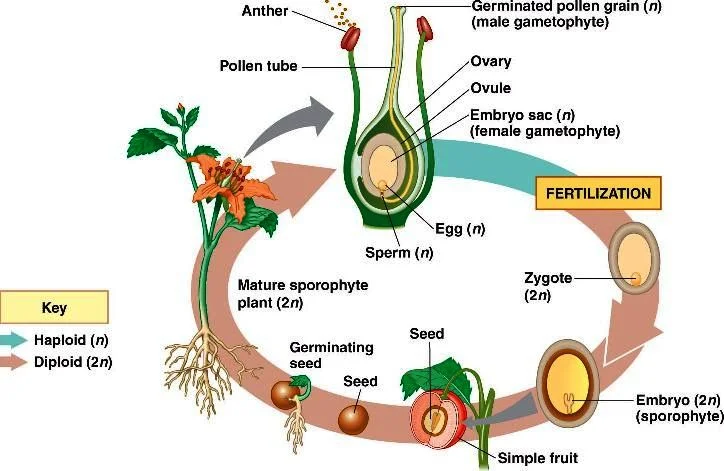
After the pollination process, the pollen grains stick on the stigma, which secretes a sugary solution, and then the pollen grain germinates, forming a pollen tube that contains 2 male nuclei.
The pollen grains germinate after the carpel is pollinated, the pollen tube emerges and grows, it extends through the style till it reaches the ovule inside the ovary through the micropyle.
Reproductive stages in plants
The pollen tube does not reach the ovary in a straight line, and there are two types of nuclei, which are the vegetative tube and generative nuclei of the pollen grain that pass into the pollen tube.
The pollen tube grows through the style and curls to the bottom of the ovary, and then near the receptacle. The pollen tube breaks into the ovule through the micropyle and then to the micropyle bursts into the embryo sac.
The end of the pollen tube degenerates? In the embryo sac, the male nucleus fuses with the nucleus of the ovum ( the egg cell ) and forms a fertilized ovum, which is known as a diploid zygote. This process is known as true fertilization or syngamy.
The other male gamete or nucleus enters into the embryo sac, and it fuses with the secondary nucleus, which gives a triploid nucleus, which is called the primary endosperm nucleus, and it becomes a food source for the growing embryo.
The process of nuclear fission, where there is the formation of the primary endosperm nucleus, is called triple fission, and the zygote undergoes successive divisions to form the embryo inside the ovule.
The ovule develops and becomes the seed, while the ovary develops and becomes the fruit, and the fruits differ from each other according to the nature of the ovary.
If the ovary contains one ovule, it will give a fruit with a single seed as olives and peaches, and if the ovary contains many ovules, it will give a fruit with many seeds as the beans and the peas. In case of fruits with multiple seeds, multiple pollen grains are necessary to fertilize with each ovule.
FAQ about the stages of fertilization in plants
What is fertilization in plants?
Fertilization is the process in which the male gamete (from pollen) fuses with the female gamete (egg cell) inside the ovule to form a zygote, which later develops into a seed. In flowering plants (angiosperms), fertilization is called double fertilization.
What are the main stages of fertilization in plants?
The stages are:
- Pollination.
- Germination of a pollen grain.
- Formation and growth of the pollen tube.
- Fusion of gametes (Double fertilization).
- Formation of seed and fruit.
What happens during pollination?
Pollination is the transfer of pollen grains from the anther to the stigma.
It can be:
- Self-pollination.
- Cross-pollination.
- Pollination is the first step before fertilization can occur.
What happens after pollen lands on the stigma?
After landing on the stigma:
- The pollen grain absorbs moisture.
- It germinates and forms a pollen tube.
- The pollen tube grows down through the style toward the ovary.
How does the male gamete reach the ovule?
The pollen tube enters the ovule through a small opening called the micropyle. The male gametes travel through the pollen tube. They are released into the embryo sac.
What is double fertilization?
Double fertilization is a special feature of flowering plants. It involves two fusion events:
- One male gamete + egg cell → Zygote
- Second male gamete + two polar nuclei → Endosperm
What is the function of the endosperm?
The endosperm:
- Provides nutrition to the developing embryo.
- Supports seed development.
What happens after fertilization?
After fertilization:
- The zygote develops into an embryo.
- The ovule becomes a seed.
- The ovary becomes a fruit.
Why is fertilization important in plants?
Fertilization is important because it:
- Produces seeds.
- Ensures reproduction.
- Maintains genetic variation.
- Leads to the formation of fruits.
What is the difference between pollination and fertilization?
- Pollination is the process by which pollen grains are transferred from the anther to the stigma of a flower. It occurs before fertilization and does not involve the fusion of gametes.
- Fertilization is the process in which the male gamete fuses with the female gamete inside the ovule. It occurs after pollination and leads to the formation of a zygote.
- Pollination takes place on the outer part of the flower (the stigma), while fertilization takes place inside the ovary. Pollination is the first step in plant reproduction, whereas fertilization is the second step that results in seed formation.
The stages of the fertilization process in plants
- Pollination occurs first. Pollen grains are transferred from the anther to the stigma of a flower.
- The pollen grain germinates. When the pollen grain lands on a suitable stigma, it absorbs moisture and begins to grow.
- A pollen tube is formed. The pollen grain produces a pollen tube that grows down through the style toward the ovary.
- The male gametes travel through the pollen tube. Two male gametes move inside the pollen tube until it reaches the ovule through the micropyle.
- Double fertilization takes place. One male gamete fuses with the egg cell to form a zygote, and the other male gamete fuses with the two polar nuclei to form the endosperm.
- Formation of the seed and fruit occurs. After fertilization, the zygote develops into an embryo, the ovule becomes a seed, and the ovary develops into a fruit.
You can subscribe to Science Online on YouTube from this link: Science Online
Asexual & sexual reproduction in plants, Pollination & Stages of fertilization process in plants