Brain Structure and Function in the Central Nervous System: 10 Essential Facts You Must Know!
The brain is the most complex organ in the human body and serves as the control center of the central nervous system (CNS). It processes information, regulates vital functions, and enables thinking, memory, movement, and emotions, making it essential for survival and daily life.
Human brain
The central nervous system is composed of the brain and the spinal cord. The brain is a nerve block containing millions of nerve cells (neurons), and it is the main control center in your body.
The brain is located inside a bony box called the skull to protect it. It directs and coordinates all the processes, ideas, behaviours, and emotions, and it weighs about 1.5 kg in the adult human.
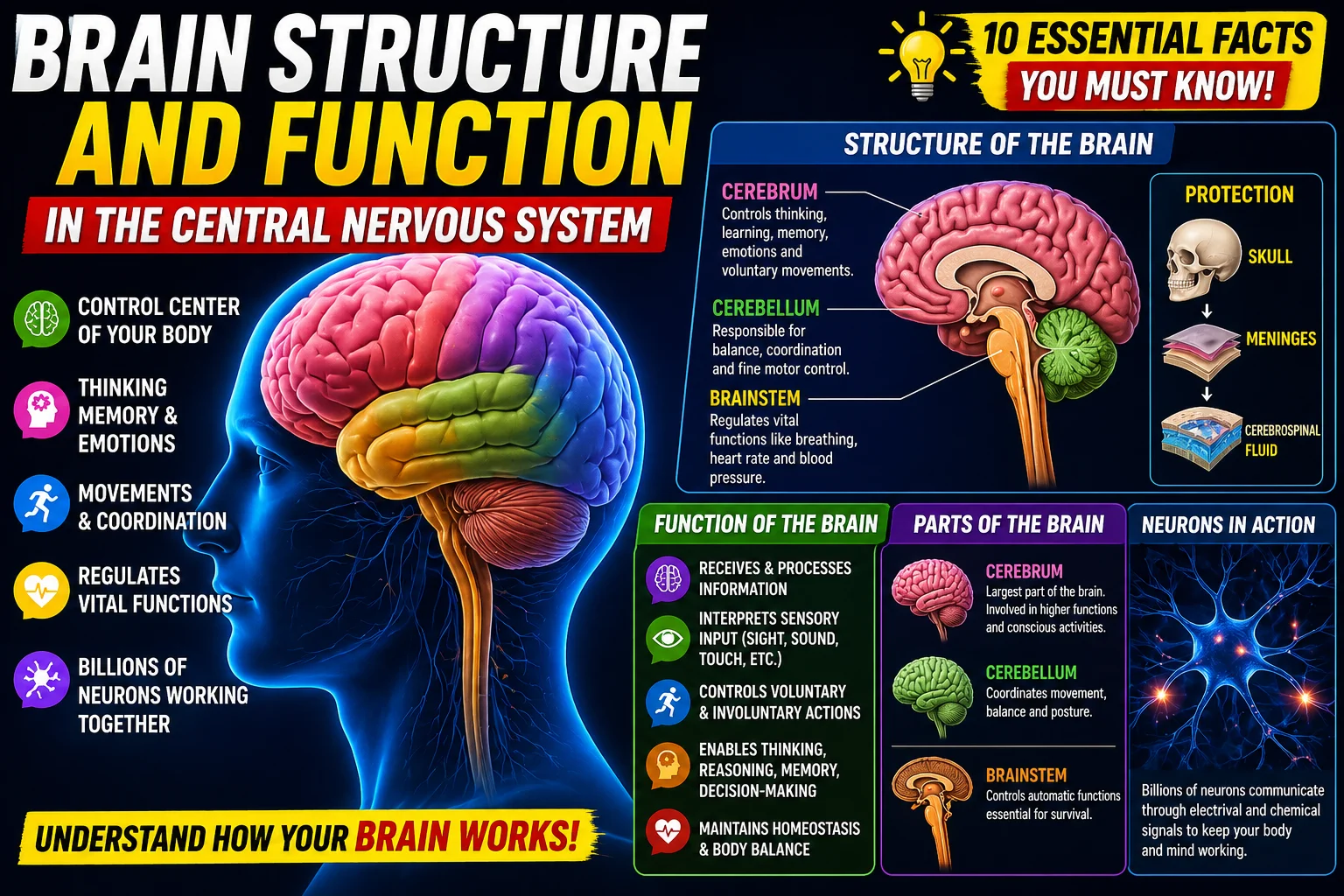
The human brain consists of three main parts, which are the cerebrum (two cerebral hemispheres), cerebellum, and the medulla oblongata.
Human brain structure
Structure of the Brain
The brain is divided into three main parts: the cerebrum, cerebellum, and brainstem, each responsible for different functions. The cerebrum is the largest part and controls higher functions such as thinking, learning, memory, and voluntary movement. It is divided into two hemispheres and further into lobes, including the frontal, parietal, temporal, and occipital lobes. The cerebellum, located at the back of the brain, plays a crucial role in coordination, balance, and fine motor control.
The brainstem connects the brain to the spinal cord and regulates essential life functions such as breathing, heart rate, and blood pressure. Structurally, the brain is made up of billions of neurons and supporting cells called glial cells, which work together to transmit electrical and chemical signals. The brain is also protected by the skull, meninges, and cerebrospinal fluid, ensuring safety and proper functioning within the central nervous system.
Function of the Brain
The brain acts as the command center of the body by receiving, processing, and responding to information from both internal and external environments. It controls voluntary actions such as movement and speech, as well as involuntary processes like heartbeat and digestion. Sensory information—such as sight, sound, and touch—is interpreted by the brain, allowing individuals to understand and interact with their surroundings effectively.
In addition to physical control, the brain is responsible for cognitive and emotional functions, including thinking, reasoning, memory, decision-making, and feelings. It enables learning and adaptation through neural connections that strengthen with experience. The brain also maintains homeostasis by regulating temperature, hormones, and other vital processes, ensuring the body remains stable and balanced.
The cerebrum (the two cerebral hemispheres)
Is the cerebrum the largest part of the brain? It is divided into two halves (the right and the left) called the two cerebral hemispheres. The cerebral hemispheres are separated by a fissure and attached to each other through the nerve fibres.
The outer surface of the two hemispheres is called the cerebral cortex, and it is a grey matter, but the inner surface is called the white matter. The two hemispheres have many convolutions and folds on their surface.
Cerebrum function
The cerebrum is a very important part of the brain as it controls the voluntary movements of the body, such as running in races. The cerebrum contains the centers of thinking and memory (the concentration). The cerebrum receives the nerve impulses from the sense organs (the eyes, the ears, the nose, the tongue, and the skin) and sends the suitable responses to these impulses.
The cerebellum
The cerebellum lies at the back area of the brain below the two cerebral hemispheres, and it maintains the balance of the body during movement.
Medulla oblongata
The medulla oblongata lies in front of the cerebellum, and it connects the brain with the spinal cord.
Function of the medulla oblongata
Damage to the medulla oblongata causes death, and it is responsible for regulating the involuntary processes of the body, such as regulating the heartbeats. The medulla oblongata regulates the movement of the respiratory system parts during breathing. The medulla oblongata regulates the movements and functions of the digestive system.
FAQ about Brain Structure and Function
1. What are the main parts of the brain?
The brain consists of the cerebrum, cerebellum, and brainstem.
2. What is the function of the cerebrum?
It controls thinking, memory, emotions, and voluntary movements.
3. Why is the cerebellum important?
It helps maintain balance, coordination, and posture.
4. What does the brainstem do?
It regulates vital functions like breathing, heart rate, and blood pressure.
5. How does the brain communicate with the body?
Through neurons that send electrical and chemical signals via the spinal cord.
6. What protects the brain?
The skull, meninges, and cerebrospinal fluid protect the brain.
7. Is the brain part of the central nervous system?
Yes, it is the main organ of the central nervous system along with the spinal cord.
Understanding the structure and function of the brain helps you appreciate how your body works every second. Explore more about the central nervous system to unlock the secrets of human intelligence and survival.
You can follow science online on YouTube from this link: Science online
Autonomic nervous system, Reflex action types and Autonomic ganglia function
Functions of Sympathetic nervous system and Role of the sympathetic in emergencies
Nervous system in man, Nerve cells types & Nature of nerve impulse
Nervous system (Central nervous system, Peripheral nervous system & Autonomic nervous system)
Human Transport system, Structure of human circulatory system (heart, blood vessels and blood)