
Powerful Root System Explained: Structure & Function in Plants (2026)
The root system in plants plays a vital role in absorption, anchorage, and nutrient transport, making it essential for plant survival, growth, and productivity in different environments.
The plant
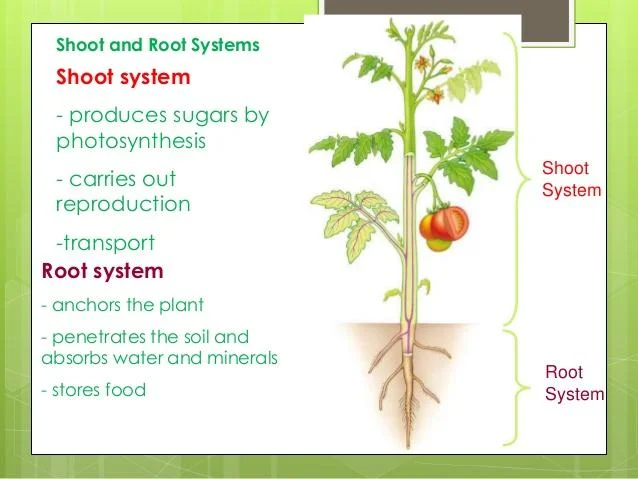
Plant structure
The plant consists of the root system and the shoot system, The root system consists of the roots, The shoot system consists of the leaves and the stems, The plant takes the raw materials from the environment to make its food by the photosynthesis process.
The plant takes carbon dioxide gas from the air, the light energy, the water from the soil, and the minerals salts from the soil (such as phosphorus, magnesium, calcium, nitrogen and zinc).
The water and mineral salts are transmitted from the soil to the other parts of the plant through the root hairs in the root system, then the transmission of the juice (the water and the mineral salts) from the root to the other parts of the plant to use it in making the food.
The root system plays a vital role in plant growth by absorbing water and nutrients, anchoring the plant, and storing food, making it one of the most important structures in plant biology. The root system is a powerful and essential part of plants, responsible for support, nutrition, and survival. Its structure and types are specially adapted to different environments, allowing plants to thrive in various conditions.
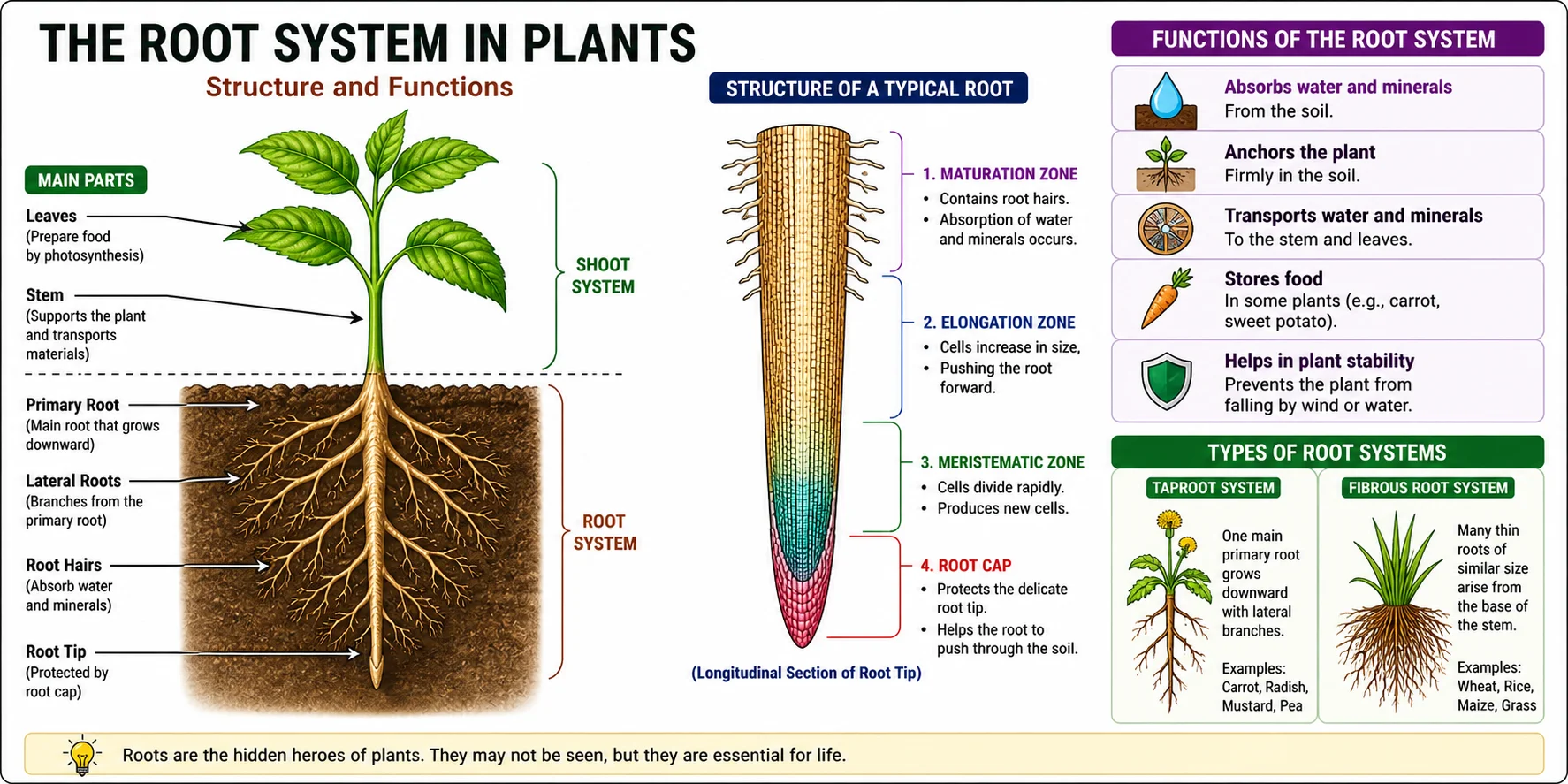
Root system in plants
Structure of the root system
The root is subdivided and extended through the soil particles, it is composed of a number of the layers which are the epidermis layer, the cortex layer, the xylem (wood) layer and the pith layer.
The epidermis layer is the external later that has the root hairs extended from its cells, The cortex layer follows the epidermis layer and its last row is called the endodermis. The xylem (wood) layer follows the cortex layer, and the pith layer is the last layer that follows the xylem layer.
Functions of the root system
The root system is very important for the plant as it is branched and extended through the soil particles to fix the plant in the soil. The root system covers a large area of the soil to search for the water and the mineral salts that the plant needs, then absorbs them from the soil by the root hairs, and raises them to the other parts of the plant (the shoot system) to form the plant’s food.
The root system absorbs the water and the minerals from the environment, It anchors the plant in the ground, and it stores the food that has been made in the leaves by the photosynthesis process, So, the food can be used later by the plant to grow and survive.
Importance of the Root System
The root system is essential for plant survival and growth. It performs several critical functions:
- Absorption of water and minerals from the soil.
- Anchorage: holds the plant firmly in place.
- Storage of food (e.g., carrots, sweet potatoes).
- Transport of nutrients to the stem and leaves.
- Soil stabilization: prevents erosion and maintains soil structure.
The importance of the root system lies in its ability to support the plant both physically and physiologically, ensuring proper growth and productivity.
Parts of the Root System
A typical root system consists of several important parts:
- Primary Root: The main root that grows downward into the soil and forms the base of the root system.
- Lateral Roots: Smaller roots branching from the primary root that increase the surface area for absorption.
- Root Hairs: Tiny hair-like structures that absorb water and minerals efficiently from the soil.
- Root Cap: A protective structure at the tip of the root that helps it push through the soil.
- Root Tip: The growing point of the root where new cells are formed.
Types of Root Systems
There are two main types of root systems:
- Taproot System: One thick main root grows deep into the soil. Has smaller lateral branches. Provides strong anchorage. Examples: carrot, radish, mango.
- Fibrous Root System: It consists of many thin roots of similar size. It spreads widely near the soil surface. It helps prevent soil erosion. Examples: wheat, rice, grass.
FAQ About the Root System
1. What is the root system in plants?
The root system is the underground part of a plant that anchors it in the soil and absorbs water and nutrients essential for growth.
2. What are the main functions of the root system?
The root system performs several key functions:
- Absorbing water and minerals.
- Anchoring the plant firmly in the soil.
- Storing food (in some plants like carrots).
- Transporting nutrients to the rest of the plant.
3. What are the main types of root systems?
There are two main types:
- Taproot System (e.g., carrot, radish).
- Fibrous Root System (e.g., grasses).
4. What is the structure of a root?
A typical root consists of:
- Root cap.
- Meristematic zone (cell division).
- Elongation zone.
- Maturation zone (with root hairs).
5. What is the function of root hairs?
Root hairs increase the surface area of the root, allowing better absorption of water and minerals from the soil.
6. How do roots absorb water?
Roots absorb water through root hairs by a process called Osmosis.
7. Do roots only grow downward?
Mostly yes, due to Geotropism, but some roots can grow sideways or even upward depending on conditions.
8. What is the role of roots in plant stability?
Roots anchor the plant firmly, preventing it from being uprooted by wind or water.
9. Can roots store food?
Yes, some roots like carrots and sweet potatoes store food for the plant.
10. How do roots help in plant growth?
Roots supply essential nutrients and water, which are necessary for photosynthesis and overall plant development.
You can subscribe to Science Online on YouTube from this link: Science Online
Excretion in plants, Importance & types of transpiration for the plant
Transportation in plant, Structure & role of the plant stem in the process of transportation
Autotrophic Nutrition in green plants, Mechanism of water & minerals absorption