Sound velocity, Nature and properties of sound waves, How do sound waves travel?
The sound is an external factor that affects the ear, causing the sense of hearing. It is produced due to the vibration of the bodies, and it stops when the vibrating bodies stop their vibration.
Nature of sound waves
| The sound waves propagate through media as spheres. |
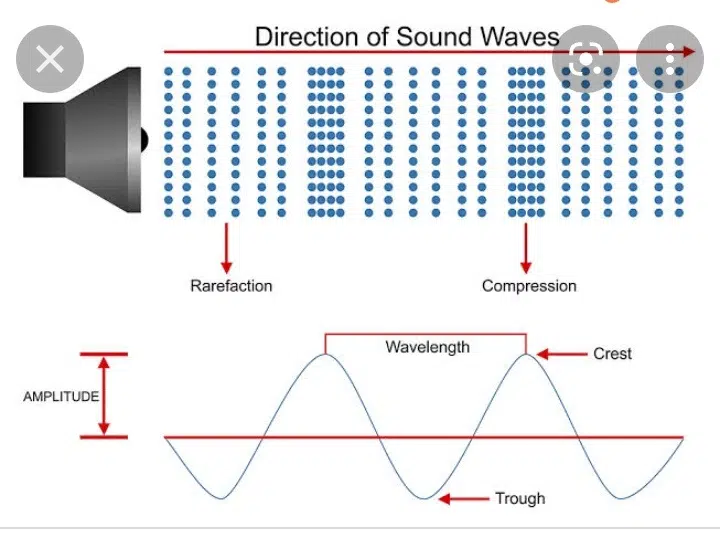
The sound waves are mechanical longitudinal waves that need a medium to propagate. They propagate through media as the spheres whose centre is the source of the sound, and they consist of the compressions and the rarefactions.
 Sound waves |
| Sound waves consist of compressions and rarefactions. |
You notice that we hear the sound from all the directions that surround the sound source because the sound travels through the air as pulses of compressions and rarefactions whose centre is the sound source.
Sound velocity
The sound velocity is the distance that is covered by the sound waves in one second, and the sound waves propagate through different media with different velocities.
The sound travels through the air at a velocity of 340 m/s, and it depends on the temperature of the air, the air pressure, and the humidity in the air.
The sound velocity through the solids is larger than that through the liquids, and the velocity through the liquids is larger than that through the gases.
 Sound waves |
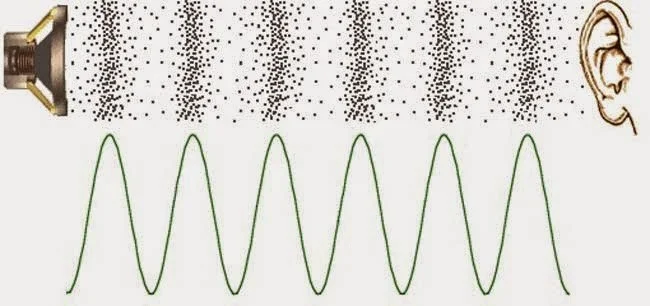
| Sound waves are mechanical longitudinal waves. |
Properties of the sound waves
The sounds may be pleasant to our ears, such as the music, and they may be the source of fear, such as the sound of the strong winds and the thunder.
The source of the disturbance and the irritation, such as the horns and the loudspeakers, The sounds can be classified into two groups which are the musical tones and the noise.
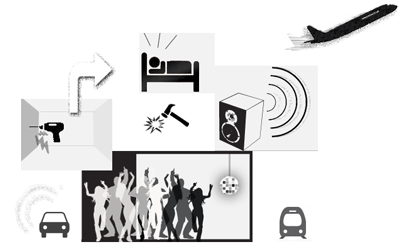 |
| Noise |
The musical tones are the tones of uniform frequency and are comfortable to be heard. Examples: The violin, the piano, and the reed pipe.
The noise is the sound of the non-uniform frequency, and is uncomfortable to be heard, Examples: The drill, the loudspeakers, and the horn of the cars.
FAQ about Sound Velocity
1. What is sound velocity?
Sound velocity is the speed at which sound waves travel through a medium such as air, water, or solids.
2. What is the speed of sound in air?
At room temperature (about 20°C), sound travels at approximately 343 meters per second in air.
3. Does sound travel at the same speed in all materials?
No, sound travels at different speeds depending on the medium. It moves fastest in solids, slower in liquids, and slowest in gases.
4. Why does sound travel faster in solids?
Because particles in solids are closely packed, allowing vibrations to transfer more quickly from one particle to another.
5. How does temperature affect sound velocity?
Higher temperatures increase the speed of sound in gases because particles move faster and transmit vibrations more efficiently.
6. Can sound travel in space?
No, sound cannot travel in a vacuum because there are no particles to carry the vibrations.
7. What factors affect sound velocity?
The main factors include the type of medium, temperature, density, and elasticity of the material.
FAQ about Nature and Properties of Sound Waves
1. What is sound?
Sound is a form of energy that travels in waves and is produced by vibrating objects.
2. What type of wave is sound?
Sound is a longitudinal wave, meaning the particles of the medium vibrate parallel to the direction of wave travel.
3. What are the main properties of sound waves?
The main properties include frequency, wavelength, amplitude, and speed, all related to the concept of Sound Waves.
4. What determines the pitch of a sound?
Pitch depends on frequency. Higher frequency produces a higher pitch, while lower frequency produces a lower pitch.
5. What determines the loudness of sound?
Loudness depends on amplitude. Larger amplitudes produce louder sounds.
6. What is the wavelength of sound waves?
Wavelength is the distance between two consecutive compressions or rarefactions in a sound wave.
7. What is the difference between frequency and amplitude?
Frequency relates to how often vibrations occur per second, while amplitude measures the strength or intensity of the wave.
8. How do sound waves travel?
Sound waves travel through the vibration of particles in a medium, transferring energy from one point to another.
9. What is resonance in sound?
Resonance occurs when an object vibrates at its natural frequency due to external vibrations, increasing the sound’s intensity.
You can subscribe to Science Online on YouTube from this link: Science Online
Audible sounds, Doppler’s effect, Savart’s wheel importance, Sound properties and velocity
Sound intensity, Factors affecting Sound intensity and Applications of ultrasonic waves
Mechanical waves and some technological applications of sound mechanical waves
The advantages and disadvantages of ultrasonic waves in detecting industrial defects