10 Amazing Facts About Determination of Sea Depth and Fish Shoals by Echo
Determination of sea depth and fish shoals by echo is one of the most practical applications of sound waves. Ships and fishing vessels use echo-sounding technology to measure ocean depth, locate underwater obstacles, and detect schools of fish quickly and accurately. This method saves time, improves navigation safety, and increases the efficiency of commercial and recreational fishing.
Determination of Sea Depth and Fish Shoals by Echo
Determination of Sea Depth and Fish Shoals by Echo
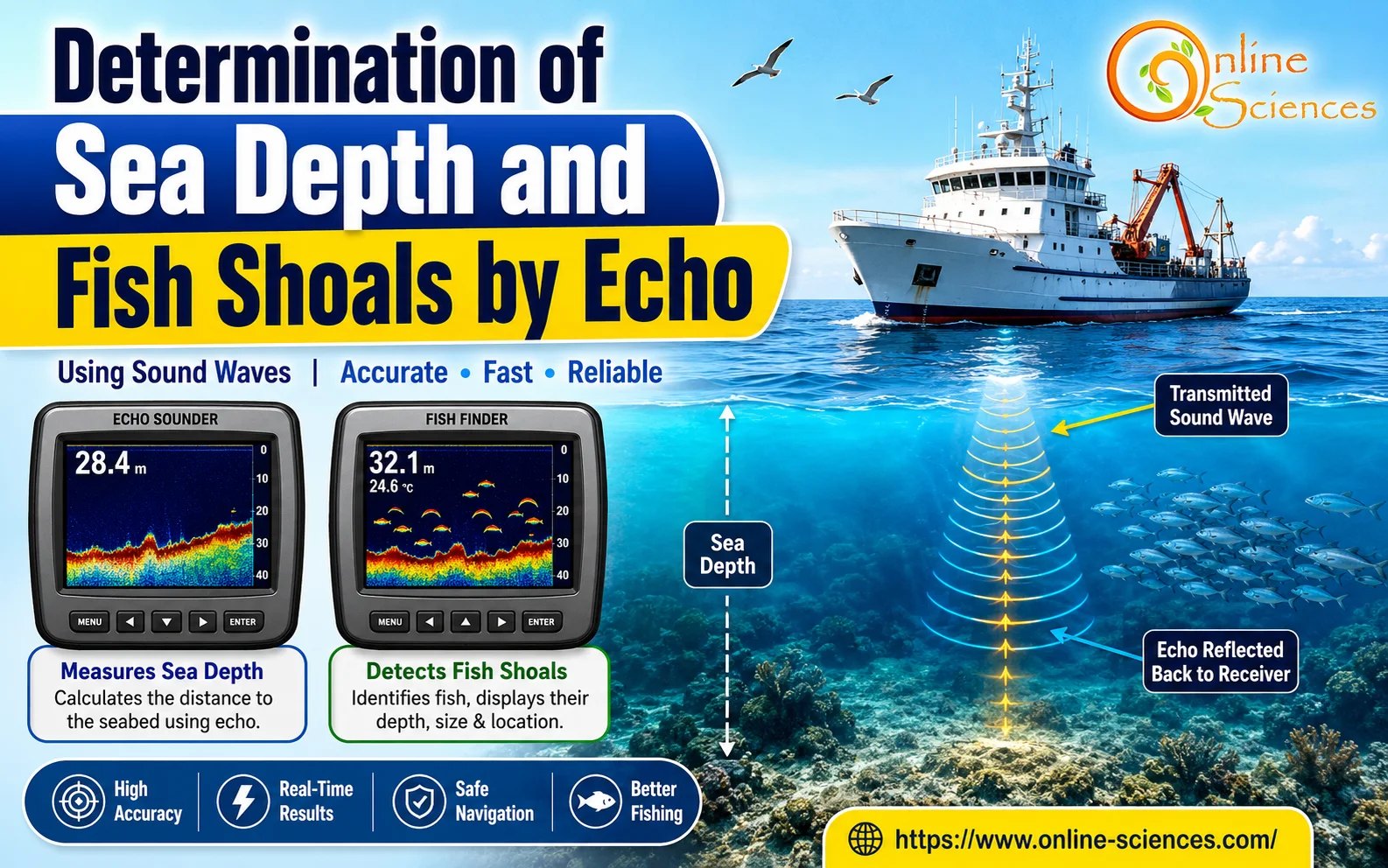
Determination of Sea Depth and Fish Shoals by Echo is a practical application of ultrasonic sound waves used in marine navigation and fishing. By transmitting sound pulses and measuring the time taken for the echoes to return from the seabed or fish shoals, echo sounding systems accurately calculate water depth and locate schools of fish, improving navigation safety, ocean exploration, and fishing efficiency.
What is the Determination of Sea Depth and Fish Shoals by Echo?
The determination of sea depth and fish shoals by echo is a technique that uses ultrasonic sound waves to measure the distance between a ship and the seabed or to locate schools of fish underwater.
A device called an echo sounder (or sonar system) sends ultrasonic pulses downward into the water. When these sound waves strike the seabed or a group of fish, they are reflected back as echoes. By measuring the time taken for the echo to return, the depth of the sea or the position of fish can be accurately calculated.
Principle of Echo Sounding
Echo sounding works based on the reflection of sound waves.
Steps
- The transmitter emits ultrasonic waves into the water.
- The sound waves travel through seawater.
- They hit the seabed or fish shoals.
- The waves reflect back to the receiver.
- The instrument measures the time between transmission and reception.
The depth is calculated using: Depth = (Speed of Sound × Time) ÷ 2
The division by two accounts for the sound traveling to the object and back.
Why are Ultrasonic Waves Used?
Ultrasonic waves are preferred because they:
- Have very high frequencies.
- Produce clear and sharp echoes.
- Travel efficiently through water.
- Can detect small underwater objects.
- Experience less interference than lower-frequency sounds.
The average speed of sound in seawater is approximately 1500 m/s.
Determination of Sea Depth
To determine sea depth:
- A ship sends an ultrasonic pulse downward.
- The pulse reaches the seabed.
- The reflected echo returns to the ship.
- The time delay is measured electronically.
- The depth is calculated instantly.
This method is much faster and more accurate than traditional weighted ropes.
Detection of Fish Shoals
Fish shoals reflect ultrasonic waves because their bodies and swim bladders have different acoustic properties than seawater.
Modern fish finders display:
- Depth of fish.
- Size of fish schools.
- Distance from the vessel.
- Approximate density of fish.
This information helps fishermen locate productive fishing areas efficiently.
Applications of Echo Sounding
- Measuring sea depth.
- Detecting fish shoals.
- Navigating ships safely.
- Mapping the ocean floor.
- Identifying underwater mountains and valleys.
- Locating submerged wrecks.
- Supporting marine scientific research.
- Offshore oil and gas exploration.
- Harbor and port surveys.
- Submarine navigation.
Advantages of Echo Sounding
- Fast and accurate.
- Safe for deep-water measurements.
- Works in darkness and poor weather.
- Covers large underwater areas.
- Reduces navigation risks.
- Saves time and fuel.
- Improves fishing efficiency.
- Provides real-time underwater data.
- Limitations of Echo Sounding.
- Accuracy may decrease in rough sea conditions.
- Air bubbles can interfere with sound transmission.
- Extremely soft seabeds may produce weaker echoes.
- Marine noise can reduce signal quality.
- Equipment requires regular calibration.
Importance of Echo Sounding
Echo sounding has transformed marine navigation and fishing by providing rapid and reliable underwater information. It helps prevent ships from running aground, assists fishermen in locating fish schools, and enables scientists to study the ocean floor with remarkable precision.
Sonar device
Sonar device
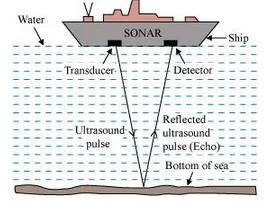
A sonar device is used on the ships to find the position of the seabed. It is used to detect sunken wrecks or submarines, and it is used to find shoals of fish. The sonar device sends out a sound and automatically calculates the distance of an object, and the submarines use the sonar to find objects under the water.
Ultrasonic waves of frequencies higher than 20000 Hz are used for estimating the depth of the seas and exploring the fish gathering in the seas. Two devices are fixed at the bottom of the ship, which are the sonar device that produces ultrasonic waves, and a hydrophone set that receives the reflected waves from the seabed or the fish shoals.
The time period ( t ) between sending and receiving the reflected waves ( echo time ) in seconds. If the velocity of ultrasonic waves through the water is ( V ) m /sec, then the depth of the sea or the location of fish shoals = ½ the velocity of ultrasonic waves ( V ) × echo time ( t ).
The sound pulse reflected from the sea is distinct and not spread out, while the sound pulse from the fish is more diffuse and spread out as it reflects from fish at different depths. Ultrasonic waves can be used by fishing boats to find the fish, as the shoal of fish between the boat and the seafloor will return the echo more quickly.
Difference Between Echo Sounding and Fish Finder
Although echo sounding and fish finders both use sonar technology and ultrasonic sound waves, they are designed for different purposes. An echo sounder is primarily used to measure the depth of water beneath a vessel. It sends ultrasonic pulses toward the seabed and calculates the water depth by measuring the time it takes for the echo to return. Echo sounders are widely used in marine navigation, hydrographic surveys, scientific research, and ensuring ships travel safely through shallow or unfamiliar waters.
A fish finder, on the other hand, is specifically designed to detect fish and underwater structures. While it also measures water depth, its main function is to identify fish shoals by interpreting the echoes reflected from fish and displaying their location, depth, and sometimes their approximate size on a screen. Fish finders are commonly used by commercial and recreational fishermen to locate productive fishing areas quickly. In summary, an echo sounder focuses on measuring the distance to the seabed, whereas a fish finder focuses on locating fish while also providing basic depth information.
FAQs about Determination of Sea Depth and Fish Shoals by Echo
1. What is the determination of sea depth and fish shoals by echo?
It is a method of using ultrasonic sound waves to measure ocean depth and locate schools of fish by analyzing reflected echoes.
2. Why are ultrasonic waves used instead of ordinary sound?
Ultrasonic waves produce stronger, clearer echoes and can accurately detect underwater objects.
3. What is the formula for calculating sea depth?
Depth = (Speed of Sound × Time) ÷ 2
4. What is the speed of sound in seawater?
The average speed of sound in seawater is about 1500 meters per second.
5. What is an echo sounder?
An echo sounder is an electronic instrument that emits ultrasonic waves and receives their echoes to determine underwater distances.
6. How do fish shoals reflect sound waves?
Fish bodies and swim bladders reflect ultrasonic waves, allowing sonar systems to detect their position.
7. Where is echo sounding used?
It is used in marine navigation, commercial fishing, oceanographic research, hydrographic surveys, offshore engineering, and submarine operations.
8. Is echo sounding accurate?
Yes. Modern digital sonar systems provide highly accurate measurements of both sea depth and fish locations.
Conclusion
The determination of sea depth and fish shoals by echo is an indispensable application of ultrasonic sound waves. By measuring the travel time of reflected sound waves, echo sounding provides precise information about underwater depth and fish locations. This technology enhances maritime safety, improves fishing productivity, supports scientific exploration, and plays a vital role in modern ocean navigation.
You can follow Science online on YouTube from this link: Science online
The effect of echo in locating the position of surfaces and barriers
The importance of ultrasonic waves in medical diagnosis
The advantages and disadvantages of ultrasonic waves in detecting industrial defects
The echo (the sound reflection) and conditions necessary for hearing the echo
The concentration of sound and importance of echo (sound reflection) in our life