Principles of living organisms classification and Taxonomic hierarchy
The cell is the building and functional unit of the living organism , Living organisms may be unicellular or multicellular , Although the similarity of all living organisms in their building and functional unit ( cell ) .
As well as in the features of life ( nutrition , excretion , respiration , reproduction , movement , sensation and growth ) , They differ in many other characteristics such as shape , structure , way of living , nutrition and reproduction .
No one knows how many several kinds of living organisms on earth’s surface , In spite of human success in describing and naming about 1.4 million kinds of these types till now , Biologists are thinking that this number is not representing more 10 % only of the living organisms on earth’s surface .
There are millions of insects , small animals and plants that live in oceans which are not yet discovered till now , Due to the enormous diversity in living organisms , the need for classification process appeared .
Classification
Classification is the arranging of living organisms in groups according to similarities and differences between each other to facilitate studying and identifying them , Taxonomy is the science that concerns with classification of living organisms in groups on scientific bases.
Importance of classification
- It facilitates identifying new organisms and adding them into their similar groups .
- It benefits many other fields of science .
The modern classification system depends on the definition of the species as a scientific and basic principle in classifying living organisms .
Principles of living organisms classification
The species
It is a group of individuals having similar morphological characteristics , mate with each other and produce fertile offspring similar to them .
There are individuals that do not give the term species because they are sterile ( infertile ) individuals, they are unable to mate and produce a new generation of the same kind, such as Tigon and Mute .
Tigon is produced from mating of female lion with a male tiger , Mule is produced from mating of a female horse with a male donkey .
Naming of living organisms
A need appeared among scientists to name living organisms with unified scientific names , where the same organism has many names that differ in various earth’s regions and environment and these names are known as common names .
To overcome this problem , The scientist Carolus Linnaeus developed a system for naming organisms and gave it the name of binomial nomenclature system .
Conditions of writing scientific names of living organisms
- Be written in Latin language .
- Be written in italic letters or underlined for distinguishing them from the others .
- Each living organism in binomial nomenclature is given a binomial name , The first represents the genus and begins with a capital letter , The second represents the species and begins with a small letter .
Example : The scientific name of the cat is Felis domesticus , where , Felis represents the genus of the cat , domesticus represents the species of the cat .
Taxonomic hierarchy
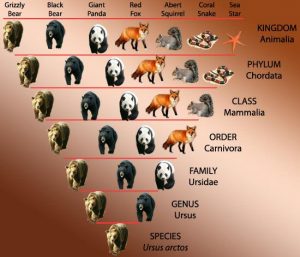
There are seven levels ( or groups ) for classifying living organisms , Each group comprises less numbers of organisms , that have more similar characteristics , than the group preceding it .
- Kingdom is the highest level in taxonomic hierarchy of living organisms and it includes a number of phyla such as Kingdom Animalia .
- Phylum includes a number of classes such as phylum Chordata .
- Class includes a number of orders such as Class Mammalia .
- Order includes a number of families such as Order Carnivora .
- Family includes a number of genera such as Family Felidae .
- Genus includes a number of species such as Genus Felis .
- Species includes an interbreeding population of organisms that can produce healthy offspring such as Species domesticus .
There are other groups that intermediate each two successive groups , such as sub-phylum and sun-class .
Dichotomous key
It is a series of descriptions ordered in pairs that lead to identify an unknown living organism, Scientists use it to help them in identifying the unknown living organisms .
Ways of its designing
- It starts with broad feature , then it gets more specified and more privacy whenever we go through the levels of dichotomous key .
- Through each step , you can choose one of the two descriptions according to the characteristics of the living organism .
- At the end , you will reach to a description leads you to the organism’s name or the group to which it belongs to .
An example : shows a bilateral dichotomous key for five species of insects .
Insects are wingless ( ants ) and winged , Winged insects contain one pair of wings and two pairs of wings .
One pair of wings → legs are shorter than the body ( Fly ) and legs are longer than the body ( Mosquito ) .
Two pairs of wings → Wings covered with bright scales ( Moth ) and Wings are transparent ( Dragonfly ) .
Modern classification of living organisms , Kingdom ( Monera and Protista )
Taxonomy, Species, Living organisms diversity & principles of their classification