
Taxonomy, species and types of living things, Can organisms belong to more than one species?
A species is a group of more similar living organisms of the same shape that can reproduce to give birth to new fertile individuals, which are able to reproduce and keep the existence of the species.
Species
The species is the basic classification unit for living organisms. Linnaeus used the species as a fundamental unit of the natural classification system; African, European, and Asian humans, whatever their colour, race, or home, also belong to one species (Human).
Taxonomy
The taxonomy is a branch of biology that searches for similarities and differences among living organisms, and it places similar ones in groups according to a certain system in order to ease their study.
Intercourse may happen between some of the coupled species, but the offspring produced is sterile.
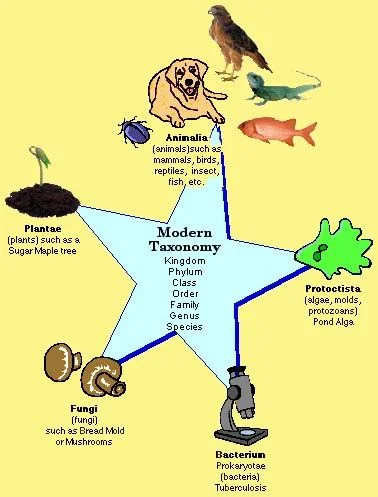
Taxonomy places similar living organisms in groups.
For example, when there is intercourse occurring between a donkey and a horse, the product offspring will be a sterile female called a “Mule”, The intercourse between a zebra, and a donkey produces a sterile female called “Zonkey”.
If you look at the dogs, the cats, and the rabbits, You will notice that although the cats differ from each other, they differ more than the rabbits, and the dogs, So it is impossible for the cats to mate with the rabbits.
Mating can take place among any couple of cats whatever the difference in shape or size, so, all the cats are placed in one species, while the rabbits are classified in another different species and so dogs.
FAQ about Taxonomy, Species, and Types of Living Things
1. What is taxonomy?
Taxonomy is the branch of biology that deals with the classification, naming, and identification of living organisms based on their characteristics and relationships.
2. Why is taxonomy important?
Taxonomy helps scientists:
- Organize living organisms into groups.
- Understand relationships between species.
- Identify new organisms.
- Study evolution and biodiversity.
3. Who is known as the father of taxonomy?
Carl Linnaeus is known as the father of taxonomy because he developed the system of naming organisms called binomial nomenclature.
4. What is binomial nomenclature?
It is the scientific naming system where each organism has two names:
- Genus (capitalized).
- Species (lowercase).
Example: Homo sapiens
5. What is a species?
A species is a group of organisms that can reproduce together and produce fertile offspring.
6. What are the main levels of classification in taxonomy?
The classification hierarchy includes:
- Kingdom.
- Phylum.
- Class.
- Order.
- Family.
- Genus.
- Species.
7. What are the types of living things?
Living organisms are classified into major groups called kingdoms, such as:
- Animals.
- Plants.
- Fungi.
- Protists.
- Bacteria.
8. What is the difference between plants and animals?
- Plants make their own food through photosynthesis.
- Animals depend on other organisms for food.
9. What are microorganisms?
Microorganisms are tiny living organisms that cannot be seen with the naked eye, such as bacteria and some fungi.
10. How are organisms classified?
- Organisms are classified based on:
- Structure (morphology).
- Genetic similarities.
- Mode of nutrition.
- Evolutionary relationships.
11. What is the five-kingdom classification system?
It is a system that divides living things into five kingdoms:
- Monera.
- Protista.
- Fungi.
- Plantae.
- Animalia.
12. What is biodiversity?
Biodiversity refers to the variety of living organisms on Earth, including different species, ecosystems, and genetic diversity.
13. What is the difference between classification and identification?
- Classification: Grouping organisms based on similarities.
- Identification: Recognizing and naming an organism.
14. What are vertebrates and invertebrates?
- Vertebrates: Animals with a backbone.
- Invertebrates: Animals without a backbone.
15. Can organisms belong to more than one species?
No, each organism belongs to only one species, but species can be closely related to others within the same genus.
You can subscribe to Science Online on YouTube from this link: Science Online
Taxonomy, Species, Living organisms diversity & principles of their classification
Modern classification of living organisms, Kingdom (Monera and Protista)
Principles of living organisms classification and Taxonomic hierarchy
Food relationships among living organisms (Predation, Symbiosis & Saprophytism)