
Network Routers importance, types and uses
The router allows computers to communicate over large distances. It is one of the most important components on the network, directing traffic across the network. Although it is not a replacement for firewall or anti-malware measures, it is the first step towards a largely secure network environment.
Network Routers
When you establish the computer network, you need to install several hardware and software components. The data is sent to the next network points in the form of packets, and the transfer of packets is carried through the routers. The routers perform the task of delivering & forwarding the information.
Routers are hardware devices that direct traffic across networks by using different routing table protocols. When the routers connect two or more networks & use logical addressing, this is called an Internet Address (IP). The routers use the Routing Table to make the path selections & to forward the packets to the remote networks.
When you connect the Internet modem directly to the PC, exposes that PC to a host of security issues. Expanding the direct-connection network becomes complicated without the addition of switches or a router, and communicating between the individual PCs becomes difficult.
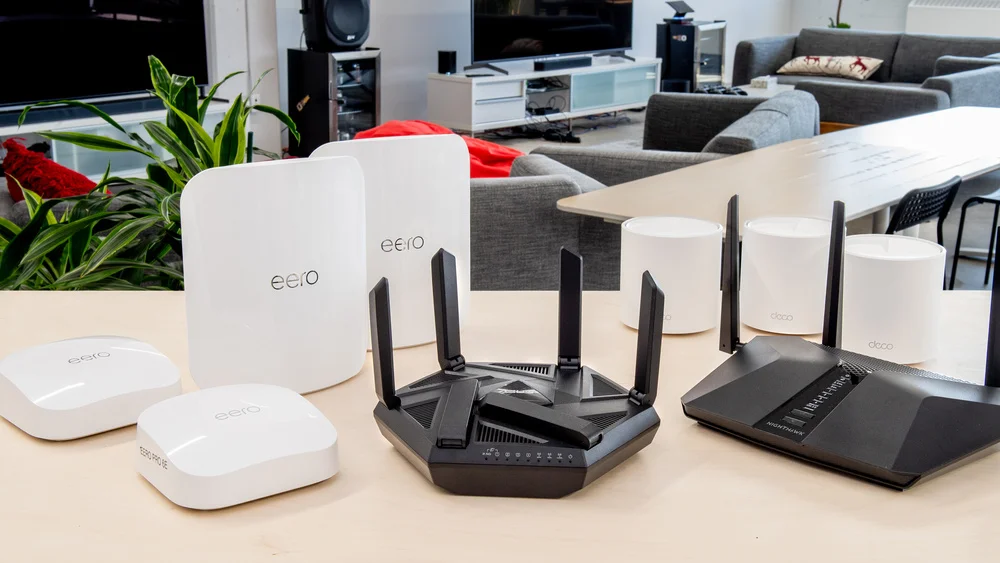
Routers
How routers work
The routers are network devices that transfer the data packets along the networks by determining the paths of the networks. They determine the path to many networks, such as Electronic networks, Transportation networks, and telephone networks. The routers operate in two ways, using either the control plane or the forwarding plane.
In the control plane, the router acts in a more neat & smart way. It can send the precise data packets to their specific location. While in the forwarding plane, the ultimate objective of the router is to deliver the data packets. The forwarding decision takes place at the data link layer of the OSI model.
Types of Routers
The routers can find the most efficient path between two IP-based networks. There are different types of routers, from small home routers connecting a few devices to the ISP, to the edge routers that maintain massive routing tables and connect dozens of networks.
Although the point-to-point wire connections provide an alternative, Many modern communications setups require the router to function best. The routers are of many kinds depending on the needs of the enterprises, the individuals, and the official use. The largest routers, such as Cisco CRS-1 and Juniper T-1600, are used to set up networks of large organizations & even of the ISPs.
The routers can be divided into three broad categories depending on the needs of the network. First of their kind is the internet connectivity routers. They are large multipurpose routers. These routers are used to exchange and carry information through the Border Gateway Protocol.
The internet connectivity routers are further divided into four sub-categories. These four sub-categories include the edge router, the subscriber edge router, the inter-provider border router, and the core router.
When the router is placed at the boundary of an ISP and when it communicates with the large autonomous router and external router, it is called an edge router. Working at the boundary of the subscriber’s network, this router helps to communicate between BGP speakers and ISPs’ AS.
When two border gateway protocols speaks to each other via ASes, It is called the inter provider border router, The router that provides sufficient support to the LAN by becoming the integral part of the LAN is called core router, If the router is inserted to make connection to the DSL or the other networks for the small geographical area, It is known as SOHO routers.
There are enterprise routers that have three branches of access. the distribution and core routers. Low-cost SOHO routers are placed at the branch offices for simple routing operations, and they are termed as the access routers.
Distribution routers can collect the flow of data from several routers, and they bring it to the main location. Distribution routers can increase the efficiency of large networks, such as a WAN. Core routers are used to connect the dispersed network routers to achieve high bandwidth.
Dual-band routers are a solution to signal interference. They provide the users with the ability to switch between frequencies of 2.4GHz and 5GHz to avoid congestion in traffic, due to the fact that many household devices give off 2.4GHz radio frequencies.
The interference can happen to the Wi-Fi signal, because the interference will slow down the speed of the Internet, reduce the range of Wi-Fi, and cause some intermittent signals. With the use of dual-band routers, you will be able to enjoy the less-utilized 5GHz frequency with ease.
Dual-band routers are compatible with wireless devices. They are built to function with many different wireless networking equipment, because they support both the 2.4GHz & 5GHz in which both should be able to work with any network adapter.
Dual-band routers enable the customization of wireless network settings. As an advanced networking technology on the market, dual-band routers can support multiple frequencies. They will provide the ability to customize the wireless network settings in accordance with your needs.
You can follow Science Online on YouTube from this link: Science online



The blog post is very useful and informative for all the people, this is a great way to explain the advantages of the routers, thank you for this blog post, because it is really helpful for us.
You are welcome