Safety skills , Applications of motion with uniform acceleration ( Free fall & Projectiles )
Safety skills
To avoid the dangers of exceeding prescribed speeds and to save souls , Traffic instructions should be followed such as leaving an appropriate distance between vehicles to allow the driver to stop safely in case of emergency , Obviously, More spacing between vehicles is required as Speed of cars gets higher , The road is wet or has oil stains , Trucks should leave larger spacing than small cars .
Free fall
If two objects of different masses ( a book and a sheet of paper ) are dropped at the same time from a high point , the two objects start motion from rest ( vi = 0 ) falling under the effect of two forces :
The gravitational pull ( their weights ) and the air resistance , Since collision of the object with air molecules affects the velocity of falling of light objects ( the paper sheet ) more than that of heavier objects ( the book ) , we find that the book reaches the ground first .
If the air resistance is neglected , The two objects fall under the effect of their weights only and acquire a uniform acceleration that acts to increase the speed of falling gradually till it reaches its maximum value when touching the ground , this acceleration is called acceleration due to gravity or free fall acceleration .
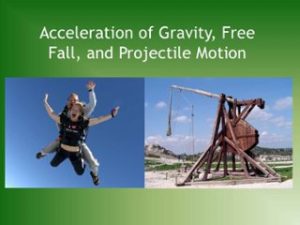
Free fall & Projectiles
Galileo proved that Falling objects of different masses , when neglecting air resistance reach the ground at the same time , He put an end for Aristotle’s idea that implied , ” Heavy objects would reach the ground in a shorter time than that taken by lighter objects ” , He proved this by dropping two objects of different masses down Tower of Pisa in Italy .
Free fall acceleration ( g )
It is the uniform acceleration by which objects move during free fall towards the ground , This acceleration varies slightly from one position to another depending on its distance from the Earth’s center , Its average value equals 9.8 m / s² and for simplicity , it can be considered 10 m / s² .
When free fall acceleration of an object = 9.8 m / s² , This means that the velocity of the object that falls freely increases by 9.8 m / s every second .
When an object falls freely downwards , The velocity of object increases gradually till it reaches its maximum value when reaching the ground , Its initial velocity vi = 0 .
g = Δ v / Δ t = ( vf − vi ) / ( t − 0 ) = vf / t
The free fall acceleration ( g ) is positive ( increasing velocity ) since the direction of object motion is in the same direction of Earth’s gravity .
When an object is projected vertically upwards , The velocity of object decreases gradually till it vanishes at the maximum height , Its final velocity vf = 0 .
g = Δ v / Δ t = ( vf − vi ) / ( t − 0 ) = − vi / t
The free fall acceleration ( g ) is negative ( decreasing velocity ) since the direction of object motion opposes the direction of Earth’s gravity .
Projectiles
Vertical projectiles
- When an object is projected vertically upwards , it starts at initial velocity ( vi ) which does not equal zero with uniform deceleration ( − 10 m / s² ) .
- Velocity of object decreases gradually as the object gets higher and reaches zero at maximum height .
- Direction of velocity changes when the object returns back to the ground under the effect of the Earth’s gravity that makes the object accelerate ( 10 m/s² ) .
- Velocity of the object when projected up = − Its velocity at the same point on falling .
- Time of rising = Time of falling .
Projectiles projected at angle ( Motion in two dimensions )
When a ball is projected upwards at an angle ( θ ) to the horizontal , It moves in a curved path , we can resolve velocity in two dimensions , Horizontal ( x ) and vertical ( y ) as shown :
In the horizontal dimension ( x ) , The ball velocity is uniform ( vix ) ( neglecting any friction ) :
vix = vi cos θ
Substituting the value of ( vix ) in the three equations of motion where : ax = 0 , then : vfx = vix
In the vertical dimension ( y ) , The ball moves at the acceleration due to gravity , Consequently , velocity varies , the initial velocity in the vertical dimension ( viy ) is found by the relation :
viy = vi sin θ
Substituting the value of ( viy ) in the three equations of motion by considering ( ay = − 10 m / s² ) .
The velocity of the projectile at any instant is given by Pythagoras’ relation :
(vf )² = (vfx )² + (vfy)²
Finding the time of reaching the maximum height ( t ) :
Substituting by vfy = 0 in the first equation of motion , we find :
0 = viy + g t , t = − viy / g
Time taken till returning back to the plane of projection ( flight time ) :
T = 2 t = ( − 2 viy ) / g
Finding the maximum height reached by the projectile ( h ) :
Substituting by vfy = 0 in the third equation of motion , we find :
2 g h = − ( viy )² , h = − ( viy )² / 2 g
Finding the horizontal range ( the horizontal distance reached by the projectile ) ( R ) :
Time of the maximum horizontal range = Flight time = T
Substituting by ( ax = 0 ) and ( d = R ) in the second equation of motion , we find :
R = vix T = 2 vix t = ( − 2 vix viy ) / g
The projectile reaches maximum horizontal range when it is projected at an angle 45° , The horizontal range is the same when the projectile at complementary angles ( Angles of sum 90° ) .
Guidelines to solve problems
Equations of motion are not applied in x – axis :
Because ax = 0 , vix = vfx , then : v = d / t ⇒ vx = R / T
Equations of motion are not applied in y – axis :
vf = vi + at ⇒ vfy = viy + gt
d = vi t + ½ a t² ⇒ h = viy t + ½ g t²
(vf )² = (vi )² + 2 a d ⇒ (vfy )² = (viy )² + 2 g h
(vi )² = (vix )² + (viy)²
(vf )² = (vfx )² + (vfy)² , d² = h² + R²
Acceleration types, units, importance & Graphic representation of moving in a straight line