
Factors affecting the friction between two solid objects, Why is friction useful?, How can friction be reduced?
Friction arises when two solid objects touch each other. When the friction force is larger than the movement force, the body does not move; when the friction force is smaller than the movement force, the body moves, and the direction of the friction force is opposite to the direction of the movement.
Friction between solids
Friction between solids is a fundamental concept in Physics that describes the force resisting motion when two solid surfaces come into contact. It arises due to the microscopic irregularities on the surfaces, which interlock and oppose movement. This force plays a crucial role in everyday life, allowing us to walk, write, and hold objects without slipping.
Despite sometimes being seen as a resistive force, friction is both useful and necessary. It helps in controlling motion, such as stopping vehicles and maintaining stability, but it can also lead to energy loss in the form of heat and cause wear and tear in machines. Understanding friction between solids is essential for improving efficiency in engineering systems and designing materials that either increase or reduce friction depending on the need.
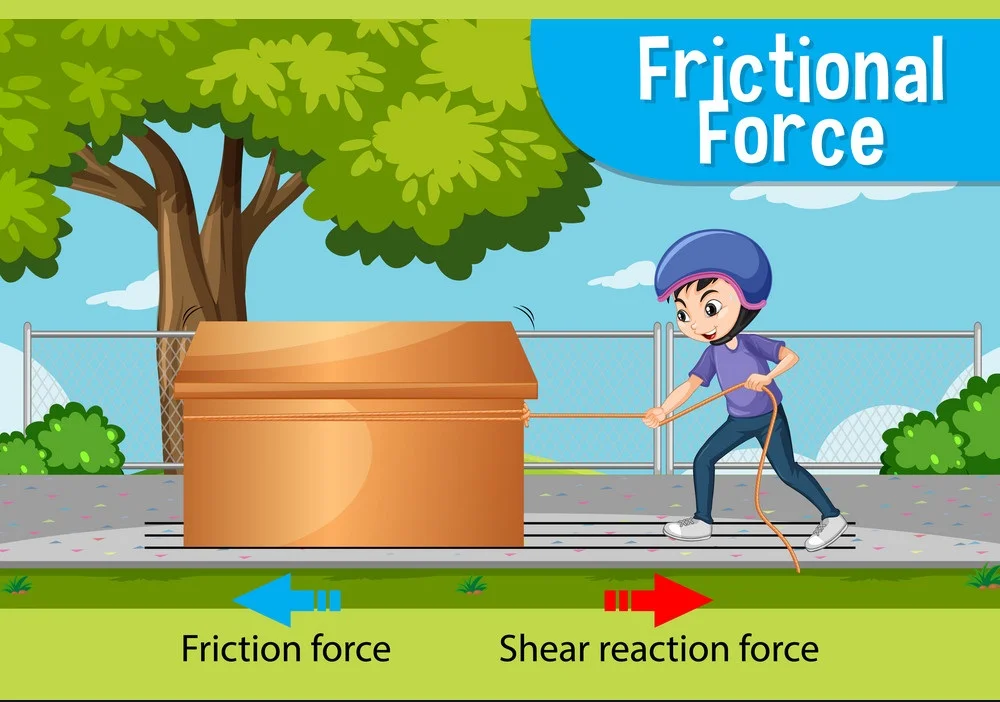
Factors affecting the friction between two solid objects
What are the factors affecting the friction between two solid objects?
The friction between two solid objects increases by increasing the speed and the surface area of the moving body. The friction between the solid objects increases between the rough surfaces.
Rubber tires
The water on the roads reduces the friction between the road and the car tires, so the drivers can not control the vehicle (the wheels). The car tires press the water under them, and the water is squeezed out when the car moves slowly on the wet roads.
When the car moves so fast, there is no time for the car tires to squeeze the water out, and the water is trapped under them, so the drivers can not control the car as the friction is reduced.
The water should be prevented from staying between the car tires and the road. So, the rubber tires are designed with narrow channels along their perimeter, and these channels are connected with curved grooves to squeeze the water out.
You must replace the car tires when their grooves disappear, as the grooves are necessary to squeeze the water out, where the water reduces the friction and makes the control of the car very hard.
FAQ: Factors Affecting Friction Between Two Solid Objects
1. What is friction?
Friction is a force that opposes the motion of one surface sliding over another.
2. What are the main factors affecting friction?
The two main factors are:
- Nature (type and roughness) of the surfaces.
- Force pressing the surfaces together (normal force).
3. How does surface roughness affect friction?
- Rough surfaces have more irregularities, which increase friction.
- Smooth surfaces have less friction because there are fewer irregularities.
4. How does the normal force affect friction?
The greater the force pressing two surfaces together, the greater the friction between them.
5. Does the type of material affect friction?
Yes, different materials have different friction levels. For example:
6. What is the coefficient of friction?
The coefficient of friction is a value that represents how much friction exists between two surfaces.
7. Does the area of contact affect friction?
In most cases, friction does not depend significantly on the contact area for solid objects, but it depends more on the nature of the surfaces and the normal force.
8. How do lubricants affect friction?
Lubricants (like oil or grease) reduce friction by forming a thin layer between surfaces, making them slide more easily.
9. What is the difference between static and kinetic friction?
- Static friction: Prevents motion from starting.
- Kinetic friction: Acts when objects are already moving.
10. Does temperature affect friction?
Yes, temperature can change surface properties: Higher temperatures may soften materials and increase friction. In some cases, it may reduce friction depending on the material.
11. Why is friction sometimes useful?
Friction is essential for:
- Walking without slipping.
- Driving vehicles.
- Writing on paper.
12. Why can friction be harmful?
Excessive friction can:
- Cause wear and tear.
- Produce heat.
- Reduce the efficiency of machines.
13. How can friction be increased?
Friction can be increased by:
- Making surfaces rougher.
- Increasing the normal force.
- Using high-friction materials.
14. How can friction be reduced?
Friction can be reduced by:
- Polishing surfaces.
- Using lubricants.
- Using wheels or ball bearings.
Friction between solid objects depends mainly on surface roughness and the force pressing them together, along with material type and external conditions like lubrication and temperature.
You can follow science online on YouTube from this link: Science online
The friction between the solid objects and the air
Advantage and disadvantage of friction and the ways to decrease friction
The factors affecting the friction between the solid objects and the water
Accompanied forces to motion, Forces of inertia, Friction forces and Biological forces




Nice answer
Thank you very much