Friction between solid objects and air, What factors affect air resistance?, Can friction be useful?
When a solid object moves in the air, a friction force arises between the object and the air. This type of friction is called air resistance, and it acts in the opposite direction of the body’s movement, so it resists its movement.
Air resistance
The object is falling through the air experience a type of friction called air resistance. As the surface area increases, the air resistance increases, and eventually the air resistance equals gravity.
The greatest velocity an object reaches is called the terminal velocity, and in a vacuum, all objects fall at the same rate.
The speed of the body and the surface area of the body are the factors affecting the air resistance, where the air resistance increases when the velocity and the surface area of the body increase, and vice versa.
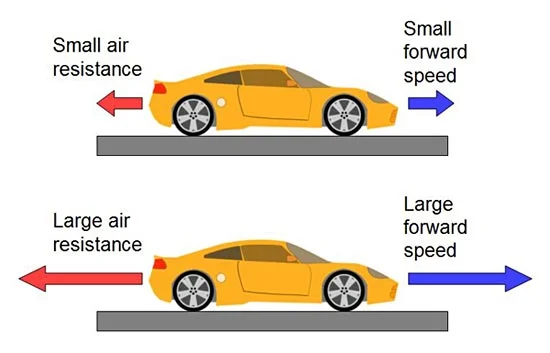
The effect of the air resistance on the car
Life application
The air resistance increases, by increasing the speed of the car or a bicycle, but to overcome this resistance, more energy is exerted, and more fuel is used. So, reduce the speed of the car to a certain limit to reduce the air resistance and the consumption of fuel.
When the air resistance affecting a moving car equals the force that results from the increase in the speed of the car, the car moves with a constant velocity.
The bodies of the birds have streamlined shapes to decrease the air resistance, and they stretch their wings on landing to increase the air resistance by increasing their surface area, which causes a decrease in their speed on landing.
The parachutist should open the parachute to land safely to increase the air resistance by increasing its surface area and accordingly, the falling speed decreases. The trains, rockets, and aircraft are designed in streamlined shapes to decrease air resistance.
FAQ about Friction Between Solid Objects and Air
1. What is friction between solid objects?
Friction between solid objects is the force that resists motion when two surfaces rub against each other. It depends on the roughness of the surfaces and how hard they are pressed together.
2. What is air friction (air resistance)?
Air friction, also called drag, is a force that opposes the motion of an object moving through air. It slows down objects like cars, planes, and falling bodies.
3. What is the difference between solid friction and air resistance?
- Solid friction: Occurs between two touching surfaces.
- Air resistance: Occurs between an object and air (a fluid).
- Solid friction is usually stronger, while air resistance increases with speed.
4. What factors affect friction between solid objects?
- Surface roughness.
- Force-pressing the surfaces together.
- Type of material.
5. What factors affect air resistance?
- Speed of the object.
- Surface area.
- Shape of the object.
- Density of the air.
6. Is air resistance a type of friction?
Yes, air resistance is a form of fluid friction. It acts in the opposite direction of motion.
7. How can friction between solid objects be reduced?
- Using lubricants (oil or grease).
- Polishing surfaces.
- Using wheels or ball bearings.
8. How can air resistance be reduced?
- Streamlining the shape (like airplanes and cars).
- Reducing surface area.
- Smoothing surfaces.
9. Can friction be useful?
Yes, friction is essential. It allows us to walk, write, and drive vehicles safely.
10. What are examples of air resistance in daily life?
- A parachute slows a skydiver.
- A car facing wind resistance.
- Leaves falling slowly from trees.
You can follow Science Online on YouTube from this link: Science online
The factors affecting the friction between the solid objects and the water
The factors affecting the friction between two solid objects
Advantage and disadvantage of friction and the ways to decrease friction
Accompanied forces of motion, Forces of inertia, Friction forces & Biological forces