Figure 03: The Best Inventions of 2025, Is the Figure 03 Robot Ready to Clean Your House?
Figure 03 is a humanoid robot developed by Figure AI, designed to perform general-purpose tasks in human environments. It represents the third major prototype in the company’s development roadmap, focusing on commercial-scale deployment, improved autonomy, and enhanced manipulation skills.
Figure 03 Robot
Figure 03 robot is a bipedal humanoid robot with human-like height, proportions, and motion capabilities. It is built to work safely in factories, warehouses, retail, and service industries. It uses advanced AI models, computer vision, and reinforcement learning for autonomous decision-making.
Figure 03 robot is designed for physical dexterity, enabling tasks like picking, sorting, carrying, machine operation, and tool use. It envisions long-term use as a general-purpose robotic worker capable of learning new tasks via demonstration and simulation. It has an extremely advanced sensing, safety-oriented design, scalable manufacturing, a powerful AI brain (Helix), and a clear vision for both home and commercial use.
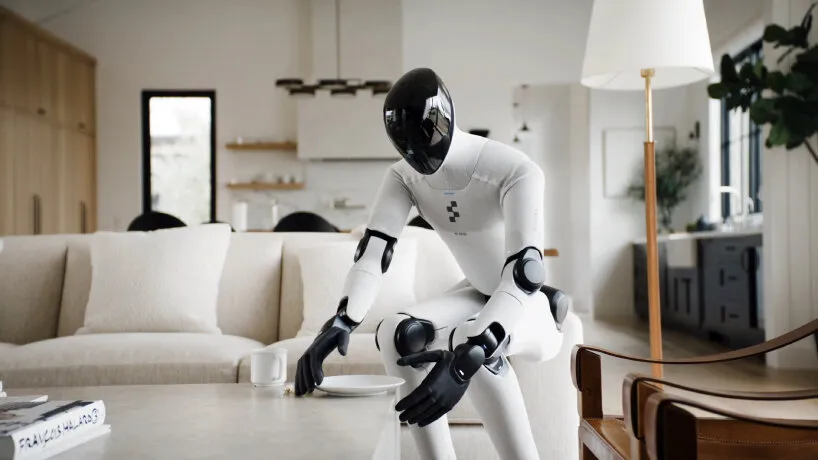
Figure 03 Robot
Features of Figure 03
- Helix AI (Vision-Language-Action): Figure 03 is built around the Figure’s proprietary AI model called Helix, which integrates vision, language, and action. This enables the robot to interpret visual input, understand verbal commands, and decide appropriate physical actions.
- Upgraded Vision System: New camera architecture with double the frame rate, 1/4 the latency, and 60% wider field of view compared to the previous generation. It has an expanded depth of field for more stable perception, especially in cluttered spaces. Palm cameras: Each hand has a camera embedded in the palm for close-range visual feedback during grasping.
- High-Precision Tactile Sensing: Fingertips can detect very light pressure, as low as 3 grams. This helps the robot distinguish between a secure grip and an object slipping.
- Redesigned Hands: More compliant and dexterous, with better surface area on fingertips for irregular object shapes. The combined vision + touch allows for more stable, adaptive manipulation.
- Safe, Human-Friendly Exterior: Figure 03 Robot is covered in soft textiles and multi-density foam instead of rigid metal, reducing the risk of injury. These soft coverings are washable and removable without tools. Modular design: Can be dressed/customized (e.g., more durable or cut-resistant clothes).
- Reduced Size and Weight: About 9% lighter and more compact than Figure 02, making it more maneuverable in home environments. Weight is around 61 kg.
- Improved Audio & Communication: Upgraded speaker (twice the size & ~4× louder than previous version) for better speech. The microphone was repositioned for clearer speech recognition/voice interaction.
- Power & Autonomy: Runtime: ~5 hours per charge. Wireless inductive charging: Coils in the feet let it dock on a pad and charge at 2 kW. Multi-layer battery protection (cell, pack, BMS), certified to UN38.3 for safety.
- High-Speed Data Offload: Figure 03 Robot supports 10 Gbps mmWave data offload, so it can upload large amounts of sensor data to improve Helix. This enables continuous learning and fleet-wide improvement.
- Mass-Manufacturability: Ground-up redesign for high-volume production, using die-casting, injection molding, and stamping. Produced in a facility called BotQ for scale.
- Mobility & Performance: Speed: can move at up to 1.2 m/s. Payload capacity: ~20 kg.
What can the Figure 03 Robot do?
- Household Chores: Figure 03 can fold laundry. It can load and unload a dishwasher. It can clear clutter in kitchens or other rooms. It can reach into cabinets or tight spaces thanks to its improved vision and palm-cameras.
- Manipulate Delicate or Irregular Objects: Its fingertip tactile sensors can detect forces as small as ~3 grams, so it can handle fragile or oddly shaped items carefully. The soft, compliant fingers + tactile feedback help prevent dropping or crushing items.
- Voice Interaction and Reasoning: Through its Helix AI, the robot can understand language commands (what you say) and tie them to actions. It has an upgraded speaker and mic to enable more natural, real-time speech-to-speech. It can “reason” — not just follow fixed scripts, but interpret and plan based on its understanding.
- Autonomous Charging and Data Management: Figure 03 can be wirelessly recharged by stepping onto a charging mat (inductive charging at 2 kW). It supports high-speed data offload (10 Gbps mmWave), so it can upload a lot of sensor/data back to Figure’s training systems to improve.
- Continuous Operation & Learning: Thanks to the wireless charging and data offload, it can operate for long periods and learn from its experiences, contributing to the fleet-wide AI training. It’s built for general-purpose use (not just factory): its design is meant for both home and commercial settings.
- Logistics / Commercial Tasks: In more industrial/commercial settings, it can do pick-and-place, material handling, assembly, or machine loading. Because it’s human-sized, it can work in environments made for humans (shelves, aisles, etc.).
- Safe Coexistence with Humans: Its body is covered in soft textiles and foam, reducing the risk of injury. Its design allows for “people-friendly” interaction in homes.
- Navigation & Movement: It has improved vision, which gives it a denser and more stable perceptual stream — important for navigating cluttered, human environments. It can walk and move with human-like mobility, enabling it to maneuver around a house or facility.
What It May Not Yet Fully Do
- While demos show it folding laundry, loading dishes, etc., human supervision might still be needed for more complex or unstructured tasks.
- It’s not yet a “butler that does everything” — its autonomy is improving, but highly unpredictable tasks (especially those requiring very fine manipulation or complex decision-making) are still a challenge.
- Large-scale “learning by watching” (i.e., learning a lot of new tasks just by observing) is part of its vision, but real-world generalization is still being proven.
Advantages of the Figure 03 Robot
Advanced Sensory & Manipulation:
- Very sensitive tactile sensors: their fingertips can detect very small forces (~3 grams).
- Palm cameras provide better vision for close-range manipulation.
- Combined vision + touch allows adaptive and precise grasping, reducing the risk of dropping or damaging delicate objects.
Safety & Human-Friendly Design:
- Soft textile and foam coverings make it safer to operate around humans and reduce hard-point injury risk.
- Lightweight and compact design (lighter than earlier versions) helps maneuver in domestic environments.
- Battery safety: multi-layer protection, certified for safety (e.g., UN38.3).
Autonomous Charging & Data:
- Figure 03 Robot supports wireless inductive charging: it can step onto a charging pad and recharge without external cables.
- High-speed data offload: can upload large amounts of data (sensor, vision) to improve fleet learning.
Scalable Manufacturing:
- Figure 03 Robot is designed for mass production: Figure AI is scaling via a factory (BotQ) to produce a large number of units.
- Use of cost-efficient manufacturing techniques (die-casting, injection molding) potentially lowers per-unit cost.
Strong AI Integration (Helix):
- Figure 03 Robot uses a “vision-language-action” AI architecture (Helix), which allows it to understand verbal commands, perceive the environment, and act intelligently.
- Figure 03 Robot can learn from human demonstrations (via VR or real-world video) to generalize tasks.
Versatility:
- Potential for both home tasks (cleaning, laundry, dishes) and commercial/industrial tasks (pick and place, logistics, manufacturing).
Flexible design allows for customization (e.g., different coverings, clothing) to adapt to various applications.
Natural Interaction:
- Improved audio system: more powerful speaker and better microphone placement make interactions more natural.
- Soft exterior + human-like form may make it more acceptable and safer in homes.
Disadvantages of Figure 03 Robot
- High Cost & Affordability: Likely to be very expensive, especially for general consumers; even with mass production, costs (R&D, hardware, AI) remain high. Users on forums speculate that only affluent households or companies might afford these robots initially.
- Speed & Efficiency: Movements are relatively slow and deliberate, likely for safety — may limit productivity in some use-cases. Not yet “generalized” in all environments: unstructured or highly variable home settings could challenge its current learning/generalization.
- Reliability & Robustness: Handling completely unpredictable objects or environments (e.g., liquids, pets, stairs) is still uncertain. Maintenance and repairs could be complex, given advanced sensors and actuators.
- Battery Life Limitations: Runtime is limited (~5 hours) before needing to recharge. Even with wireless charging, the need for frequent docking could interrupt long, continuous tasks or require infrastructure.
- Privacy & Data Concerns: As it collects a lot of visual and possibly personal data inside homes, there are privacy risks. Potential cybersecurity risks: if connected, the robot could be vulnerable to hacking. (General risk for smart robots.)
- Job Displacement & Ethical Issues: Widespread deployment could displace human jobs, especially in tasks involving manual labor. (A general risk of robotics.) Ethical concerns: responsibility, liability if the robot makes a mistake, and long-term social impact. Safety risk: though designed for safety, there is still risk if the AI “hallucinates” or misinterprets — given it’s a powerful, physical system.
- Unproven at Scale: While the design is for mass production, real-world large-scale deployment (especially in homes) is not yet proven. The real utility, reliability, and ROI (return on investment) for non-industrial users remain uncertain.
- Ethical and Regulatory Hurdles: Regulatory issues: using humanoid robots in domestic spaces raises new policy questions (safety standards, liability). Social acceptance: not everyone may feel comfortable with humanoid robots working in their home.
You can follow science online on YouTube from this link: Science online
Figure 02 robot review, advantages, disadvantages, features, and Is the Figure AI robot real?
Top trending topics on Emo robots and What can Emo do?
Fun facts about Emo robot pets and will your best friend be a robot?
Ameca robot review, features, advantages, disadvantages and What can Ameca Do?
Eilik Desktop Companion Robot structure, features, use, advantages and disadvantages
Humanoid robots use, types, risks, advantages, and disadvantages
Sophia robot review, features, use, advantages and disadvantages