
Properties of the formed images by convex lens and concave lens
The convex lens is a converging lens as it collects the refracted rays. The point of collection of the parallel rays (produced from the sun or any distant object) after being refracted from the convex lens is called the focus of the lens (F).
Convex lens
The distance between the focus of the lens and its optical center is called the focal length of the lens (f), The focal length (f) = ½ × radius of curvature (r).
We notice that the image formed by the convex lens can be received on the screen, as it is a real image formed as a result of the collection of the refracted rays.
The piece of paper can be burned by a convex lens because the convex lens can converge and direct the sunlight in a point (focus), which is burned.
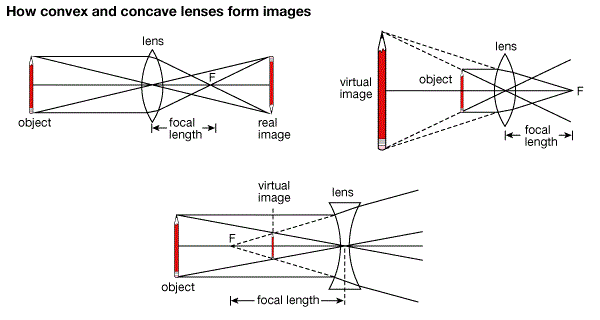
Properties of the formed images by the convex lens and the concave lens
If we have a thin lens and a thick lens, the thin lens has a greater focal length than the thick one because the radius of the thin lens is bigger than that of the thick lens.
The light rays after passing through the convex lens
The incident light ray that is parallel to the principal axis, It exists from the lens (or refracts) passing through the focus.
The incident light ray that passes through the focus, It exists from the lens parallel to the principal axis.
The incident light ray that passes through the optical center of the lens, it passes through the lens without refraction.
Cases of formation of images by the convex lens (converging lens)
When the position of the object is very far, the position of the image is at the focus, The formed image will be real and very tiny (dot).
When the position of the object is at a distance greater than the double (twice) of the focal length, (after the center of curvature), the position of the image is between the focus and the center of curvature. The formed image will be real, diminished (small), and inverted.
The position of the object is at the center of curvature (C) (at a distance equals the radius of curvature), The position of the image is at the center of curvature, The formed image will be real, inverted, and equal to the object.
When the position of the object is between the focus and the center of curvature (at a distance greater than the focal length but less than the radius of curvature, the position of the image is after the center of curvature, The formed image is real, inverted, and magnified.
When the position of the object is at the focus, no image is formed as the image is at infinity, where the rays penetrate as parallel.
When the position of the object is before the focus (at a distance less than the focal length), the position of the image is after the position of the object in the same side (in front of the lens), The formed image will be virtual, erect, and magnified.
Concave lens
If the convex lens is replaced by a concave lens, the formed image can not be received on the screen, because the incoming rays diverge after refraction.
When the position of the object is in front of the concave lens, the position of the image is before the object on the same side. The image formed by the concave lens is always virtual, erect, and small.
The concave lens is known as the diverging lens because it diverges the rays after they pass through it, The image formed by the concave lens is virtual because it can not be received on a screen.
FAQ about Properties of Images Formed by Convex and Concave Lenses
What are the properties of images formed by a convex lens?
A convex lens can form different types of images depending on the object’s distance from the lens:
- If the object is beyond the focal length, the image is real, inverted, and can be smaller or larger than the object.
- If the object is at the focal point, the image is formed at infinity and cannot be clearly seen on a screen.
- If the object is between the lens and the focal point, the image is virtual, upright, and magnified.
Is the image formed by a convex lens always real?
No, the image is real when the object is outside the focal length. The image is virtual when the object is placed between the lens and its focal point.
What are the properties of images formed by a concave lens?
A concave lens always forms an image that is:
- Virtual.
- Upright (erect),
- Diminished (smaller than the object).
- Formed on the same side of the lens as the object, between the lens and the focal point.
Can a concave lens form a real image?
No, A concave lens cannot form real images because it diverges light rays instead of converging them.
When does a convex lens form a magnified image?
A convex lens forms a magnified image when:
- The object is placed between the lens and the focal point (virtual, upright, magnified image).
- The object is placed between the focal point and the center of curvature (2F) (real, inverted, magnified image).
What is the difference between real and virtual images in lenses?
- Real image: Can be projected on a screen and is usually inverted.
- Virtual image: Cannot be projected on a screen and is upright.
Why is a convex lens used in reading glasses or for farsightedness?
Convex lenses are used to correct hyperopia (farsightedness) because they converge light rays and help focus the image correctly on the retina.
Why is a concave lens used in glasses for nearsightedness?
Concave lenses are used to correct myopia (nearsightedness) because they diverge light rays and move the image back onto the retina.
How do the image properties change as the object moves closer to a convex lens?
As the object moves closer to a convex lens, the magnification increases, and the image changes from real to virtual when the object moves inside the focal length.
Can a convex lens be used as a magnifying glass?
Yes, when the object is placed between the lens and the focal point, a convex lens acts as a magnifying glass, producing a virtual, upright, and magnified image.
You can follow Science Online on YouTube from this link: Science online
Lenses use, types, Convex lens, Concave lens, Vision defects, Contact lenses & Cataract
Uses of the concave mirror and the convex mirror in our daily life
The properties of the image formed by a plane mirror
The types and uses of lenses in our life
The uses of lenses to treat the vision defects
What are the spherical mirrors? & Some concepts related to spherical mirrors



Dear editor,
Thank you this article was needed.
You are welcome , Thank you very much for your comment
Thanks … its really helpful
You are welcome
Thank you for your comment
Nice website.It is useful to me.
Thank you very much
very helpful thank u
You are welcome
Thank u ..its very helpful
You are welcome
This was very helpful
Thank you for your comment
nice answers and point to point answers.liked the site and answers
it was well explained
Thank you for your comment
This article was really helpful .Just what I needed continue with the good work
Thank you very much for your comment