Factors affecting friction between solid objects and water, Water resistance importance
When any object moves through the water (such as the fish, the swimmer, the dolphin, and the ship), a friction force arises between this object and the water, which is called water resistance. Friction isn’t just something that happens between dry surfaces—it also plays a crucial role when objects move through water. From swimming and sailing to submarines and ships, understanding how friction works in liquids can explain why some objects move smoothly while others slow down quickly.
Water resistance
Water resistance, also known as drag force, is a type of fluid friction that occurs when an object moves through water. As the object pushes against the water, the water resists its motion, creating a force that slows it down. This resistance depends on how fast the object is moving and how the water flows around it. The faster the object moves, the greater the resistance it experiences.
Several factors influence water resistance, including the shape, size, and surface texture of the object. Streamlined shapes, like those of fish or submarines, allow water to flow smoothly around them, reducing resistance and enabling faster movement. In contrast, objects with rough surfaces or irregular shapes create more turbulence in the water, increasing drag. Additionally, a larger surface area in contact with water results in greater resistance.
Water resistance plays an important role in everyday life and engineering. Swimmers adjust their body positions to reduce drag and move more efficiently, while ship and boat designers create streamlined hulls to improve speed and fuel efficiency. Understanding water resistance also helps scientists and engineers design better underwater vehicles and sports equipment, making movement through water easier and more effective.
Water resistance
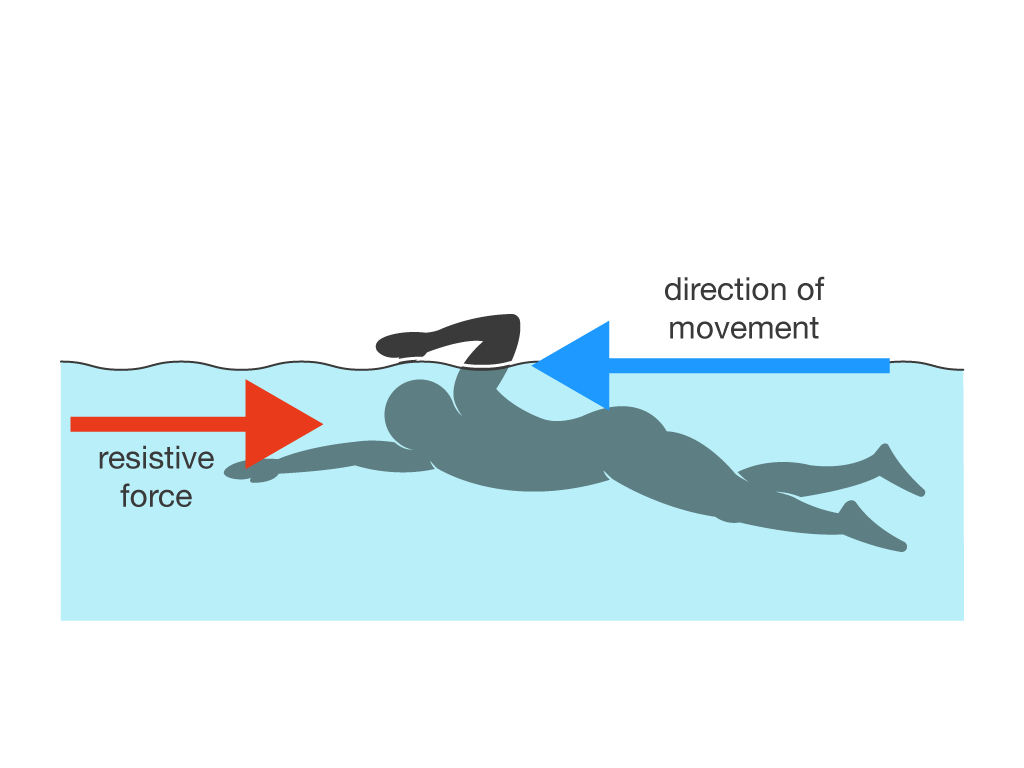
The direction of the water resistance is in the opposite direction of the movement, so, the movement of the fish, the dolphin, the swimmer, and the ship is in the opposite direction of the water resistance.
When you look at the fish, you will notice that the fish have streamlined shapes. The streamlined shapes are very important to decrease the water resistance, and also the ships are designed in streamlined shapes to decrease the water resistance ( in the sea, the oceans, and the rivers).
Water resistance importance
Water resistance is important because it directly affects how objects move through water. It acts as a force that slows down motion, helping to control speed and stability. For example, without water resistance, swimmers or boats would move uncontrollably fast, making movement difficult to manage. This resistance allows for smoother and safer motion in aquatic environments.
It also plays a key role in improving efficiency and performance. Swimmers, athletes, and engineers study water resistance to reduce drag and move more easily. By designing streamlined shapes—like those of fish, submarines, and ships—less energy is wasted overcoming resistance, which leads to faster speeds and lower fuel consumption.
In addition, water resistance is essential in science and engineering applications. It helps in designing better ships, underwater vehicles, and sports equipment. It also contributes to safety by preventing excessive speeds and helping objects maintain balance in water. Overall, understanding water resistance allows us to optimize movement, save energy, and improve technology used in aquatic environments.
Do you know the factors affecting the water-resistance?
The factors affecting water resistance are the speed of the body through the water and the surface area of the body.
The water resistance increases by increasing the speed of the body through the water, and vice versa. The water resistance increases, by increasing the surface area of the body that moves through the water, and vice versa.
FAQ about Factors Affecting Friction Between Solids and Water
1. What is the friction between solid objects and water?
It is a type of fluid friction (drag) that occurs when a solid object moves through water, resisting its motion.
2. What are the main factors affecting friction in water?
The main factors include:
- Speed of the object.
- Surface roughness.
- Shape of the object.
- Water viscosity.
- Surface area in contact with water.
3. How does speed affect friction in water?
As speed increases, friction (drag force) also increases, making it harder for the object to move.
4. What role does surface roughness play?
Rough surfaces create more resistance, increasing friction, while smooth surfaces reduce it.
5. How does the shape of an object affect friction?
Streamlined shapes (like fish or submarines) reduce friction, while irregular shapes increase resistance.
6. What is viscosity, and how does it affect friction?
Viscosity is the thickness of a liquid. Higher viscosity means more resistance and greater friction.
7. Does surface area affect friction in water?
Yes, a larger surface area in contact with water increases friction.
8. What are real-life examples of friction in water?
- Swimming.
- Boats moving in water.
- Submarines underwater.
- Fish swimming efficiently.
You can follow science online on YouTube from this link: Science online
Friction between solid objects and air
Factors affecting friction between two solid objects
Advantage and disadvantages of friction and ways to decrease friction
Accompanied forces to motion, Forces of inertia, Friction forces & Biological forces