Apple iPhone 16 vs. Apple iPhone 17: 15 Powerful Upgrades You Should Know Before Buying
Apple iPhone 16 vs. Apple iPhone 17 is one of the biggest smartphone comparisons for Apple users looking for the latest technology. While both devices share Apple’s premium build quality and software experience, the iPhone 17 introduces a smoother 120Hz LTPO display, the new Apple A19 processor, a brighter OLED panel, an improved ultrawide camera, a larger battery, Bluetooth 6.0, and several hardware refinements that make it a compelling upgrade.
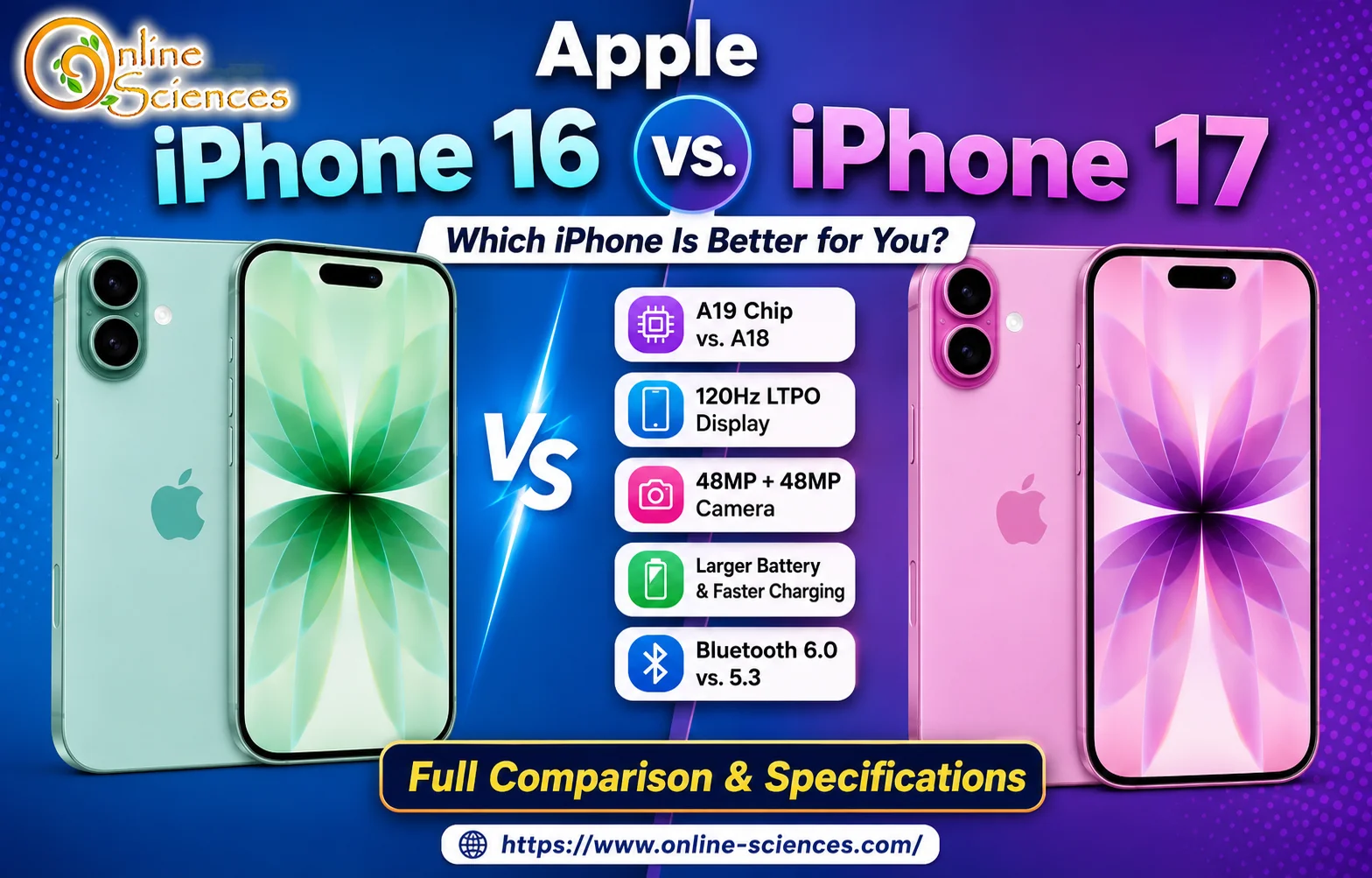
Apple iPhone 16 vs. Apple iPhone 17
Apple iPhone 16 vs. Apple iPhone 17 Design
Apple keeps its elegant aluminum frame and glass construction on both smartphones.
Apple iPhone 16
- 147.6 × 71.6 × 7.8 mm.
- 170 g.
- Ceramic Shield.
- Compact design.
- Five attractive colors.
Apple iPhone 17
- 149.6 × 71.5 × 8 mm.
- 177 g.
- Ceramic Shield 2.
- Anti-reflective coating.
- Larger display with thinner bezels.
Winner: Apple iPhone 17. Its stronger Ceramic Shield 2 and larger immersive screen provide a more premium experience.
Apple iPhone 16 vs. Apple iPhone 17 Display
The display is where the biggest improvements appear.
Apple iPhone 16
- 6.1-inch Super Retina XDR OLED.
- HDR10.
- Dolby Vision.
- 60Hz refresh rate.
- 2000 nits peak brightness.
Apple iPhone 17
- 6.3-inch LTPO Super Retina XDR OLED.
- Adaptive 120Hz refresh rate.
- HDR10.
- Dolby Vision.
- 3000 nits peak brightness.
- Anti-reflective coating.
Why the iPhone 17 Display is Better
- Much smoother scrolling.
- Better gaming experience.
- More responsive animations.
- Higher outdoor visibility.
- Improved battery efficiency through LTPO technology.
Winner: Apple iPhone 17
Apple iPhone 16 vs. Apple iPhone 17 Performance
Apple significantly upgraded the processor.
Apple iPhone 16
- Apple A18 (3nm).
- GeekBench: 7,929.
- AnTuTu: 1,721,149.
- 3DMark: 4,295.
Apple iPhone 17
- Apple A19 (3nm).
- GeekBench: 9,360.
- AnTuTu: 2,109,773.
- 3DMark: 4,803.
Performance Improvements
The Apple A19 offers approximately:
- 22% higher GeekBench score.
- 23% faster AnTuTu score.
- Better AI processing.
- Improved graphics rendering.
- Better thermal efficiency.
- Faster app launching.
- Improved multitasking.
- Gaming.
The A19 GPU delivers:
- Higher frame rates.
- Faster ray tracing.
- Better sustained performance.
- Lower power consumption.
Performance Winner: Apple iPhone 17
Apple iPhone 16 vs. Apple iPhone 17 Camera
Apple iPhone 16
Rear Cameras:
- 48 MP Wide.
- 12 MP Ultrawide.
Front Camera: 12 MP
Apple iPhone 17
Rear Cameras:
- 48 MP Wide.
- 48 MP Ultrawide.
Front Camera: 18 MP.
Camera Improvements
Apple iPhone 17 offers:
- Sharper ultrawide images.
- Better landscape photography.
- Higher-resolution selfies.
- Improved low-light performance.
- Better HDR processing.
- Enhanced video quality.
Both phones support:
- 4K recording.
- Dolby Vision HDR.
- Stereo audio recording.
- Sensor-shift stabilization.
Camera Winner: Apple iPhone 17
Apple iPhone 16 vs. Apple iPhone 17 Battery
Apple iPhone 16
- 3561 mAh.
- Active Use Score: 15:42 hours.
Apple iPhone 17
- 3692 mAh.
- Active Use Score: 14:59 hours.
Although the iPhone 17 has a larger battery and faster wired charging (PD3.2), its brighter 120Hz display increases power consumption, resulting in slightly shorter measured active-use time.
Both devices support:
- MagSafe.
- Qi2 wireless charging.
- Reverse wired charging.
Apple iPhone 16 vs. Apple iPhone 17 Connectivity
Apple iPhone 17 introduces several improvements.
Apple iPhone 17 Advantages
- Bluetooth 6.0.
- Improved GPS (L1 + L5).
- NavIC support.
- Updated satellite features.
- Faster wireless communication.
Apple iPhone 16 vs. Apple iPhone 17 Software
Both devices support the latest iOS updates.
- Apple iPhone 16 ships with iOS 18 and is upgradeable to iOS 26.5.
- Apple iPhone 17 ships with iOS 26 and is upgradeable to iOS 26.5.
Both phones should receive many years of software and security updates.
Apple iPhone 17 Features
The Apple iPhone 17 introduces several premium upgrades over its predecessor:
- 6.3-inch LTPO 120Hz OLED display.
- 3000 nits peak brightness.
- Apple A19 3nm processor.
- Ceramic Shield 2.
- Anti-reflective screen coating.
- 48 MP ultrawide camera.
- 18 MP selfie camera.
- Bluetooth 6.0.
- Larger battery.
- Faster PD3.2 charging.
- Improved graphics performance.
- Enhanced AI capabilities.
- Better outdoor visibility.
Apple iPhone 16 Pros and Cons
Apple iPhone 16 Pros
- Lower price.
- Excellent cameras.
- Powerful A18 processor.
- Lightweight design.
- Long software support.
- Excellent battery life.
Apple iPhone 16 Cons
- 60Hz display.
- Smaller screen.
- Older Bluetooth standard.
- Lower performance.
Apple iPhone 17 Pros and Cons
Apple iPhone 17 Pros
- 120Hz LTPO display.
- Apple A19 processor.
- Brighter OLED screen.
- Improved cameras.
- Better graphics.
- Bluetooth 6.0.
- Ceramic Shield 2.
- Better gaming experience.
Apple iPhone 17 Cons
- Higher price.
- Slightly heavier.
- No 128GB storage option.
Is the Apple iPhone 17 Worth Upgrading?
Upgrade to the Apple iPhone 17 if you want:
- A smoother 120Hz display.
- Faster gaming performance.
- Better multitasking.
- Higher-quality ultrawide photos.
- Improved selfies.
- Better outdoor visibility.
- Longer future-proofing.
Keep the Apple iPhone 16 if:
- You are satisfied with a 60Hz display.
- You want to save money.
- You already own an iPhone 16 and don’t need the latest hardware upgrades.
Final Verdict
The Apple iPhone 17 is clearly the superior smartphone. Its 120Hz LTPO display, Apple A19 processor, brighter OLED panel, upgraded cameras, Bluetooth 6.0, and improved durability deliver a noticeably more premium experience than the iPhone 16.
However, the Apple iPhone 16 remains an excellent value, offering flagship-level performance, strong battery life, and high-quality cameras at a lower price. For most new buyers seeking the best Apple experience, the iPhone 17 is the recommended choice, while budget-conscious users will still find the iPhone 16 an outstanding option.
Frequently Asked Questions (FAQ) about Apple iPhone 16 vs. Apple iPhone 17
1. Is the Apple iPhone 17 faster than the Apple iPhone 16?
Yes. The Apple A19 chipset delivers noticeably higher benchmark scores, faster graphics performance, and improved AI processing compared with the A18.
2. Does the Apple iPhone 17 have a 120Hz display?
Yes. The iPhone 17 features a 6.3-inch LTPO Super Retina XDR OLED display with an adaptive 120Hz refresh rate, while the iPhone 16 uses a 60Hz panel.
3. Which phone has the better camera?
The iPhone 17 offers a better camera system thanks to its upgraded 48 MP ultrawide camera and higher-resolution 18 MP front camera, providing sharper ultrawide shots and improved selfies.
4. Which phone has better battery life?
Although the iPhone 17 has a larger 3692 mAh battery, measured active-use tests give the iPhone 16 a slight edge due to its lower-power 60Hz display.
5. Is the Apple iPhone 17 worth buying?
Yes. If you want Apple’s latest hardware, a smoother display, stronger performance, a brighter screen, and improved cameras, the iPhone 17 is a worthwhile upgrade.
6. Does the Apple iPhone 17 support Wi-Fi 7?
Yes. Both the Apple iPhone 16 and Apple iPhone 17 support Wi-Fi 7, but the iPhone 17 adds Bluetooth 6.0 and enhanced positioning features.
7. Which phone offers better value for money?
The iPhone 16 provides better value for budget-conscious buyers, while the iPhone 17 delivers the best overall flagship experience with its premium upgrades.
Apple iPhone 16 vs. Apple iPhone 17 Specifications
The Apple iPhone 16 and Apple iPhone 17 share Apple’s premium design philosophy, including an aluminum frame, glass back, IP68 water and dust resistance, Face ID, USB-C connectivity, and long-term iOS support. However, the iPhone 17 introduces several notable hardware improvements, making it a more capable flagship. It features a larger 6.3-inch LTPO Super Retina XDR OLED display with ProMotion technology and an adaptive 120Hz refresh rate, while the iPhone 16 has a 6.1-inch Super Retina XDR OLED display limited to a 60Hz refresh rate. The newer display also reaches up to 3,000 nits of outdoor peak brightness and includes an anti-reflective coating for improved visibility.
Performance is another major upgrade. The Apple iPhone 16 is powered by the 3nm Apple A18 chipset, whereas the Apple iPhone 17 features the newer 3nm Apple A19 processor with higher CPU clock speeds and improved graphics performance. Benchmark results highlight the difference, with the iPhone 17 scoring around 2.1 million points in AnTuTu and approximately 9,360 in GeekBench, compared with roughly 1.72 million and 7,929 respectively for the iPhone 16. These improvements translate into faster app launches, smoother multitasking, and enhanced gaming performance.
The camera system also receives meaningful upgrades. Both smartphones include a 48 MP primary camera with sensor-shift optical image stabilization, but the iPhone 17 replaces the 12 MP ultrawide camera found on the iPhone 16 with a new 48 MP ultrawide sensor, capturing sharper landscape and macro images with improved detail. The front-facing camera also jumps from 12 MP to 18 MP, offering clearer selfies and better-quality video calls. Both devices support 4K Dolby Vision video recording, HDR, stereo audio recording, and advanced computational photography features.
Storage options differ as well. The iPhone 16 is available in 128GB, 256GB, and 512GB variants with 8GB of RAM, while the iPhone 17 starts at 256GB and is offered in 256GB and 512GB configurations, also paired with 8GB of RAM. This higher base storage makes the iPhone 17 more suitable for users who frequently capture high-resolution photos and videos or install large applications.
Battery capacity has increased from 3,561 mAh on the iPhone 16 to 3,692 mAh on the iPhone 17. The newer model also supports PD3.2 wired charging, compared with PD2.0 on the iPhone 16, while both devices offer 25W MagSafe and Qi2 wireless charging along with reverse wired charging. Despite its larger battery, the iPhone 17’s brighter 120Hz display can offset some of the endurance gains during intensive use.
Connectivity improvements include Bluetooth 6.0 on the iPhone 17 instead of Bluetooth 5.3 on the iPhone 16, along with enhanced GPS supporting both L1 and L5 frequencies and NavIC compatibility. Both models feature Wi-Fi 7, NFC, USB Type-C, second-generation Ultra Wideband, satellite emergency services, and Apple’s latest wireless technologies for faster and more reliable connections.
Overall, the Apple iPhone 17 builds upon the strengths of the iPhone 16 with a larger and smoother display, a faster A19 chipset, upgraded cameras, improved wireless connectivity, stronger Ceramic Shield 2 protection, and a larger battery. While the iPhone 16 remains an excellent flagship offering impressive performance and value, the iPhone 17 delivers a more premium experience that is especially attractive for gamers, content creators, photographers, and users seeking the latest Apple innovations.
You can follow Science online on YouTube from this link: Science online