Newton’s Second Law of motion, Newton’s Third Law, Factors that affect the acting force & the acceleration
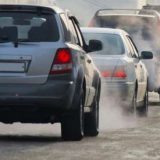
It is preferable to use air bags in the cars to protect the driver during accident , The colliding of a large truck with wall is more destructive than the colliding of a small truck because the acting force increases by the mass , Colliding car with a wall is a more destructive than colliding than colliding haystack .
If a person falls in water , he will not be harmed , while if he falls on the ground , he will be harmed , The severity of injury increases by increasing the height of falling because the change in velocity ( momentum ) , An egg will not break if it falls on a pillow , while it will break if it falls on the ground .
Newton’s Second Law of motion
Newton’s Second Law of motion
There are two forms of Newton’s Second Law :
The resultant force affecting an object equals to the rate of change in the object’s momentum ( motion amount ) .
F = Δ p / Δ t = Δ m v / Δ t = ( Δ m vf − Δ m vi ) / Δ t
F = m ( vf − vi ) /Δ t = m ( Δ v / Δ t ) = m a
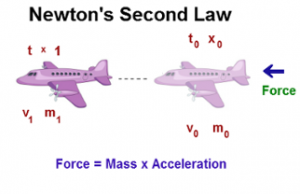
F = m a → a = F / m
From Newton’s Second Law : The change in momentum depends on the time of this change and the acting force :
Δ m v = F Δ t
The other form of Newton’s Second Law of motion :
When a resultant force affects an object , The object acquires an acceleration that is directly proportional to the resultant force and it is inversely proportional to the object mass .
Explanation of Newton’s Second Law :
When a resultant force acts on a car during an interval of time , its velocity increases and acquires an acceleration .
If two cars of equal masses are affected by two forces 20 N and 5 N , the acceleration of the first car motion will be greater than the acceleration of the second car motion .
Acceleration is directly proportional to the resultant force acting on the object at constant mass ( a ∝ F ) .
If two cars are affected by equal forces but the mass of the first car is greater than the mass of the second car , the acceleration of the first car motion will be less than the acceleration of the second car motion .
Acceleration is inversely proportional to the object mass at constant force ( a ∝ 1 / m ) .
The mathematical formula that expresses Newton’s Second Law :
a = ∑ F / m or ∑ F = m a
The force ( F ) is a vector quantity since it is the product of a scalar quantity ( mass ) and a vector quantity ( acceleration ) .
The unit of measuring force is kg.m/s² which is equivalent to the Newton ( N ) and its dimensions are MLT−2 .
The Newton : It is the force that when acts on an object of mass 1 kg accelerates it at 1 m/s² in the same direction .
When the resultant force acts on a body = 20 N , It means that it is the product of the mass of the body and its acceleration = 20 kg.m/s² .
Factors that affect the acting force :
- Mass : The acting force increases by increasing the mass of the object .
- Change in velocity : The acting force increases by increasing the change in velocity .
- The time of impact : The acting force decreases by increasing the time of impact .
F = m Δ v / Δ t
If the change in momentum occurs in short time interval , the effect of impact will be larger , If the change in momentum occurs in long time interval , the effect of impact will be smaller .
Factors that affect the acceleration :
The resultant force : The acceleration is directly proportional to the resultant force acting on the constant mass , Slope = a / F = 1 / m .
The object mass : The acceleration is inversely proportional to the object mass at constant resultant force , Slope = m a = F .
Guidelines to solve problems
Use the law , F = m a
If we compare between two resultant forces which affect on two different objects , they move with uniform acceleration : F1 ÷ F2 = ( m1 a1 ÷ m2 a2 ) .
If the object mass decreases to half and the acquired acceleration increases to double , the resultant force remains unchanged .
F1 = m1 a1 , F2 = m2 a2 , m2 = ½ m2 , a2 = 2 m1
F2 = ½ m1 × 2 a1 = m1 a1
∴ F1 = F2
If the object mass decreases to half and the resultant force increases to double , the acquired acceleration increases to four times .
a1 = F1 / m 1 , a2 = F2 / m 2 , m2 = ½ m 1 , F2 = 2 F1
a2 = ( 2 F1 ÷ ½ m 1) = 4 ( F1 ÷ m 1 )
∴ a2 = 4 a1
If there is a friction force ( Ffriction ) between the surface and the body , the body moves due to acting force ( Facting ) :
Fmoving = ∑ F = Facting + ( − Ffriction )
Negative sign indicates that friction force acts in opposite direction .
In case of more than one force acts on the body , then
∑ F = Fmoving = F1 + F2 + F3 + …… , where the forces acting in opposite direction such as friction force take negative sign .
Newton’s Third Law
When the object acts on another object by a force , the second object reacts with an equal force on the first object in a direction opposite to that of the action or for every action there is a reaction equal in the magnitude and opposite in the direction .
Explanation of Newton’s Third Law :
This law is related to two mutual forces between two different bodies , If we considered the first force as an action , the second force is considered as a reaction in the opposite direction .
The mathematical formula that expresses the law : F1 = − F2 , ( The negative sign indicates that the two forces act in opposite direction ) .
Action and reaction are paired , Originate and vanish together , This means that no single force can exist in the universe , Although they are equal , It is not a must that action and reaction are equilibrium since they act on different bodies , Action and reaction are of the same type , if the reaction is a gravitational force , reaction is a gravitational force , as well .
Applications of Newton’s Third Law
Launching a rocket is based on Newton’s Third Law of motion , A huge amount of burning gases rush down the rocket to generate a reaction pushing the rocket upwards , When a bullet is fired ( action ) , the rifle recoils backwards ( reaction ) , because of this a soldier should mount the rifle back firmly to his shoulder .
When a man jumps from a boat to the reef ( action ) , the boat shifts backwards ( reaction ) , When a person setting on a moving chair , pushes the wall ( action ) , the chair moves backwards ( reaction ) , When blowing a balloon and leaving it free , the trapped air pushes out the open end , causing the balloon to move forward .
Laws of Circular motion & Types of centripetal force
Fundamental Forces in nature, Gravitational forces, Electromagnetic forces & Nuclear forces
Acceleration types, units, importance & Graphic representation of moving in a straight line