Factors that affect work and Effect of the angle between force and displacement on work
The meaning of work in physics is different from that used in everyday life, Work does not mean that a tough task is done. In physics, there are two conditions for work to be done, which are the acting force and the displacement in the direction of the force.
Work
Work can be illustrated by the following two examples:
The player who lifts weights does work because the force acting on the weights moves them upwards through a distance in the direction of the force.
The person who pushes the wall does no work because the force acting on the wall fails to move it, and the wall remains motionless.
So, when a force acts on an object to move it through a certain displacement in the direction of the force, it is said that the force does work.
Work done (W) is determined by the relation: W = F . d, where (F) is the acting force and (d) is the displacement of the object along the line of the force action.
If the direction of the force (F) is inclined at an angle (θ) to the direction of displacement (d), so, W = F d cos θ.
The unit of measuring work is kg.m²/s², which is equivalent to N · m or Joule (J). The dimensions of work are ML²T−2.
Factors that affect work & Effect of the angle between force & displacement on work
Thus, work and its unit Joule are defined as follows:
Work: It is the dot product of the acting force (F) and the displacement (d) in the direction of the force.
The Joule: It is the work done by a force of one Newton to move an object through a displacement of one meter in the direction of the force.
When a person does work of 200 J on an object, it means that when this person acts on the object by a force of 200 N, the object is displaced through 1 m along the line of the force action.
Although both force and displacement are vector quantities, work is a scalar quantity because work is the dot product of the force and the displacement.
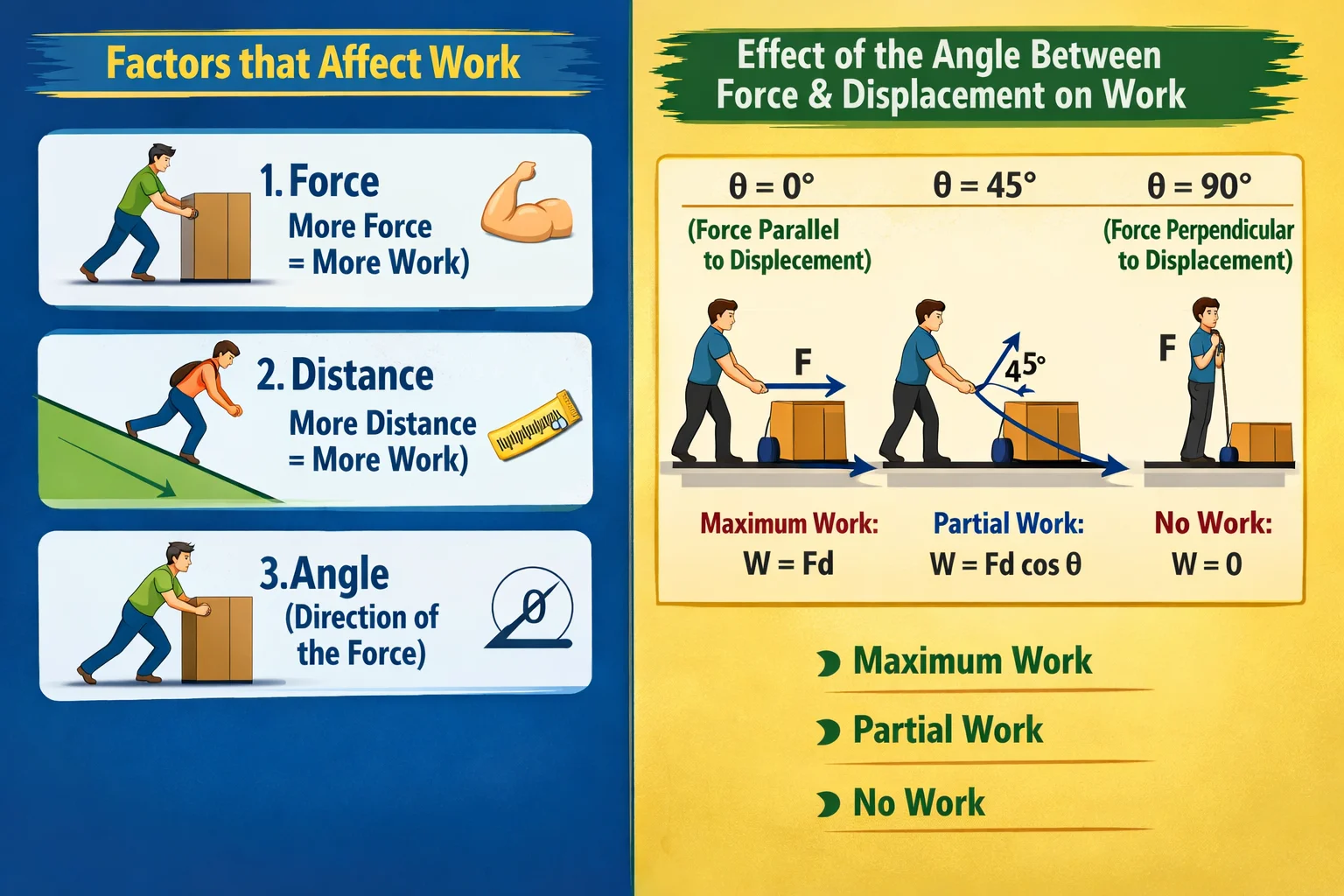
Factors that affect work
The acting force on the body: Work is directly proportional to the acting force at constant displacement and constant angle between force and displacement.
Slope = W / F = d cos θ
The displacement of the body: Work is directly proportional to the displacement at constant force and constant angle between force and displacement.
Slope = W / d = F cos θ
W = F d cos θ
The angle between the force and displacement: Work is directly proportional to the cosine of the angle between the force and the displacement at constant force and constant displacement.
Slope = W / cos θ = F d
The effect of the angle between force and displacement on work
When the angle between the force and displacement = zero, the work done is maximum when the direction of force is the same as the direction of displacement, such as a person pulling an object through a certain distance.
W = F d cos 0° = F d
When θ =90°, the work done is zero when the direction of force is perpendicular to the direction of displacement, W = F d cos 90° = 0.
Example: A person moves horizontally while carrying an object, where the horizontal displacement of the object is perpendicular to the direction of pulling.
When 0 ≤ θ < 90°, Work done is positive, the person does work on the object, W = F d cos θ = + ve value.
Example: A person pulling an object.
When 180° ≤ θ < 90°, Work done is negative, The object does work on the person, W = F d cos θ = − ve value.
Example: A person pulling an object while moving opposite to the direction of the force.
When θ =180°, Work done is negative, The direction of force is opposite to the direction of displacement, W = F d cos 180 = − F d.
Example: The work done by the force of the car brakes, the work done by the frictional forces.
Work done when pushing an object forward is greater than when dragging it behind, because: On pushing, the force component (F sin θ) acts in the direction of the object’s weight (w), which increases friction. More work is required to move the object.
On dragging, the force component (F sin θ) acts opposite to the direction of the object’s weight (w), which decreases friction. Less work is required to move the object.
Finding work done graphically
Work done can be found graphically by using the (force – displacement) graph. If a constant force (F) acted on a body and displaced it through a displacement (d) in the direction of the force, then θ = 0.
When representing the relation (force versus displacement) graphically, we get a straight line parallel to the displacement axis.
Work = Force × Displacement
Work (graphically) = Length × Width
Work = The area below the (force – displacement curve.
James Joule (1818 – 1889): An English scientist who was the first to realize that work generates heat. In one of his experiments, he found that water temperature at the bottom of a waterfall is higher than that at the top, concluding that a part of water energy is converted into heat.
FAQ About Factors that Affect Work
1) What is work in physics?
Work is done when a force causes an object to move in the direction of the force.
It is calculated using the formula: W = F × d × cosθ, Where:
- W = Work
- F = Force
- d = Displacement
- θ = Angle between force and displacement
2) What are the main factors that affect work?
There are three main factors:
- Force (F) – A greater force produces more work (if displacement is constant).
- Displacement (d) – Greater distance moved produces more work (if force is constant).
- Angle (θ) – The direction of force relative to displacement affects the amount of work done.
3) How does force affect work?
Work is directly proportional to force. If force doubles (and distance stays the same), work also doubles.
4) How does displacement affect work?
Work is directly proportional to displacement. If distance increases, work increases (if force remains constant).
5) Does mass affect work?
Mass does not directly appear in the formula, but it can affect the required force (according to Newton’s Second Law).
FAQ About the Effect of the Angle Between Force and Displacement
6) Why does the angle between force and displacement matter?
Only the component of the force in the direction of motion does work. That is why we use cos θ in the formula.
7) What happens when θ = 0°?
When force is parallel to displacement: cos 0° = 1, Work is maximum. Formula becomes: W = F × d
8) What happens when θ = 90°?
When force is perpendicular to displacement: cos 90° = 0, Work = 0, No work is done. Example: Carrying a bag horizontally — the upward force does no work on the horizontal motion.
9) What happens when 0° < θ < 90°?
Work is partial (positive work). Example: Pulling a box with a rope at an angle.
10) What happens when θ = 180°?
cos 180° = –1, Work is negative. This happens when a force acts opposite to displacement (like friction).
11) What is positive and negative work?
- Positive Work: Force helps motion (θ < 90°).
- Negative Work: Force opposes motion (θ > 90°).
- Zero Work: Force is perpendicular to motion (θ = 90°).
12) Why is work zero even if a force is applied?
If there is no displacement, or if the force is perpendicular to the motion, then no work is done.
Example:
- Pushing a wall that doesn’t move.
- Carrying a bag while walking horizontally.
You can subscribe to Science Online on YouTube from this link: Science Online
Newton’s Second Law of Motion, Factors that affect the acting force and the acceleration
Force, Newton’s First Law of Motion, Inertia and Factors that Affect the momentum