Types of solar eclipses and safety precautions on observing the solar eclipse
Solar eclipse
The type of solar eclipse changes according to the distance between the Moon and the Earth during its rotation in its oval-shaped orbit around the Earth.
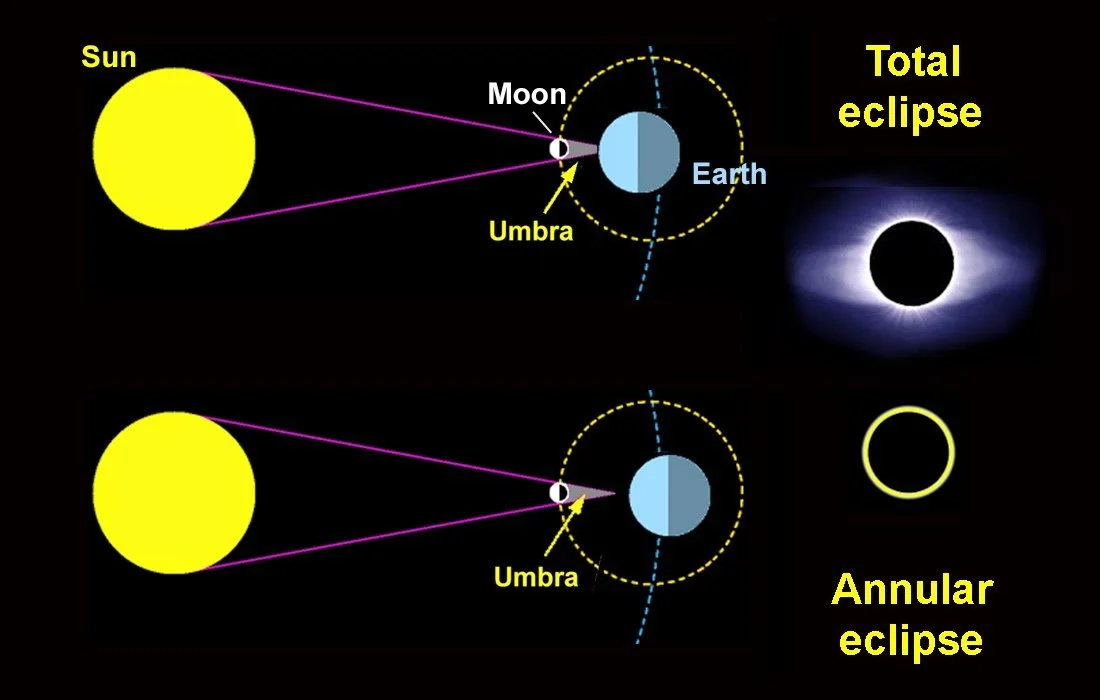
The cone umbra (the umbra) is the dark inner shadow in which the total solar eclipse appears. The penumbra is the faint outer shadow in which the partial solar eclipse appears.
Although the solar eclipse does not last more than seven minutes and forty seconds, we can observe more than one type of solar eclipses occurring during the moon’s passage in front of the Sun’s disk and the part of the Sun that it hides from the Earth.
Types of solar eclipses
Types of solar eclipses
-
The Total solar eclipse: It is the type of solar eclipse in which the Sun disappears completely, and it is formed in the shadow area (the umbra) of the moon, as the moon is nearer to the Earth.
-
The Partial solar eclipse is formed in the semi-shaded area (the penumbra) of the moon, and we can see a part of the Sun.
The annular solar eclipse: It is the type of solar eclipse in which the Sun appears as a lighted ring, and it is formed when the Moon is in a higher orbit from Earth so, its cone shadow does not reach the Earth.
When the Moon rotates farther from the Earth (in a higher orbit from the Earth) and comes between the Sun and the Earth, it causes an annular solar eclipse (as the Moon appears smaller than the Sun).
Safety precautions for observing the solar eclipse
We must not look directly at the Sun on ordinary days due to the harmful rays emitted by the Sun, such as ultraviolet rays (UV) and infrared rays. These harmful rays affect the eye, especially the retina, and may cause blindness within a few minutes.
Although the glow of the Sun during the solar eclipse seems weak, we must not focus on looking directly at the Sun because the outer solar corona keeps emitting harmful rays to the eye, like ultraviolet rays (UV) and infrared rays.
The doctors warn against direct observation of the solar eclipse and advise using special glasses to view it. The special solar eclipse viewers or the welding glasses at a strength of 14 can protect your eyes.
You can poke a hole in a piece of paper or cardboard and then look at the protected image. You need a special filter to properly view through a camera, binoculars, or a telescope. Just looking at the digital screen should be fine. But looking through the viewfinder is dangerous.
FAQ about Types of Solar Eclipses and Safety Precautions
1. What is a solar eclipse?
A solar eclipse occurs when the Moon passes between the Earth and the Sun, blocking all or part of the Sun’s light from reaching Earth.
2. What are the main types of solar eclipses?
- Total Solar Eclipse: A total solar eclipse happens when the Moon completely covers the Sun. The sky becomes dark for a few minutes. The Sun’s outer atmosphere (corona) becomes visible. It can only be seen from specific areas called the “path of totality.”
- Partial Solar Eclipse: A partial solar eclipse occurs when the Moon covers only part of the Sun. The Sun looks like a crescent shape. It is more common than total eclipses.
- Annular Solar Eclipse: An annular solar eclipse happens when the Moon is too far from Earth to completely cover the Sun. A bright ring of sunlight appears around the Moon. It is often called the “Ring of Fire.”
- Hybrid Solar Eclipse: A hybrid solar eclipse is rare. It appears as a total eclipse in some places and annular in others. It changes type along its path.
3. Is it safe to look at a solar eclipse?
No, it is not safe to look directly at the Sun during a solar eclipse without proper protection. It can cause serious eye damage or permanent blindness.
4. What are the safety precautions for observing a solar eclipse?
- Use Certified Eclipse Glasses: Wear ISO-certified eclipse glasses. Regular sunglasses are NOT safe.
- Use Solar Filters for Telescopes & Cameras: Always attach special solar filters. Never look through binoculars or a telescope without protection.
- Use Indirect Viewing Methods: Pinhole projector, Solar viewing box, and watching live broadcasts.
- Supervise Children: Make sure children wear proper eye protection.
- Remove Glasses Only During Totality: You may remove eclipse glasses only during the brief total phase of a total solar eclipse. Put them back on as soon as sunlight reappears.
5. What happens if you look at a solar eclipse without protection?
It can cause solar retinopathy, which damages the retina and may lead to:
- Blurred vision.
- Dark spots.
- Permanent vision loss.
6. How often do solar eclipses happen?
Solar eclipses occur about 2 to 5 times per year, but total solar eclipses are rare in the same location.
You can subscribe to Science Online on YouTube from this link: Science Online
Lunar eclipse and safety precautions for observing the lunar eclipse
What are the advantages & disadvantages of Refracting Telescopes?