Uses of lenses to treat the vision defects
The light rays reflect from the body to fall on the eye. Light rays refract when passing through the cornea and then the lens (the convex lens), The refracted rays are collected on the retina, forming a small, real inverted image. Most vision defects can be easily corrected using suitable lenses, contact lenses, or refractive surgery.
The vision
The optic (sight) nerve transmits the image to the brain, which re-corrects the image to become erect and in its natural size. The eyeball diameter is the distance between the lens optical center and the retina. The image must be formed on the retina to see clearly. A normal person can see clearly the near objects (at a distance, not less than 25 cm) and the far objects (at a distance up to 6 m).
Vision defects
Vision defects are common eye problems that affect the ability to see clearly. They occur when light rays do not focus properly on the retina, leading to blurred or distorted vision. These defects are usually caused by changes in the shape of the eye, cornea, or lens. Common types of vision defects include myopia (short-sightedness), hypermetropia (long-sightedness), astigmatism, and presbyopia.
Uses of lenses to treat vision defects
The vision defects occur because the eye cornea is not always convex or the eye is not always spherical. The most important vision defects are short-sightedness and long-sightedness.
Short-sightedness
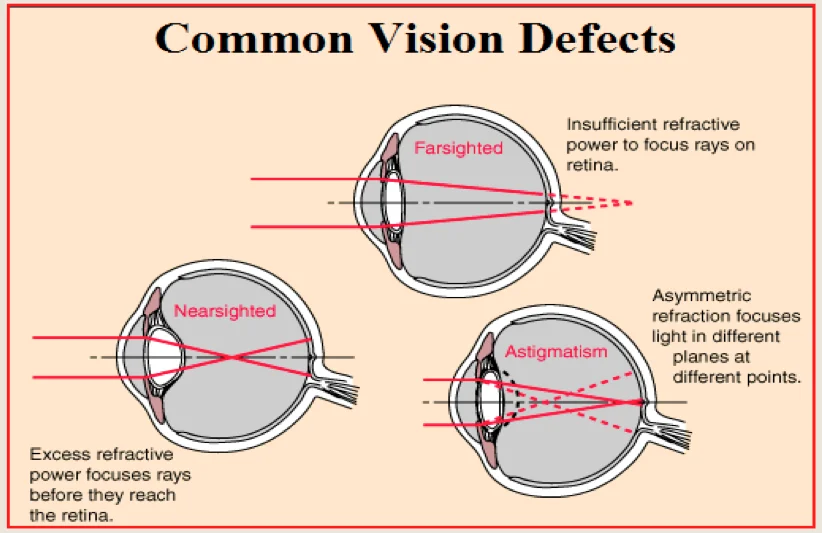
Short-sightedness is a vision defect through which near objects can be seen clearly, but far objects seem distorted. The images of the far objects do not fall on the retina of the eye but in front of it.
Vision defects
Short-sightedness reasons
The short-sightedness is due to the increase in the eyeball diameter that causes the retina to be far from the eye lens, and the increase in convexity of the eye lens surface that results in a smaller focal length of the eye lens, the parallel rays coming from the far object are collected at a point in front of the retina and disperses after that forming an unclear image.
Correcting short-sightedness
The short-sightedness is corrected by using a concave lens which diverges the rays coming from the far object, so, the image of the object is formed on the retina. Therefore, a short-sighted person needs medical eyeglasses with concave lenses.
Long-sightedness
Long-sightedness is a vision defect through which the far objects can only be seen clearly, but the close objects are not seen clearly. The images of close objects do not fall on the eye retina but behind it.
Reasons for long-sightedness
- The long-sightedness is due to the decrease of the eyeball diameter that causes the shortness of the radius of the eye sphere, thus the retina is close to the eye lens.
- The long-sightedness is due to the decrease of convexity of the eye surface that results in more focal length, so the rays coming from the near objects are collected in a point behind the eye retina.
Correcting long-sightedness
The long-sightedness is corrected by using a convex lens which collects the rays coming from the near objects, so, the image of the objects is formed on the retina. Therefore, a Long-sighted person needs medical eyeglasses with convex lenses.
Contact lenses
Contact lenses are used instead of glasses to treat vision defects. They are very thin lenses that are made of plastic, and they can stick to the eye cornea with the eye fluid.
Cataract disease
A cataract is one of the most dangerous diseases that infect the eye. It is due to old age, illness, the side effects of drugs, and genetic readiness.
The result of a cataract is difficulty in vision as a result of the darkness of the eye lens. The treatment of cataract is done through surgery to replace the eye lens with a plastic lens transplanted permanently in the eye, so, the person can see again and clearly.
FAQ about Uses of Lenses to Treat Vision Defects
1) What are vision defects?
Vision defects (refractive errors) occur when the eye cannot properly focus light on the retina, causing blurred vision.
Common types include:
- Myopia (short-sightedness).
- Hypermetropia (long-sightedness).
- Astigmatism.
- Presbyopia.
2) How do lenses correct vision defects?
Lenses correct vision by:
- Bending (refracting) light rays.
- Adjusting the focal point.
- Helping the image form exactly on the retina.
3) What lens is used to correct Myopia (short-sightedness)?
- Myopia. A person with myopia can see near objects clearly, but cannot see distant objects clearly. Image forms in front of the retina.
- Correction: A concave lens (diverging lens) is used. It spreads light rays outward and moves the image back onto the retina.
4) What lens is used to correct Hypermetropia (long-sightedness)?
- Hypermetropia. A person with hypermetropia can see distant objects clearly, cannot see nearby objects clearly, and the image forms behind the retina.
- Correction: A convex lens (converging lens) is used. It converges light rays and brings the image forward onto the retina.
5) What lens is used to correct Astigmatism?
- Astigmatism. Astigmatism occurs due to irregular curvature of the cornea or lens, blurred or distorted vision at all distances.
- Correction: A cylindrical lens is used. It corrects uneven focusing and helps light focus properly on the retina.
6) What lens is used to correct Presbyopia?
- Presbyopia. Occurs with aging (usually after 40 years), Loss of elasticity of the eye lens, and difficulty focusing on near objects.
- Correction: Convex lenses, Bifocal lenses, and Progressive lenses.
7) What are Bifocal lenses?
Bifocal lenses have: an upper part for distant vision, a lower part for near vision, and they are commonly used to treat presbyopia.
8) Can contact lenses correct vision defects?
Yes, Contact lenses: Sit directly on the cornea. Work the same way as eyeglass lenses. Can correct myopia, hypermetropia, astigmatism, and presbyopia
9) Can vision defects be permanently treated?
Yes, in some cases: LASIK surgery, PRK surgery, and Implantable lenses. These procedures reshape the cornea to correct refractive errors.
You can subscribe to Science Online on YouTube from this link: Science Online
Lenses use, types, Convex lens, Concave lens, Vision defects, Contact lenses and Cataract
Types and uses of lenses in our life & special concepts related to the lenses
Properties of the formed images by convex lens and concave lens
Uses of the concave mirror and the convex mirror in our daily life