Soil layers and living organisms, Top soil layers, Lower soil layers & Rocky layers
Soil layers, also known as horizons, are essential for supporting plant life and maintaining ecosystems, as each layer has unique properties and functions. The topsoil is rich in nutrients and living organisms, making it the most important layer for plant growth, while the subsoil stores minerals and water that roots can access. Beneath these layers, the parent material and bedrock provide the foundation for soil formation, showing how soil develops gradually over time through natural processes.
Soil layers
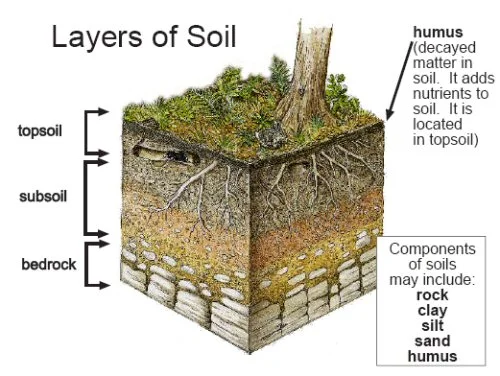
Soil is made up of different layers, known as soil horizons, which form over long periods through weathering and organic processes. The top layer, called topsoil (A-horizon), is the most fertile and rich in humus, minerals, and living organisms like earthworms and bacteria. This layer is essential for plant growth because it provides nutrients, water, and support for roots. Beneath it lies the subsoil (B-horizon), which contains fewer organic materials but is rich in minerals that have leached down from the topsoil.
Below the subsoil is the parent material (C-horizon), made up of partially broken rocks and minerals that contribute to soil formation. The deepest layer is the bedrock (R-horizon), a solid rock layer that has not yet been broken down. Each soil layer plays an important role in supporting plant life, storing water, and maintaining ecosystems, making soil a vital natural resource for both the environment and human life.
The soil is composed of three layers: the top soil layers, the lower soil layers, and the rocky layers. The soil horizon is the layer that is parallel to the soil crust, and its physical characteristics differ from the layers above and beneath each soil type.
Soil Layers
Top soil layers
The top soil layers contain the roots of the plants, the leaves of the plants, the humus, the small pieces of rocks that may be found, and the organisms such as earthworms, ants, spiders, and insects. So, a lot of the creatures exist in the top layers.
The roots of the plants extend deeply into the top soil layers, and they are very important to the plants. The roots take the water and the nutrients from the soil, and they fix the plant in the soil.
The roots are essential to the soil as they help the soil to be cohesive, they provide the soil with nutrients as they are converted into humus after death, and they prevent soil erosion from happening quickly.
The leaves of the plants are the parts of the plants that exist in the top soil layers, and when these parts fall into the soil, they decay, forming the humus.
The ants and other insects are the organisms existing in the top soil layers. They dig tunnels in the soil to make nests and lay eggs, and when these organisms die, their bodies decay, forming the humus.
The earthworms and some spiders are the organisms existing in the top soil layers, and the soil is essential to them. It is considered a shelter for earthworms and some spiders because they make their home underground by digging tunnels.
The earthworms and some spiders are very important to the plants as they help in the growth of the plant roots, as the tunnels that are formed by them allow the air, water, and nutrients to pass easily through the soil, then to the plant roots.
Lower soil layers
The lower soil layers lie beneath the top soil layers, and they do not have much humus.
Rocky layers
The upper layers of the rocky layers contain pieces of the rocks, but their lower layers contain the solid rocks.
FAQ about Soil Layers
1. What are soil layers?
Soil layers, also called horizons, are different levels of soil formed over time. Each layer has unique characteristics, such as color, texture, and composition.
2. What are the main soil layers?
The main soil layers are:
- Topsoil (A-horizon).
- Subsoil (B-horizon).
- Parent material (C-horizon).
- Bedrock (R-horizon).
3. What is topsoil?
Topsoil is the uppermost layer of soil and is rich in organic matter (humus). It contains most of the nutrients and living organisms, making it ideal for plant growth.
4. Why is topsoil important?
Topsoil is important because it supports plant life, stores nutrients, and holds water. It is also the most fertile layer used in agriculture.
5. What living organisms are found in topsoil?
Topsoil contains many living organisms such as earthworms, insects, bacteria, fungi, and plant roots. These organisms help decompose organic matter and improve soil fertility.
6. What is the lower soil layer (subsoil)?
The subsoil lies beneath the topsoil and contains fewer organic materials but more minerals. It plays a role in water storage and supports plant roots.
7. What organisms live in the subsoil?
Fewer organisms live in the subsoil compared to topsoil, but some bacteria, insects, and burrowing animals can still be found there.
8. What is the rocky layer (parent material)?
The rocky layer consists of partially broken rocks and minerals. It is the source from which soil develops over time.
9. What is bedrock?
Bedrock is the solid rock layer beneath all soil layers. It is not soil but the base material from which soil forms through weathering.
10. Why are soil layers important?
Soil layers are important because each layer plays a role in supporting plant growth, storing water, and maintaining ecosystems.
11. How do living organisms benefit soil?
Living organisms improve soil structure, recycle nutrients, help decompose organic matter, and support plant health.
You can follow Science Online on YouTube from this link: Science online