Reachy Mini 2026: This Powerful Tiny AI Robot Can See, Hear, Talk & Move!
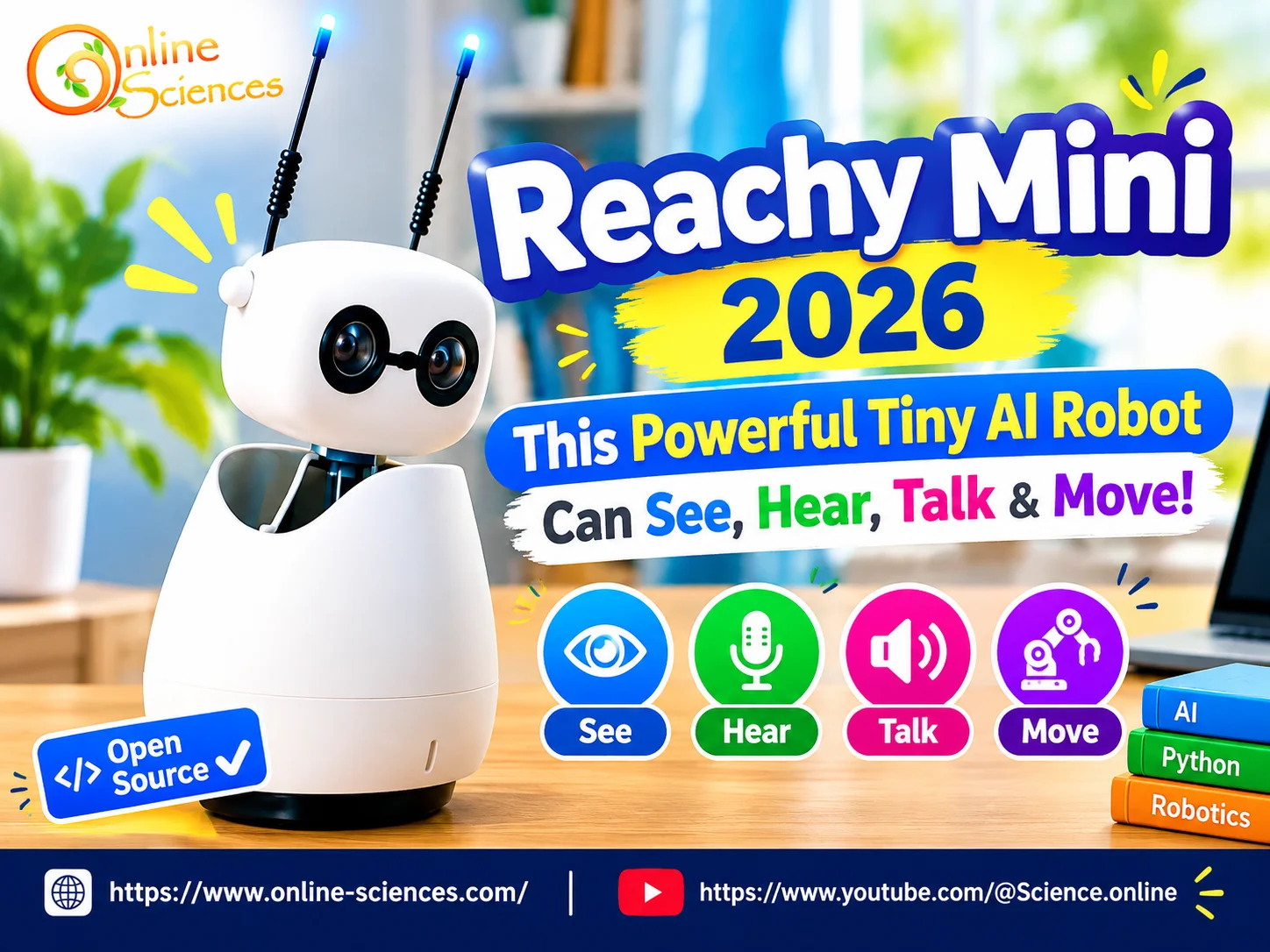
Reachy Mini is a compact open-source AI robot designed to make robotics, artificial intelligence, programming, and human-robot interaction more accessible. Developed by Pollen Robotics with Hugging Face, this expressive desktop robot combines a camera, four microphones, a speaker, animated antennas, and programmable movements, allowing developers, researchers, educators, and enthusiasts to build interactive AI experiences right on a desk.
Reachy Mini 2026
What is Reachy Mini?
Reachy Mini is a small, expressive robot created specifically for AI experimentation, creative coding, education, research, and human-robot interaction. Rather than being designed primarily as an industrial machine, it provides an approachable desktop platform for experimenting with AI models and robotic behaviors.
Pollen Robotics and Hugging Face introduced the robot, emphasizing open-source hardware, software, and simulation. It can be programmed using Python, while its ecosystem is designed to let users create, test, share, and download robotic behaviors.
This makes Reachy Mini particularly interesting for people who want to understand how modern AI can move beyond a computer screen. An AI model can potentially see through the robot‘s camera, hear through its microphones, respond through its speaker, and express itself through physical movement.
Reachy Mini 2026: Compact Design With Expressive Movement
One of Reachy Mini’s most noticeable features is its compact desktop design. Pollen Robotics describes the robot as approximately 28 cm tall and 16 cm wide, with a weight of around 1.5 kg. The detailed hardware documentation lists dimensions of approximately 30 × 20 × 15.5 cm when extended and a mass of 1.475 kg.
Despite its small size, Reachy Mini has several degrees of movement. Its head provides 6 degrees of freedom, while the body can rotate and the two antennas can move independently. These movements allow the robot to create more expressive interactions than a stationary desktop device.
The animated antennas are especially important to the robot‘s personality. Rather than communicating only with words, Reachy Mini can use movement to create visual expressions and reactions.
Camera, Microphones and Speaker
Reachy Mini is designed for multimodal AI interaction, combining visual and audio sensing with physical movement. Its wide-angle camera is based on the Raspberry Pi Camera 3 Wide and provides a 12-megapixel sensor with autofocus. The camera can provide the visual information required for computer-vision applications and AI experiments.
The robot also includes four digital microphones. Its microphone system can support features such as acoustic echo cancellation and direction-of-arrival detection, helping applications determine where sound is coming from.
For responses, Reachy Mini includes a 5W speaker. Combining the camera, microphones, speaker, and moving hardware creates a platform for experimenting with voice assistants, vision systems, conversational AI, interactive games, educational applications, and other multimodal experiences.
Reachy Mini Lite vs Reachy Mini Wireless
Reachy Mini is available in two main configurations: Reachy Mini Lite and Reachy Mini Wireless. The Lite model is designed to work with an external computer and is listed at $399, while the Wireless model includes onboard computing, Wi-Fi, and a battery and was introduced at $499, before applicable taxes and shipping.
Reachy Mini Lite and Reachy Mini Wireless share the same core robotic capabilities, including expressive movement, a wide-angle camera, four microphones, a 5W speaker, two animated antennas, and a 6-DoF head. The main difference is computing and connectivity.
Reachy Mini Lite is designed to connect to an external computer, making it the simpler and lower-cost option at its launch price of $399, while Reachy Mini Wireless includes onboard Raspberry Pi 4 computing, Wi-Fi, and a battery, providing greater freedom to operate without being continuously connected to an external computer.
The Wireless model launched at $499 before taxes and shipping. Both versions are designed for Python programming, AI experimentation, robotics research, and creating custom interactive applications. These specifications are based on Pollen Robotics‘ published product information; prices and availability can change.
Open-Source AI Robotics
One of the biggest reasons Reachy Mini has attracted attention is its open-source philosophy. The platform is designed around open-source software and hardware, while the robot‘s simulation environment allows developers to experiment before working with the physical machine. Python provides an accessible programming route for developers who want to create their own behaviors and AI applications.
Integration with Hugging Face is another important part of the ecosystem. Developers can experiment with AI models for areas such as speech, vision, and personality, then connect those capabilities to the physical robot.
This approach makes Reachy Mini more than a ready-made gadget. It can function as a physical experimentation platform for developers learning how AI systems interact with the real world.
What Can Reachy Mini Do?
Reachy Mini can be used for a wide variety of projects. Examples include:
- AI voice assistants.
- Computer-vision experiments.
- Object tracking.
- Interactive educational projects.
- Creative coding.
- Robotics research.
- AI companion experiments.
- Human-robot interaction.
- Voice-controlled applications.
- Interactive games.
- Custom robotic behaviors.
- AI demonstrations and prototypes.
Pollen Robotics says the ecosystem launched with more than 15 robot behaviors, while its current getting-started experience highlights 30+ community-created apps, including applications for hand tracking and AI conversations. The platform can also work with audio and video streams locally or remotely, allowing AI applications to run on the robot, a connected computer, or even GPU-backed cloud environments.
Building and Programming Reachy Mini
Reachy Mini is supplied as a kit, allowing users to assemble their robot rather than simply taking a finished consumer device out of a box. Pollen Robotics‘ current getting-started guide says the assembly process generally takes around 2–3 hours, although experienced users can complete it faster. The company also provides visual and digital assembly instructions.
After assembly, users can connect the robot and explore existing applications or move into programming with the Python SDK. This makes Reachy Mini particularly suitable for students and makers because the learning process can cover several areas at once: mechanical assembly, electronics, programming, artificial intelligence, computer vision, audio processing, and robotics.
Why Reachy Mini Is Interesting for AI in 2026
AI is increasingly moving from purely digital applications toward physical AI, where intelligent systems interact with cameras, microphones, motors, sensors, and the surrounding environment. Reachy Mini provides a relatively small platform for experimenting with that concept.
A developer could build an application in which the robot recognizes an object through its camera, listens to a spoken command, processes the information using an AI model, answers through its speaker, and moves its head or antennas to express a reaction. That combination of AI + perception + conversation + physical movement is what makes Reachy Mini an interesting platform for robotics experimentation.
Reachy Mini and Privacy
Pollen Robotics states that Reachy Mini does not store, transmit, or process personal data by default, and that use of its camera and microphone functions is under the user’s control. The company also states that Pollen Robotics and Hugging Face do not collect or access user data from the robot. As with any connected AI device, users should still understand which applications, models, cloud services, and network connections they choose to activate.
Final Thoughts
Reachy Mini brings together open-source robotics, AI, computer vision, audio interaction, and expressive movement in a compact desktop platform. Its Python programming environment, Hugging Face ecosystem, camera, microphone array, speaker, and multiple degrees of movement make it a flexible tool for experimenting with physical AI.
Rather than being simply another robotic gadget, Reachy Mini is designed as a platform for building and sharing new AI-powered robotic experiences. For developers, students, researchers, teachers, and robotics enthusiasts, it provides an accessible way to explore how intelligent software can interact with the physical world.
Reachy Mini FAQ
What is Reachy Mini?
Reachy Mini is a compact, open-source robot developed by Pollen Robotics with Hugging Face. It is designed for AI experimentation, programming, education, research, creative coding, and human-robot interaction.
How much does Reachy Mini cost?
The launch prices were $399 for Reachy Mini Lite and $499 for Reachy Mini Wireless, before taxes and shipping. Current prices and availability should be checked with the manufacturer.
What is the difference between Reachy Mini Lite and Wireless?
The Lite version relies on an external computer, while the Wireless version includes onboard Raspberry Pi 4 computing, Wi-Fi, and a battery. Both include the camera, four microphones, speaker, expressive head movement, body rotation, and antennas.
Can Reachy Mini use AI?
Yes. Reachy Mini is specifically designed for AI experimentation and can work with AI models for areas such as speech, vision, and personality. Its ecosystem also integrates with Hugging Face.
Can I program Reachy Mini AI Robot?
Yes. Reachy Mini provides an open-source Python SDK that developers can use to create custom robotic applications and behaviors.
Does Reachy Mini have a camera?
Yes. It uses a wide-angle camera, with the hardware documentation specifying a 12MP autofocus camera.
Does Reachy Mini Robot have microphones?
Yes. Reachy Mini has four digital microphones, supporting audio interaction and features such as acoustic echo cancellation and direction-of-arrival detection.
Is Reachy Mini a humanoid robot?
Reachy Mini is an expressive desktop robot rather than a full-size humanoid robot. Its design focuses on human-robot interaction, AI experimentation, and programmable movement.
How long does it take to assemble Reachy Mini?
Pollen Robotics currently estimates around 2–3 hours for getting started and assembly, while its FAQ says many users complete assembly in roughly 1.5–2 hours, with the time varying according to experience.
Is Reachy Mini open source?
Yes. Pollen Robotics describes the hardware, software, and simulation environments as open source and community-supported.
Can Reachy Mini recognize objects?
Its camera and software ecosystem make computer-vision applications such as object tracking and recognition possible. The exact capabilities depend on the AI or computer-vision application being used.
Who is Reachy Mini designed for?
It is aimed at AI developers, researchers, teachers, students, makers, robotics enthusiasts, and people interested in experimenting with AI and physical robots.
Does Reachy Mini work with Hugging Face?
Yes. Hugging Face is a major part of the Reachy Mini ecosystem, providing a platform for sharing robot behaviors and experimenting with AI models and applications.
You can follow Science Online on YouTube from this link: Science Online
🔥 Reachy Mini Has to Break Bad News to Microduck 🤖💔 You Won’t Expect What Happens Next! 🚀
🔥 Tesla Bot Gen 4 UPDATE 5000 Tasks As HOMEMAKER & Surgeon! Elon Musk SHOCKED Inside Optimus! 🤯
Boston Dynamics Atlas review, advantages and features, How does Atlas robot work?
Tesla robots (Optimus) review, use, advantages and disadvantages
Emo robot review, advantages, disadvantages, features and what can Emo do?
Advantages and disadvantages of using robots in our life
Artificial intelligence (AI) definition, advantages, disadvantages, features and applications
Robot teachers use, advantages and disadvantages
Sophia robot review, features, use, advantages and disadvantages
Vector robot review, advantages, disadvantages and specifications