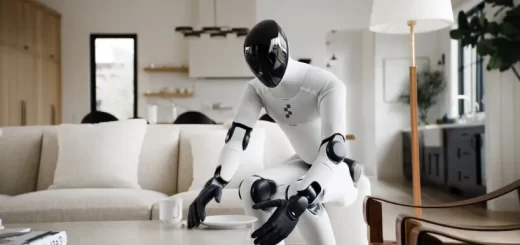
Unitree unveils its new R1 humanoid, What Can the Unitree R1 Robot Do?
The Unitree R1 Robot is a humanoid service robot developed by Unitree Robotics, a Chinese robotics company best known for its quadruped robots, such as the Go1 and B2. The R1 is designed to function as a home, office, and research assistant, combining mobility, manipulation, and interaction capabilities.
Unitree R1 Robot
The Unitree R1 is a humanoid service and research robot equipped with dual arms, dexterous hands, AI interaction capabilities, and mobility features, designed to assist with domestic, office, and educational tasks.
It is a dual-arm humanoid robot that can walk on two wheels (balancing on a wheeled base), has 5-finger dexterous hands, and supports AI-driven interaction through speech and vision. The R1 can perform tasks such as fetching objects, handling household chores, and providing companionship or assistance in work and research environments.
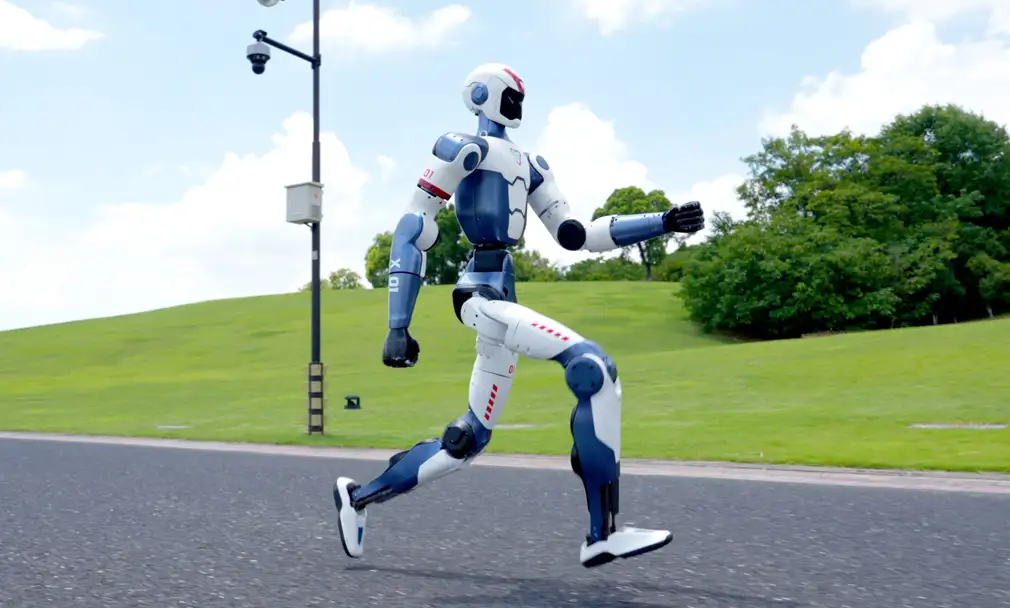
Unitree R1 Robot
What Can the Unitree R1 Robot Do?
- Dynamic, Athletic Movement: Cartwheels, handstands, running, spin-kicks, and simulated sparring are all part of its repertoire—demonstrating impressive agility for a sub-$6K humanoid. It can balance, vault into flips, recover from stumbles, sprint downhill, and get up from the ground with gymnastic ease.
- Bipedal Locomotion & Human-like Gestures: Unitree R1 is equipped with 24–26 degrees of freedom, and R1 can walk, squat, wave, kick, and mimic human motion fluidly. It possesses balance control and real-time motion stabilization, enabling walking, running, and jumping in a coordinated manner.
- Perception & Multimodal Interaction: Binocular stereo vision (with up to 220° field of view) gives R1 depth perception and environmental awareness. A 4-mic microphone array allows it to detect and localize sound sources, paired with a built-in speaker for voice response. R1 integrates a multimodal large language model (UnifoLM) to process speech and visuals on-device, enabling interactive responses based on voice and image cues.
- Developer-Friendly & Expandable Platform: Unitree R1 features open control interfaces, supports mainstream simulation tools, and is ideal for AI and robotics R&D. The EDU version can optionally include NVIDIA Jetson Orin (40–100 TOPS) for accelerated AI workloads. It supports ROS 2, OTA updates, and standard developer toolchains for experimentation and custom behavior.
- Use Cases and Practical Roles: Unitree R1 is Ideal for teaching kinematics, control theory, ethics, or AI interaction in hands-on labs. With its humanoid form and perception suite, R1 can serve as a greeter, guide, or presenter in controlled venues like museums or events. Unitree R1 can be integrated into remote communication setups or dance/interactive performances. While not equipped with dexterous hands, it has modest lifting ability (~5–10 kg), making it suitable for light tasks.
Unitree R1 Robot features
Affordable & Accessible: The Unitree R1 humanoid robot is sleek, agile, and surprisingly affordable. It is priced from about $5,900 (≈ 39,900 CNY), significantly less expensive than Unitree’s previous G1 model (~99,000 CNY). It is aimed at educators, developers, and robotics enthusiasts seeking an accessible humanoid platform.
Agile Mobility: The Unitree R1 weighs approximately 25 kg and stands about 1.21 meters (4 feet) tall. It is available in Standard (24 DOF) and EDU (26 DOF) versions: Legs: 6 DOF each, Arms: 5 DOF each, Waist: 2 DOF, Head: 2 DOF (EDU only), CNX Software – Embedded Systems News. It is built for dynamic stunts—shown doing running, cartwheels, handstands, spin-kicks, and shadowboxing in promotional demos.
Onboard Computing & Connectivity: Unitree R1 is powered by an 8-core high-performance CPU, with an optional NVIDIA Jetson Orin (40–100 TOPS) module for the EDU version. It is equipped with Wi-Fi 6 and Bluetooth 5.2 for seamless communication.
Machine Perception & Interaction: Unitree R1 features binocular stereo cameras, a 4-microphone array, and a built-in speaker for immersive interactions. It supports multimodal AI, enabling tasks such as voice and image recognition, and uses a large language model to integrate both speech and visual understanding.
Design & Mechanical Structure: Unitree R1 moves through a hollow internal wiring system with local air cooling, offering streamlined aesthetics and easy maintenance. Telescoping quick-release lithium battery provides about 1 hour of runtime, ideal for demo sessions or development cycles. Joint mechanisms incorporate precision bearings (crossed roller and double hook ball) and low-inertia PMSM motors for responsive, heat-efficient movement.
Customizability & Development: Exterior is fully customizable, allowing for personal aesthetic touches. The EDU version includes support for secondary development, enabling custom programming and modular enhancements.
Unitree R1 Robot advantages
- Highly Affordable: At approximately $5,900 (39,900 yuan), the R1 is offered at a strikingly lower price than the previous G1 model (~99,000 yuan). This price point dramatically lowers the barrier to entry for humanoid robotics.
- Impressive Agility & Mobility: Despite its modest stature (~1.21 meters tall, ~25 kg), the R1 executes dynamic moves—running, cartwheels, handstands, spin-kicks, and shadowboxing—often outshining more expensive models. Its lightweight, compact build allows it to navigate indoors, up stairs, and through doorways with agility.
- Developer-Friendly & Customizable: Unitree R1 offers an open control interface and supports mainstream simulation platforms, making it excellent for R&D and educational use. The R1 EDU variant adds 2 head DOF, supports OTA updates, secondary development, and optional dexterous hands.
- Onboard AI & Perception: Unitree R1 is equipped with binocular stereo vision, a 4-microphone array, and a built-in speaker, enabling voice and visual interaction. It features a multimodal large language model (UnifoLM) integrated onboard, allowing real-time processing of speech and images without cloud dependency.
- Clean, Efficient Design: Unitree R1 uses internal wiring, air cooling, low-inertia PMSM motors, and precision bearings (crossed-roller and double-hook ball), resulting in responsive, heat-efficient movement with minimal maintenance. Quick-release lithium battery makes charging and swapping straightforward.
Disadvantages of Unitree R1
- Limited Manipulation — Basic Hands: The default model lacks articulated hands capable of gripping or manipulating objects; the base model has fixed “fist” parts, making real-world tasks like picking or cooking infeasible.
- Short Battery Life: Limited to approximately 1 hour of operation per charge, which is restrictive for longer demonstrations or educational sessions.
- Limited Payload & Practical Use: Mechanical strength allows for light lifting only—around 2–10 kg, depending on conditions—insufficient for heavy-duty tasks. It’s not optimized for household or industrial applications due to its limited manipulation and runtime.
- Questionable Reliability & Stability: Some online sources flagged concerns over system glitches—such as erratic behavior and less reliable performance—which could limit user confidence in certain environments.
- Not Designed for Casual Home Use: Unitree R1 is best suited for controlled environments like labs, classrooms, or research spaces—not for unsupervised home or consumer use. It requires technical know-how to program and operate via SDK—it’s not plug-and-play.
You can follow Science Online on YouTube from this link: Science online
Unitree G1 humanoid robot advantages and disadvantages, What does Unitree G1 do?
Unitree B2 features, advantages, disadvantages, What can Unitree B2 do?, Is Unitree B2 real?
Sophia robot review, features, use, advantages and disadvantages
Robot teachers use, types, advantages and disadvantages
Advantages and disadvantages of using robots in our life
Automation in manufacturing use, advantages and disadvantages
Humanoid robots use, types, risks, advantages and disadvantages
Pepper robot review, features and What can Pepper do for your business?
Boston Dynamics Atlas review, advantages and features, How does Atlas robot work?