
Asymmetric Digital Subscriber Line (ADSL) advantages, disadvantages and features
(ADSL) connection is a type of Internet connection that is well-suited for moderate gaming, computer-aided design, streaming multimedia, and downloading large files. It can be used for Internet access at the same time as voice calls, and it can be used for email and to receive faxes.
DSL (Digital Subscriber Line)
DSL (Digital Subscriber Line) is a service that offers a faster Internet connection than a standard dial-up connection, while ADSL (Asymmetric Digital Subscriber Line) is a type of DSL. It is a broadband connection technology that enables computers to connect over the Internet using the existing copper-wired telephone networks.
DSL technology works by splitting the existing telephone line signal into two, which are the voice and the data. ADSL uses most of the channel to transmit downstream to the user and only a small part to receive information from the user.
ADSL is a replacement for dial-up modems and ISDN, It appears to be always online, so, you do not have to wait to get connected to the Internet, the phone calls can be made at the same time as the ADSL link is being used.
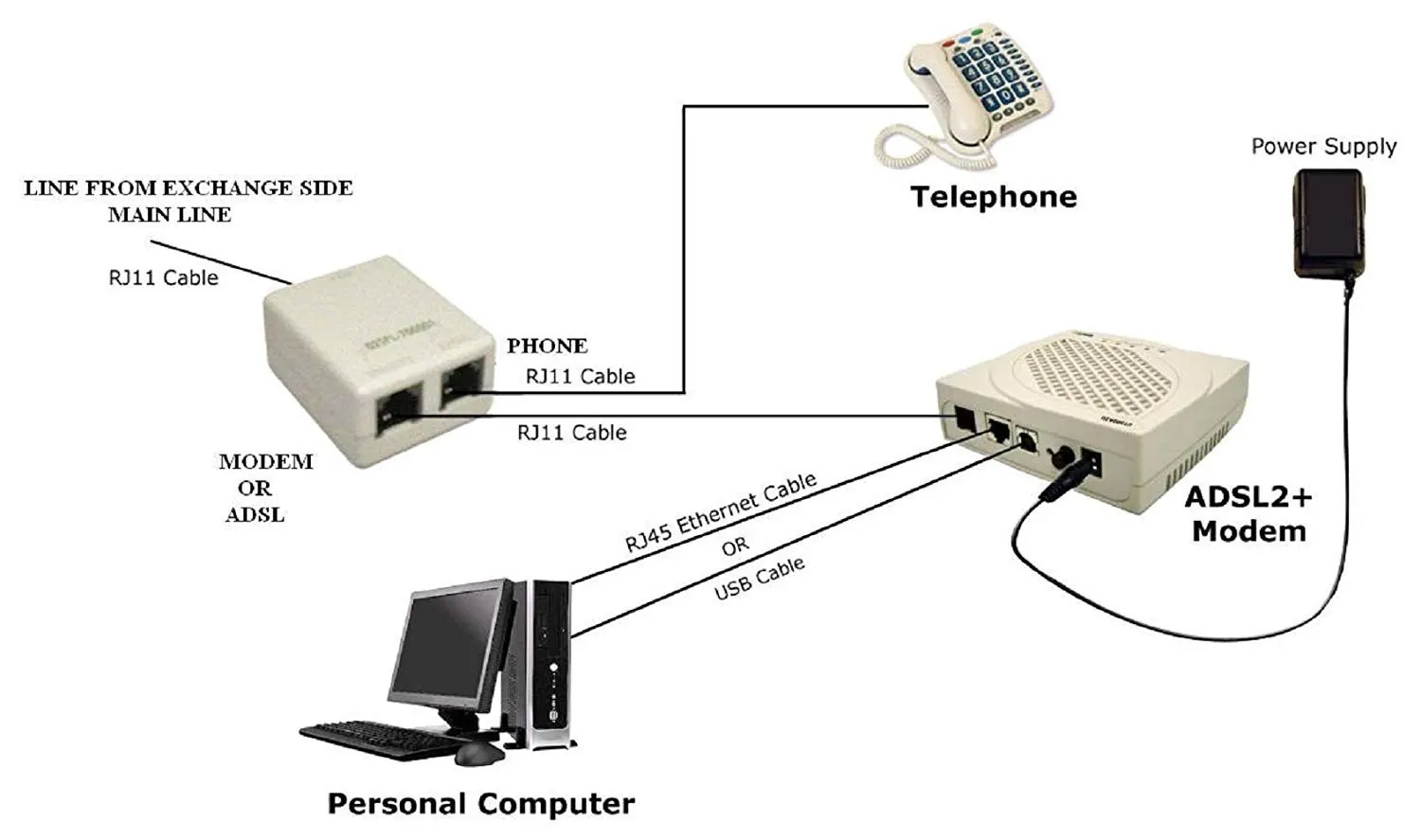
ADSL (Asymmetric Digital Subscriber Line)
Adsl meaning
ADSL stands for Asymmetric Digital Subscriber Line, a type of DSL (Digital Subscriber Line) technology used for internet access. It allows data transmission over traditional copper telephone lines, enabling users to have both internet and telephone services on the same line without interference. ADSL is a popular and cost-effective broadband solution for homes and small businesses, especially in areas where faster fiber-optic connections are not available.
Asymmetric: The term “asymmetric” refers to the different speeds for downloading and uploading data. ADSL offers higher download speeds compared to upload speeds, making it suitable for most home users who typically download more content (e.g., browsing, streaming) than they upload.
ADSL uses the existing copper telephone lines, making it cost-effective to implement without laying new infrastructure. Download speeds typically range from 1 Mbps to 24 Mbps, depending on the quality of the line and distance from the local exchange. Upload speeds are usually lower, ranging from 128 Kbps to 3.5 Mbps.
ADSL performance degrades as the distance between the user and the telephone exchange increases. ADSL uses existing phone lines, so there’s no need for additional wiring. Users can make phone calls and use the internet simultaneously.
ADSL (Asymmetric Digital Subscriber Line)
ADSL is a type of digital subscriber line (DSL) technology, It is a data communications technology that allows faster data transmission over copper telephone lines than a conventional voiceband modem can provide, ADSL differs from the less common symmetric digital subscriber line (SDSL).
In ADSL, bandwidth and bit rate are asymmetric, meaning greater toward the customer premises (downstream) than the reverse (upstream), Providers market ADSL as an Internet access service primarily for downloading content from the Internet, but not for serving content accessed by others.
Symmetric DSL (SDSL) can transmit data over a telephone network, with SDSL, the downstream bandwidth — from the network to the subscriber — is the same as the upstream bandwidth. ADSL offers high transmission speeds for video and voice to homes over an ordinary copper telephone wire, It is most cost-effective in areas with a low market penetration of cable TV.
ADSL facilitates fast data transmission at a high bandwidth on existing copper wire telephone lines to homes and businesses, It offers continuously available, always-on broadband connections, It is asymmetric, It can transmit downstream to the user, and only a small part for uploading information from the user, It simultaneously accommodates analog (voice) information and data on the same phone line.
ADSL leverages existing telephone lines, making it accessible in many areas where newer internet options like fiber aren’t available. Since ADSL separates voice and data traffic into different channels, you can chat on the phone and browse the web at the same time, without one interfering with the other.
ADSL is more affordable than some other broadband internet options. It presents faster download speeds compared to traditional dial-up connections. This makes activities like web browsing, downloading files, and streaming videos much more enjoyable.
Advantages of ADSL
Asymmetric Digital Subscriber Line (ADSL) is a type of digital subscriber line (DSL) technology that enables faster data transmission over copper telephone lines than a conventional voiceband modem can provide.
Asymmetric Digital Subscriber Line (ADSL) offers a high-speed connection. You can use the phone line while connected. It presents a fixed monthly cost, It has good value for the money, there is no extra wiring, ADSL uses the existing phone line, and it has lower pings in online games.
Asymmetric Digital Subscriber Line (ADSL) does not present more dropped connections. You can talk on the phone when you surf the Internet because the voice and data work in separate bands, which implies a separate channel.
Asymmetric Digital Subscriber Line (ADSL) uses existing infrastructure (the basic telephone network), The cost and time it takes to keep the service available is less than if the operator had to undertake works to build new infrastructure, ADSL users have to access the Internet, they do not have to establish this connection by dialing or signaling to the network, comparative ADSL compares with a switched network architecture.
Asymmetric Digital Subscriber Line (ADSL) presents connection speeds much higher than those made by the dial-up Internet, It is a technology for high-speed Internet access, you can surf the web whilst allowing you to talk on the phone simultaneously.
ADSL connection can use a telephone and the Internet simultaneously. You do not need to connect or reconnect, you are always online with ADSL, There are no call charges for using an ADSL connection like in the modem or ISDN connection. It offers better internet functionality and higher ADSL bandwidth compared with ISDN or a modem connection.
You can download the documents, on the web pages and send an email faster. You can view or send real-time audio and video files very quickly. ADSL can be very useful to businesses to cut call costs to customers internationally, ADSL service is typically configured for internet usage, as downloading is higher than uploading.
Asymmetric Digital Subscriber Line (ADSL) presents a broadband connection technology, ADSL uses the existing copper wires that are installed for the telephone systems to deliver high-rate digital data. They can provide customers with high-speed data services even before switching to fiber-optics.
ADSL can offer high speeds, around thirty to forty times faster than a dial-up connection. It uses a wide range of frequencies, ADSL connections present the bandwidth needed for high-quality voice services. It is used for web surfing and internet telephony, and asa fax line at the same time.
The asymmetric of ADSL connection is because of its different capacity to download and upload. It offers more capacity for downloads from the internet to your computer than for uploads. The information you can send out in a particular time is much less than the amount of information you can download.
The ADSL connection is very useful because most users download more documents, web pages, and emails that they send out, It makes use of your existing telephone line and splits the signal into voice communications and high-speed data connection.
Disadvantages of ADSL
Asymmetric Digital Subscriber Line (ADSL) service is not available everywhere. It works better when closer to the ISP’s central office, It offers variable speeds depending upon the time of the day, It presents faster download than upload, The line testing takes a long time.
The home user contends at 50:1, you may share your 512 Kbps with 49 other people, giving you 10Kbps, ADSL is affected by the number of people using your line in a certain area, and the connection is faster to download (receive the data) than to send the information.
Every ADSL line is shared among 50 users so the ratio comes out to be 50:1, in the case of the home users, whereas for the business users, the ratio is 20:1, The users’ numbers can make your bandwidth fluctuate. ADSL connection does not offer any guarantee of the level of service.
ADSL can travel reliably over the copper line only, so, if the telecommunications provider added the fiber between your organization and the local exchange, you will be unable to receive ADSL, When the distance from the telephone exchange is further, the signal strength is weaker, Slower connection at peak times.
ADSL, as the name implies, offers unequal download and upload speeds. Download speeds are typically much faster than upload speeds. While download speeds are decent, upload speeds can be a bottleneck for activities like video conferencing or uploading large files.
The “Asymmetric” in ADSL refers to the difference in download and upload speeds. which might not be ideal for users who upload a lot of data, such as gamers or content creators. The speed of your ADSL connection can be impacted by the distance between your location and the service provider’s central office.
Overall, ADSL is a good choice for basic internet needs like web browsing, email, and streaming, especially in areas lacking more advanced options. However, if you regularly upload large files or need symmetrical speeds for applications like video conferencing, ADSL might not be the best fit.
FAQ about Asymmetric Digital Subscriber Line (ADSL)
What is ADSL?
ADSL (Asymmetric Digital Subscriber Line) is a broadband internet technology that delivers high-speed internet over traditional copper telephone lines. It’s called asymmetric because download speeds are higher than upload speeds, which fits typical home usage (streaming, browsing, downloads).
Features of ADSL
- Always-on connection (no dial-up needed).
- Asymmetric speeds: faster download, slower upload.
- Uses existing phone lines (no new wiring in most homes).
- Simultaneous internet & voice calls with a splitter/filter.
- Widely available in many rural and suburban areas.
- Stable connection for basic browsing, email, and video streaming.
Advantages of ADSL
- Affordable compared to fiber in many regions.
- Easy installation using existing landline infrastructure.
- Suitable for home users who mostly download content.
- Always connected (no need to reconnect each time).
- Works with landline calls at the same time.
Disadvantages of ADSL
- Slower speeds than fiber or cable internet.
- Upload speed is limited (bad for creators, cloud backups, live streaming).
- Speed drops with distance from the telephone exchange.
- Performance can be affected by line quality and electrical noise.
- Outdated technology is being phased out.
Typical ADSL Speed Range (approx.)
- Download: 1 – 24 Mbps
- Upload: 128 Kbps – 1.4 Mbps.
(Actual speed depends on distance from the exchange and line quality.)
Is ADSL good for online learning and Zoom?
Yes, basic video calls and online classes work, but quality may drop if multiple devices use the internet at once. HD meetings can be unstable.
Can I watch YouTube and Netflix on ADSL?
Yes, SD and HD streaming usually works. 4K streaming may buffer, especially if more than one user is connected.
Why is ADSL slower than fiber?
ADSL uses old copper phone lines, while fiber uses optical cables that carry much more data at higher speeds over longer distances.
Does ADSL need a landline phone?
Yes. ADSL works over telephone lines, but you don’t have to actively use a phone service—just the line itself.
Is ADSL still used today?
Yes, in many areas where fiber isn’t available yet. However, it’s being replaced by fiber and 4G/5G home internet in most countries.
ADSL vs Fiber Internet
Download Speed: ADSL provides low to medium download speeds that are sufficient for basic web browsing, email, and standard video streaming. In contrast, Fiber Internet offers very high download speeds that can easily support 4K streaming, large file downloads, and multiple users at the same time without slowdowns.
Upload Speed: ADSL has much lower upload speeds compared to download speeds, which makes it less suitable for video calls, live streaming, and uploading large files. Fiber Internet provides very high and often symmetrical upload speeds, making it ideal for content creators, remote workers, and cloud-based tasks.
Stability and Reliability: ADSL connections can be affected by line quality and electrical interference, which may cause speed drops or unstable performance. Fiber Internet is much more stable and reliable because it uses optical cables that are resistant to noise and signal degradation.
Effect of Distance: With ADSL, the internet speed decreases as the distance from the telephone exchange increases, so users who live far away may experience slow connections. Fiber Internet performance is not significantly affected by distance, and users can enjoy consistent speeds even over long distances.
Best Use Cases: ADSL is best suited for light home use, such as browsing, emailing, social media, and basic video streaming. Fiber Internet is ideal for heavy internet usage, including online gaming, 4K streaming, remote work, video conferencing, and households with many connected devices.
ADSL is okay for light home use (browsing, email, YouTube, online classes). If you need fast uploads, gaming, or multiple users streaming at once, upgrading to fiber or 5G home internet is a much better experience.
You can follow science online on YouTube from this link: Science online
Digital business Transformation (Digital technology) benefits and uses
Online marketing uses, advantages and disadvantages
Disadvantages and risks of Digital technology (digital transformation) in human life


There are audio gamers designed specifically for the onerous-of-hearing.