
Importance, structure and uses of periscope, How does a periscope work
The periscope is an instrument for observation over, around, or through the object, obstacle, or condition that prevents direct line-of-sight observation from the observer’s current position. The periscope is used to monitor the dangerous chemical reactions in the laboratory, and it is used to observe the nuclear reactors.
The Periscope
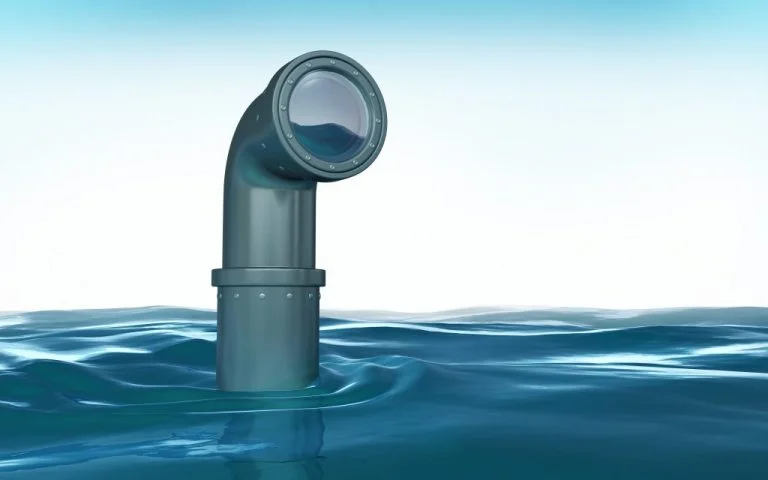
Periscope of a submarine
The periscope is an instrument for observation. It consists of a tube with mirrors at each set parallel to each other at a 45-degree angle, with the addition of two simple lenses, and it depends on the occurrence of regular light reflection on the plane mirrors.
The periscopes allow the submarine to search visually for nearby targets and threats on the surface of the water and in the air when they are submerged at a shallow depth.
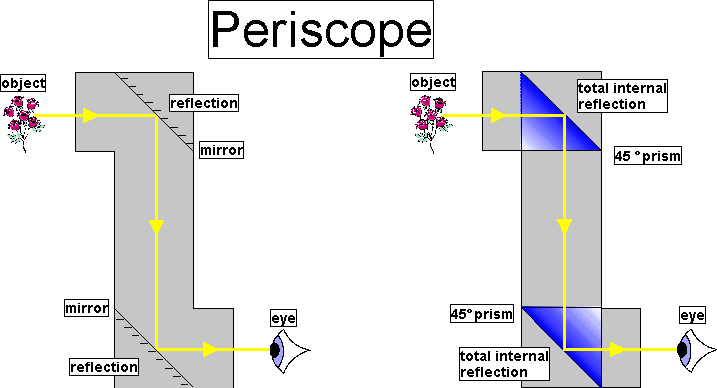
Periscope
The periscope is used in submarines to see what is going on the water surface. It was used for observation purposes in the trenches during World War I, It is used in some gun turrets, and it is used in armed vehicles.
The periscope is used in submarines to see the events that are happening behind a wall or a barrier, and some submarines use complex periscopes that use prisms or advanced fiber optics instead of mirrors to provide magnification. Complex periscopes operate on submarines and in different fields of science.
The periscopes are used to observe obstacles between 9 and 26 meters in height, and they are used in submarines for general observation of submerged navigation, and for correctly aligning the submarine when firing a torpedo at a target.
The periscope is used to determine the distance of the torpedo attack, it determines the correct time to fire the torpedo at high speed. The periscopes are used to observe dangerous places, and they are used in the fuel tanks to see around and above the vehicles.
The periscopes are used in pointing and firing the guns; they are used in submarines to view possible threats, such as enemy submarines or sea mines in the Navy.
Importance of a Periscope
A periscope is an optical device commonly used to observe objects from a concealed or protected position. It consists of a tube with mirrors or prisms at each end, which allows the user to see over, around, or through obstacles. The periscope is a versatile tool with applications ranging from military and defense to scientific research and education. Its ability to provide indirect viewing makes it invaluable in various fields.
- Periscopes are crucial in military applications, especially in submarines. They allow submarines to observe the surface of the water while remaining submerged, providing critical information on enemy positions, ships, or land. Periscopes are used in armored vehicles like tanks to allow the crew to see the battlefield while remaining protected inside.
- Periscopes are used in situations where direct line-of-sight observation would be dangerous or impractical. This includes observing hazardous areas, like inside nuclear reactors or monitoring sensitive installations.
- In scientific instruments, periscopes help researchers observe phenomena from a safe distance or under controlled conditions, like observing wildlife or in laboratory settings.
- The principle of periscopes is applied in engineering designs where indirect viewing is necessary, such as in the inspection of engines or other complex machinery without dismantling.
Uses of a Periscope
- Periscopes are essential for submarines, allowing them to scan the surface for enemy ships, land, or aircraft while staying underwater and undetected.
- Tanks and Armored Vehicles: Periscopes allow the crew to see outside while being protected inside, helping them navigate and engage targets.
- In observation towers or posts, periscopes provide a wide view of the surroundings without exposing the observer to potential threats.
- Simple periscopes are often used in educational settings to teach principles of optics, reflection, and light.
- Adaptations of the periscope’s design are used in medical instruments like endoscopes, allowing doctors to see inside the human body with minimal invasion.
- In some outdoor activities, such as bird watching or hunting, periscopes help observers maintain a low profile while observing wildlife.
FAQ about the Periscope, and How a Periscope Works
What is a periscope?
A periscope is an optical instrument used to see objects that are not in the direct line of sight. It allows a person to observe from a hidden or protected position by using mirrors or prisms inside a long tube.
What is the basic structure of a periscope?
A simple periscope consists of:
- A long tube or body.
- Two plane mirrors (or prisms).
- The mirrors are placed at 45° angles at both ends of the tube.
- An eyepiece or viewing opening at one end.
This arrangement allows light rays to be reflected from the top opening to the observer’s eye.
How does a periscope work?
A periscope works based on the reflection of light. Light from an object enters the top opening and strikes the first mirror placed at 45°. The light is reflected downward inside the tube to the second mirror, which reflects the light into the observer’s eye. This allows the observer to see over obstacles or from a hidden position.
What is the importance of a periscope?
The periscope is important because it allows safe and hidden observation. It is widely used in submarines, tanks, and observation posts to view surroundings without exposing the observer to danger. It is also useful in science education to demonstrate the laws of reflection.
Where is a periscope used?
Periscopes are used in many fields, such as:
- Submarines (to see above the water surface).
- Military vehicles and bunkers.
- Trench warfare observation.
- Science experiments and school projects.
- Simple surveillance and inspection tasks.
What are the advantages of a periscope?
- Allows viewing over walls and obstacles.
- Enables observation from a safe or hidden position.
- Simple design and easy to make for educational purposes.
- Demonstrates basic optical principles clearly.
What are the disadvantages of a periscope?
- Limited field of view compared to direct vision.
- Image brightness may be reduced due to reflection losses.
- Simple periscopes do not magnify objects.
- The length of the tube limits how far above obstacles you can see.
What type of mirrors are used in a periscope?
A simple periscope uses two plane mirrors placed at 45° angles. More advanced periscopes use prisms instead of mirrors to produce clearer and brighter images.
How is a periscope different from a telescope?
A periscope is mainly used to see over or around obstacles from a hidden position, while a telescope is used to magnify distant objects. A periscope changes the line of sight, whereas a telescope increases the size of the image.
Can a periscope be made at home for experiments?
Yes, a simple periscope can be made at home using cardboard tubes and two plane mirrors placed at 45° angles. It is a common school project to demonstrate reflection of light.
You can follow science online on YouTube from this link: Science online
The advantages and disadvantages of optical fiber cables over electrical cables
Applications on the total reflection of light (Optical fibers, Reflecting prism and Mirage)
Nuclear submarines (Nuclear Powered Ships) advantages and disadvantages
The importance of lasers in communication and advantages of fiber optics cables



I like this website. It is very accurate
I recommend it.
Thank you very much for your comment
Welcome in my website
it is a very good page and it helped me a lot
Thank you very much
It is trendy for knowledge I know many things from this
Thank you very much
I liked this
Thank you
You are welcome
I like your website
Thank you very much for your comment
Nice
This really helped with my science project, it is a great website.
It helped me in my exams
Thank you for your comment
nice site loved it amazing just ill recommend to owner try to put answers of defence studies book std 9 and std 10 it will be very helpfull to students
Good page
a very good and useful website for my project
Great Site! It helped me do my physics outline,