Diversity of animals, plants and micro-organisms, What are the threats to Biodiversity?
Biodiversity is essential for a healthy planet and helps ecosystems stay stable and productive. If you go to the zoo, you will see a lot of different animals with different characteristics, and there is a variety among these animals in terms of shape and the way of feeding.
Biodiversity
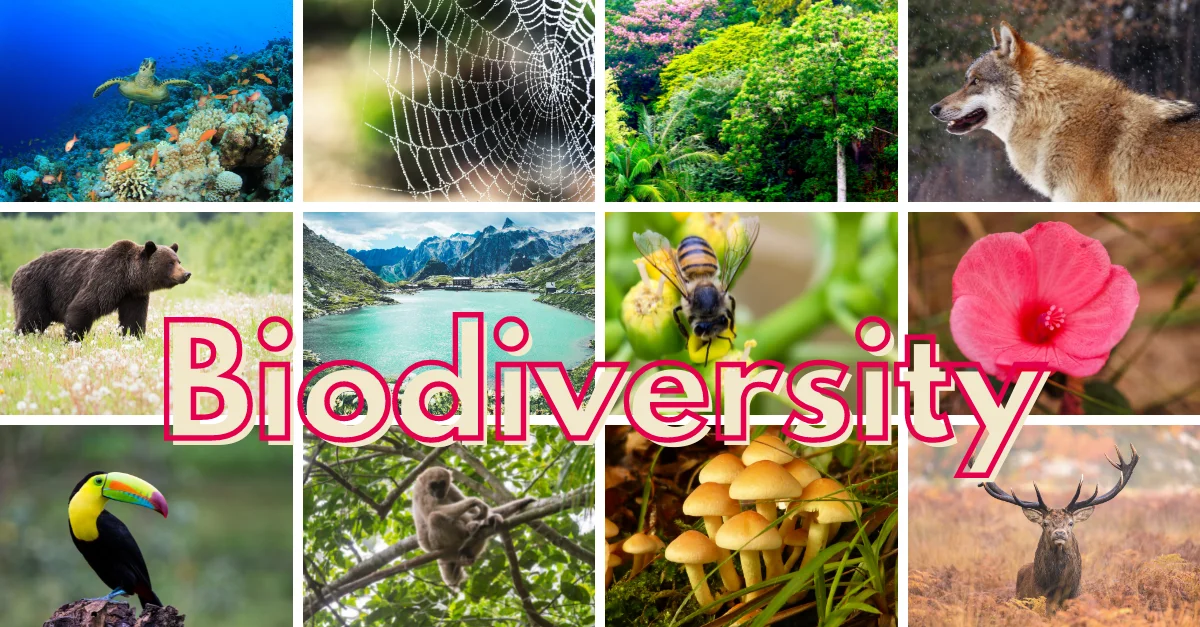
Biodiversity refers to the variety of life on Earth, including animals, plants, and microorganisms. It plays a vital role in maintaining the balance of ecosystems and supporting life. High biodiversity helps provide food, medicine, and clean environments, making it essential for the survival of all living organisms.
Biodiversity
Diversity of the animals
There is a variety according to the size of the animals. There are big animals and small animals. The big animals, such as the elephants and the rhinoceros. The small animals, such as the rabbit, the rat, and the lizard.
There is a variety of animals according to the environment where these animals live. Some animals live in the water, and there are animals that live on land.
The animals live in the water, such as the fish, the crocodiles, and the hippopotami. The animals live on the land, such as the horse, the lion, and the dog.
Diversity of the plants
There is a variety in the plants’ sizes. There are huge trees and short weeds. The huge trees, such as camphor and the palm trees, the short weeds such as the clover and the gargeer.
There is a variety according to the size of the leaves of the plants. There are plants that carry large leaves, such as the banana plant, and plants that carry small leaves, such as molukhiyah plant.
Diversity of microorganisms
Microorganisms are living organisms that can not be seen by the naked eye, but they spread everywhere around us in the air, the water, and the soil. They can be seen only by the microscope.
Many microorganisms can be seen. Most of them are unicellular organisms, such as the amoeba, the euglena, and the paramecium. The microorganisms differ from each other in their shape and way of movement.
FAQ about the Diversity of Animals, Plants, and Microorganisms
FAQ About Biodiversity (Animals, Plants & Micro-organisms)
1. What is biodiversity?
Biodiversity is the variety of living organisms on Earth, including animals, plants, and micro-organisms, as well as the ecosystems they form.
2. What are the main groups of living organisms?
Living organisms are mainly classified into:
- Animals.
- Plants.
- Micro-organisms (bacteria, fungi, protozoa, algae).
3. What is the diversity of animals?
Animals show great diversity in:
- Size (tiny insects → large whales).
- Habitat (land, water, air).
- Structure (vertebrates & invertebrates).
Examples: Mammals (lion, human), Birds (eagle, pigeon), Fish (shark, salmon), Insects (ant, butterfly).
4. What is the diversity of plants?
Plants vary in:
- Shape and size.
- Reproduction methods.
- Habitat (desert, aquatic, forest).
Types:
- Flowering plants (rose, sunflower).
- Non-flowering plants (ferns, mosses).
- Trees, shrubs, and herbs.
5. What is the diversity of microorganisms?
Microorganisms are tiny living things seen under a microscope. Found everywhere: soil, water, air, and inside organisms.
Types:
- Bacteria.
- Fungi.
- Protozoa.
- Some algae.
6. Why is biodiversity important?
- Maintains ecological balance.
- Provides food, medicine, and resources.
- Supports life systems (oxygen production, pollination).
7. What factors affect biodiversity?
- Climate (temperature, rainfall).
- Habitat type.
- Availability of food and water.
- Human activities.
8. What are the threats to biodiversity?
- Pollution.
- Deforestation.
- Climate change.
- Overexploitation (hunting, fishing).
9. How can we protect biodiversity?
- Protect natural habitats.
- Reduce pollution.
- Support conservation programs.
- Use resources sustainably.
10. What is the difference between animals, plants, and microorganisms?
Animals, plants, and microorganisms differ mainly in structure, nutrition, and size:
- Animals are multicellular organisms that can move from place to place and depend on other organisms for food.
- Plants are multicellular organisms that usually remain fixed in one place and make their own food through photosynthesis.
- Microorganisms are microscopic living organisms; some are single-celled, and they can obtain food in different ways, either by making it or absorbing it from their surroundings.
You can subscribe to Science Online on YouTube from this link: Science Online
Modern classification of living organisms, Kingdom (Monera and Protista)
Principles of living organisms classification and Taxonomic hierarchy