Factors affecting Sound intensity and How can human ear differentiate between sounds?
The human ear differentiates between sounds that reach it through the different factors, which are the sound pitch, the sound intensity, and the sound quality.
Sound pitch
The sound pitch is a property by which the ear can distinguish between the rough and the sharp voices. The sound is described as high-pitched or low-pitched, where the high-pitched sound is sharp (soft), and the low-pitched sound is rough (hard).
You noticed that the voice of the woman is high-pitched, as it is sharp, and the voice of the man is low-pitched, as it is rough. When the sharpness of the voices increases, the level of the voice (the sound pitch) gets higher.
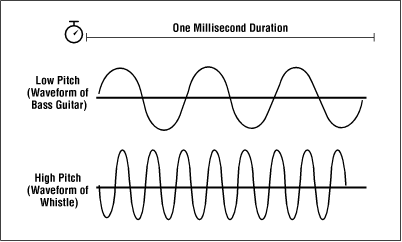 |
| Low pitch sound of the guitar and the high-pitched sound of a whistle. |
The sound pitch depends on the frequency of the sound source, and the sound pitch increases by increasing the frequency and vice versa.
Sound intensity
The sound intensity is the property by which the ear can distinguish between the sounds, whether strong or weak. Every sound around us has a level of sound intensity.
You notice that the shouting is stronger than the whispering, and the drum produces a strong sound when it is beaten strongly, and it produces a weak sound when it is beaten softly.
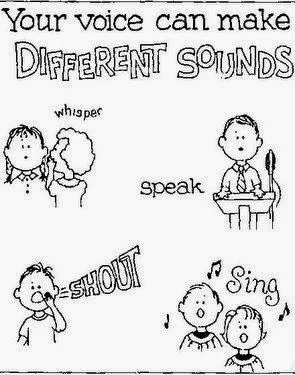 |
| The level of the sound intensity changes from one person to another. |
Factors affecting the sound intensity
- The sound intensity at a point depends on the distance between the ear and the sound source.
- It depends on the amplitude of the vibration of the sound source.
- It depends on the direction of the wind and the area of the vibrating surface.
- It depends on the density of the medium through which the sound travels.
Sound quality
The sound quality (type) is the property by which the human ear can distinguish between the different sounds according to the nature of the source, even if they are equal in intensity and pitch.
Harmonic tones
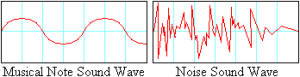 |
| Human can distinguish between sounds from different sources. |
The harmonic tones are tones that accompany the fundamental tone, but they are lower in intensity and higher in pitch and differ from one instrument to another.
The human ear distinguishes between the sounds from the different sources even if they are equal in intensity and pitch due to the harmonic tones that are associated with the fundamental tone of the source of the sound, and are lower in intensity and higher in pitch.
FAQ about Factors Affecting Sound Intensity
1. What is sound intensity?
Sound intensity is the amount of sound energy passing through a unit area per second. It determines how loud or soft a sound is.
2. What are the main factors affecting sound intensity?
- Distance from the sound source.
- Amplitude of the sound waves.
- The medium through which sound travels.
- Size and power of the sound source.
3. How does distance affect sound intensity?
As the distance from the source increases, sound intensity decreases due to energy spreading out (inverse square law).
4. What is the role of amplitude in sound intensity?
Higher amplitude means greater energy in the wave, resulting in a louder sound.
5. Does the medium affect sound intensity?
Yes, sound travels differently through solids, liquids, and gases. Denser media can transmit sound more efficiently.
6. How does the size of the sound source influence intensity?
Larger or more powerful sources produce more energy, leading to higher sound intensity.
7. Can obstacles affect sound intensity?
Yes, barriers can absorb, reflect, or scatter sound waves, reducing intensity.
FAQ about How the Human Ear Differentiates Between Sounds
1. How does the human ear detect sound?
Sound waves enter the ear canal, vibrate the eardrum, and are converted into electrical signals in the inner ear, which are sent to the brain.
2. What helps the ear distinguish between loud and soft sounds?
The amplitude of sound waves:
- High amplitude → loud sound.
- Low amplitude → soft sound.
3. How does the ear differentiate between high and low pitch?
Pitch depends on frequency:
- High frequency → high pitch.
- Low frequency → low pitch.
4. What is the role of the cochlea in hearing?
The Cochlea contains tiny hair cells that respond to different frequencies, helping distinguish various sounds.
5. How can the ear recognize different types of sounds (voices, music, noise)?
The brain analyzes sound wave patterns, including frequency, intensity, and waveform, allowing us to identify and differentiate sounds.
6. What is timbre, and how does it help in sound differentiation?
Timbre is the quality or character of a sound that makes different sources (like musical instruments or voices) sound unique, even if they have the same pitch.
7. Can the human ear hear all sound frequencies?
No, the typical human hearing range is about 20 Hz to 20,000 Hz.
8. How does the brain contribute to sound differentiation?
The brain processes signals from the ear and interprets them based on experience, helping recognize familiar sounds.
You can subscribe to Science Online on YouTube from this link: Science Online
Audible sounds, Doppler’s effect, Savart’s wheel importance, Sound properties and velocity
Sound intensity, Factors affecting Sound intensity & Applications of ultrasonic waves
The importance of ultrasonic waves in medical diagnosis
The advantages and disadvantages of ultrasonic waves in detecting industrial defects
The concentration of sound and importance of echo (sound reflection) in our life