Types of mirage and the reasons for the occurrence of mirage phenomenon
The mirage can occur on the seas or in the deserts. It is a natural phenomenon that occurs in the desert at noon, especially in the summer, when objects on the roadsides seem as if they have inverted images in a wet area.
Mirage phenomenon
A mirage is a natural optical phenomenon that occurs when light rays bend due to variations in air temperature, creating the illusion of water, distant objects, or reflections where none exist.
When the air above the desert road is heated at noon, which leads to the formation of different air layers of different temperatures by convection currents, the mirage occurs when the ground heats the air above, making it hotter than the air at higher altitudes.
When cold air is denser than warm air, and it has a greater refractive index, when the light travels at a shallow angle along a boundary between the air of different temperatures, the light rays bend towards the colder air.
If the air near the ground is warmer than that higher up, the light ray bends upward, it will be totally reflected above the ground, and the light rays curve downward, and the result in seeing the upright image and the inverted image, which appears to you as a reflection in the water.
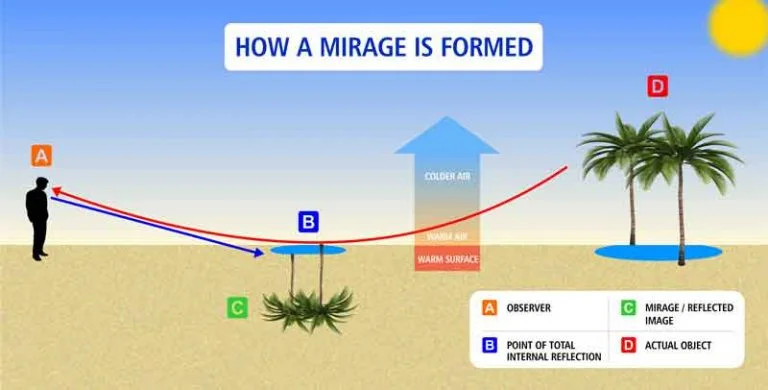
How a mirage is formed
How do you explain a mirage?
The mirage phenomenon is caused by refraction, the bending of light, as it passes through layers of air at different temperatures. This often happens on hot days when the ground heats the air just above it. The sun heats the ground, which in turn heats the air directly above it. This air is much warmer than the cooler air just above.
Light traveling from the sky into this gradient of air changes speed and direction. The light bends upward toward your eyes, making it appear as though it’s reflecting off a surface below, like water. Your brain interprets the bent light rays as coming from a flat reflective surface (like water), so you might see what looks like a puddle on a road or a shimmering lake in the desert.
Types of mirages
- Inferior Mirage: Most common; appears below the actual object (e.g., water on a hot road).
- Superior Mirage: Appears above the actual object, often due to cold air near the surface and warmer air above (inversion layer); can make ships or land appear to float.
- Fata Morgana: A complex and layered superior mirage that can distort objects dramatically and stack images.
The mirage is called also an inferior mirage which appears in the desert, it appears to be a lake of water in the distance, it is called inferior as the mirage is located under the real object, So, the inferior mirage causes the observer to see a bright and bluish patch on the ground in the distance.
The inferior mirage is usually upside down, it is not stable, when an object (as a tree) exists on the roadside, the rays coming from it refract several times, going from the higher cold layers to the lower hot layers, and the hot-road mirage (fake water) on the road is the most common example of an inferior mirage.
At the hottest air layer (which lies directly above the Earth’s surface), a total internal reflection happens to the rays coming from the object. So, this layer appears as a watery area, and a virtual inverted image is formed below the object.
The heat haze is called the heat shimmer which refers to the inferior mirage that experienced when viewing the objects through a layer of heated air such as viewing the objects across hot asphalt or through the exhaust gases produced by jet engines, and it is called a highway mirage, and the image is usually upside down.
The superior mirage occurs when the air below the line of sight is colder than the air above it, and it is less common than the inferior mirages. it is common in the polar regions over large sheets of ice that have a uniform low temperature.
The superior mirages also occur at more moderate altitudes, and they are weaker and tend to be less smooth and stable, and it can be right-side up or upside down depending on the distance of the true object and the temperature gradient.
The Fata Morgana mirages are most common in the polar regions, especially over large sheets of ice with a uniform low temperature, and they can be observed on cold days, in desert areas, over oceans, and lakes.
Fata Morgana appears with the alternations of compressed and stretched zones, the erect images, the inverted images, and it is also a fast-changing mirage.
What is the cause of mirages?
The cause of mirages is the refraction (bending) of light as it passes through layers of air at different temperatures and densities, a condition known as a temperature gradient.
Uneven Heating of Air: The ground (like a road or desert sand) gets heated by the sun. This heats the air closest to the surface, making it warmer than the air above. Warm air is less dense than cool air.
Light Travels Through Air Layers: Light from the sky or distant objects passes through these layers. As light moves from cooler (denser) to warmer (less dense) air, it bends away from the normal, curving upward.
Light Reaches Your Eyes Indirectly: Instead of traveling in a straight line, the light curves and reaches your eyes from a lower angle. Your brain assumes the light came in a straight line, so it “projects” the image downward, creating the illusion of water or a reflection.
Mirages are caused by light bending due to temperature differences in the air, typically when hot ground heats the air directly above it, creating an optical illusion.
Applications on the total reflection of light (Optical fibers, Reflecting prism, and Mirage)
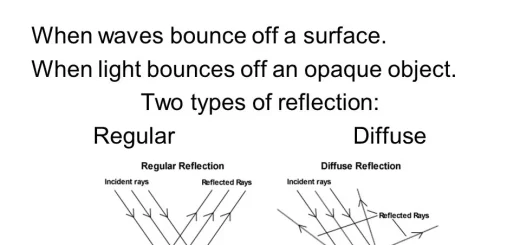
Regular reflection and irregular reflection of light