
Techman (TM) collaborative robots features, TM Robot, Cobot with a Built-in Vision System
Techman (TM) collaborative robots are smart, vision-equipped robotic arms designed to safely collaborate with humans in manufacturing, logistics, and service industries, offering flexible, easy-to-program automation without the need for safety cages.
Techman (TM) collaborative robots
Techman (TM) collaborative robots are a family of human-friendly robotic arms developed by Techman Robot Inc. that are designed to work safely alongside people in industrial and commercial environments.
TM cobots are referred to as collaborative robots (cobots) because, unlike traditional industrial robots that require cages or fences, they are equipped with safety features, force-limiting mechanisms, and intelligent vision systems that enable them to coexist safely with humans in a shared workspace.
Collaborative robots (cobots) are designed to cooperate with humans instead of replacing or isolating them. TM cobots are unique in having a built-in camera and vision tools (TMvision™) for object recognition, inspection, and alignment. They are operated through TMflow™, a drag-and-drop graphical interface that doesn’t require coding expertise.
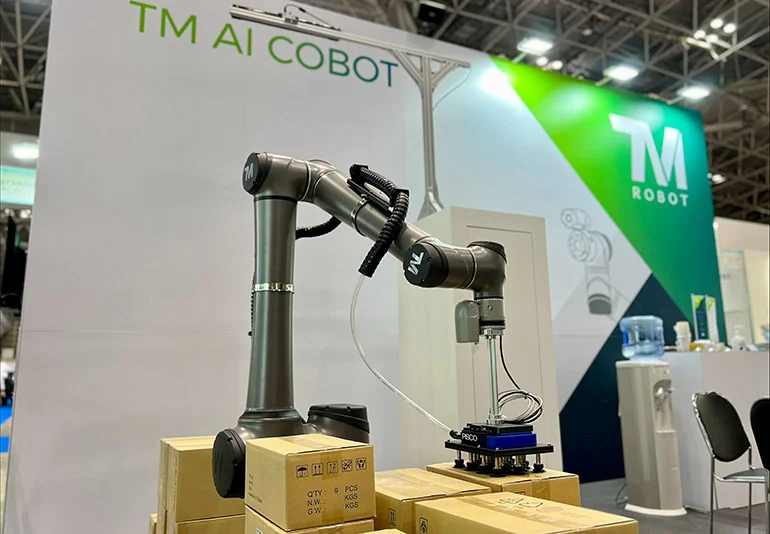
TM cobots
Collaborative robots can comply with ISO safety standards (ISO 10218-1 and ISO/TS 15066) and include collision detection and force-limiting features. They can perform tasks such as pick and place, assembly, machine tending, inspection, palletizing, welding, and packaging across industries like electronics, automotive, logistics, and food.
What can TM cobots do?
Techman (TM) collaborative robots or TM Cobots, are designed to combine industrial precision with human-friendly collaboration. They work safely alongside people while handling a wide range of tasks across industries. Techman cobots can pick, place, assemble, inspect, weld, package, and move items — all while collaborating safely with humans, reducing costs, and improving productivity.
Main Capabilities of Techman Cobots:
- Pick & Place / Material Handling: Techman Cobots move objects from one location to another with precision. They handle tasks like tray loading, parts sorting, or packaging. They are suitable for delicate electronic parts or heavier items (depending on the model).
- Assembly: Techman Cobots perform repetitive assembly tasks such as screwing, fitting, or fastening. They ensure consistency and reduce worker fatigue. They work in electronics, automotive, and consumer goods assembly lines.
- Quality Inspection (Vision + AI): With built-in TMvision™, cobots can inspect product quality. They can detect defects or missing parts. They read barcodes, QR codes, and text (OCR). They are often used in electronics, semiconductors, and packaging industries.
- Machine Tending: Techman Cobots are used for load/unload CNC machines, injection molding machines, or test equipment. They run 24/7 without breaks, boosting machine utilization. They improve safety by keeping humans away from hazardous zones.
- Palletizing & Depalletizing: Techman Cobots are used to stack boxes, bags, or products onto pallets. They automate warehouse or logistics workflows. They reduce strain from heavy or repetitive lifting.
- Welding & Soldering: Some TM cobots can be equipped with welding torches or soldering tools. They provide precision in arc welding, spot welding, and electronics soldering.
- Surface Treatment: Techman Cobots are used for tasks like polishing, deburring, sanding, or painting. They maintain consistent finish quality compared to manual work.
- Packaging & Labelling: Techman Cobots can pack products into cartons, apply labels, and seal boxes. They integrate well with conveyor systems.
- Logistics & Mobile Robotics: When mounted on an AGV/AMR (mobile base), TM cobots can move around the factory/warehouse. They perform pick, place, or inspection tasks on the go. They use TM Landmark™ for navigation and positioning.
- Research & Education: Techman Cobots are used in universities and training centers for robotics, AI, and automation research. Intuitive TMflow™ drag-and-drop programming makes them suitable for students and beginners.
Industry Applications
- Electronics & Semiconductors → circuit board assembly, chip inspection.
- Automotive → machine tending, welding, parts handling.
- Logistics & Warehousing → palletizing, mobile robotics.
- Food & Beverage → packaging, labeling, sorting.
- Pharma & Medical → precise handling, inspection, lab automation.
Techman Robot Features
1. Built-in Vision System (TMvision™): Techman robots come with an integrated vision system—no need for separate vision add-ons. This includes capabilities like:
- Shape-/image-based pattern matching and position alignment.
- Barcode, QR code, and DataMatrix reading.
- Color classification and OCR.
- Image enhancement functions like contrast adjustment and morphology operations.
- One-click visual calibration using a calibration board.
- TM Landmark: allows the robot to relocate within 3D space and update object coordinates without manual recalibration.
2. Simple, Code-Free Programming (TMflow™): Techman offers intuitive “click-and-drag” programming via TMflow™, a graphical flow-based editor.
- Build workflows visually without any coding.
- Create reusable components with TM Component Editor™.
- Programming can often be done by beginners in just minutes.
3. Safety and Collaboration: These robots are designed to operate safely alongside humans:
- Force-limiting and collision detection with immediate stop.
- Compliance with ISO 10218-1 and ISO/TS 15066 safety standards.
- Built-in options to limit speed and define safe zones—making fences optional.
4. Flexible Series and Payload Options: Techman offers several robot series tailored to different needs:
- Regular Payload Series (e.g., TM5-700, TM5-900): Compact, ideal for electronics, assembly, pick & place. TM5-700: ~746–750 mm reach, 6 kg payload. TM5-900: ~600–946 mm reach, 4 kg payload.
- Medium–Heavy Payload Series (e.g., TM12, TM14, TM16): Longer reach and higher payloads—suitable for semiconductor, CNC, and panel industries. Payloads: 12 kg (TM12), 14 kg (TM14), 16 kg (TM16). Reach: ~800–1300 mm
- AI Cobot S Series (enhanced performance): Examples: TM5S, TM7S, TM12S, TM14S, TM25S, TM30S. Improved speed (450°/s 6th axis), high repeatability (±0.03 mm), built-in 5 MP autofocus camera, TÜV safety certified. Additional features: TM AI+ Trainer, TMscript, TMcraft, optional touchscreen, Robot Stick 2.0.
- Mobile Solution: Combines a cobot arm with AGV/AMR for mobility. Features include DC power design, SEMI-S2 compliance, TM Landmark for navigation, and sensor-based safety.
5. Software and Expandability: Techman enhances its robots with supportive software modules: TMflow, TMvision, Conveyor Tracking, ROS Driver, API access, TMstudio, and TM AI+. These add-ons enable features like AI-based inspection, conveyor synchronization, ROS integration, and broader automation workflows.
6. Global Recognition & Applications: Techman Robot Inc., founded in Taiwan and spun off in 2015, specializes in cobots with built-in vision—earning awards like COMPUTEX D&I Gold and Taiwan Excellence. TM Robots are widely used in electronics, automotive, semiconductors, logistics, food, and more. Applications include pick & place, palletizing, machine tending, welding, quality inspection, packaging, and more.
Advantages of Techman (TM) Cobots
- Built-in Vision System: Techman (TM) collaborative robots—commonly known as “Techman Robots” or “TM Robots. Techman robots ship with TMvision™, a seamlessly integrated vision system—no extra hardware or complex setup required. It supports features like barcode/QR code reading, image-based alignment, OCR, and one-click calibration.
- Intuitive, Code-Free Programming: Programming is drag-and-drop via TMflow™, enabling non-programmers to set up tasks quickly—sometimes within just a few minutes. The TM Component Editor™ enables the reuse of workflows across projects.
- Safety-Centric Design: These robots comply with ISO 10218-1 and ISO/TS 15066 standards. They include force limiting, emergency stops, configurable speed limits, and even body-part-specific safety zones.
- Highly Flexible and Compact: TM cobots come in various payload sizes (regular, medium/heavy) and mobile AGV-integrated models—making them adaptable for assembly, logistics, or dynamic workflows.
- Accessible and Cost-Efficient: They’re generally more affordable than industrial robots and require less infrastructure and setup. No safety cage needed means faster, lower-cost integration.
- Boosted Productivity & Worker Satisfaction: Cobots handle repetitive or strenuous tasks, freeing workers to focus on value-added activities. That improves output, reduces injury risk, and enhances job satisfaction.
- Rapid ROI and Versatility: Flexible use, easy redeployment, and low maintenance often lead to quick ROI—typically within 1 to 3 years.
- Better Ergonomics: By taking over monotonous or physically demanding work, cobots help reduce fatigue and injury, improving workplace ergonomics.
Disadvantages of Techman Cobots
- Lower Payload and Slower Speeds: Cobots typically handle lighter payloads (often <15 kg) and move slower to ensure safety. This can be a drawback if your tasks are heavy or need high-speed precision.
- High Initial Costs and Integration Complexity: Even though cheaper than industrial robots, TM cobots still carry a notable upfront cost (often €20,000–€50,000). Integration can get complex when retrofitting into legacy systems, sometimes requiring customization and training.
- Training and Adoption Curve: Despite intuitive interfaces, effective deployment often requires training. Ramp-up times can take from hours to days, impacting initial productivity.
- Limited Autonomy and Performance in Complex Tasks: Cobots frequently require human oversight and may lag in tasks needing full autonomy, adaptability, or ultra-high precision.
- Operational and Environmental Sensitivities: Cobots can be sensitive to temperature, dust, humidity, and power instability. This can lead to decreased performance or increased maintenance needs.
- Safety Isn’t Absolute—”Cage-less” Isn’t Risk-free: Cobots are safer by design, but not impervious. In real-world use, deployments may still require guards or supplemental safety systems depending on the application, tooling, or human interaction.
- Training and Workforce Resistance: Some workers may resist using cobots due to fear of automation replacing jobs, or simply a lack of familiarity with the technology.
You can subscribe to Science Online on YouTube from this link: Science Online
Scara robot advantages and disadvantages and What is the structure of the SCARA robot?
Serial Robots review, advantages, disadvantages and what can serial robots do?
Collaborative robot arm (cobot robots) applications, uses, advantages and disadvantages
Automation in manufacturing uses, advantages and disadvantages
Industrial robot (Auto industry) uses, advantages and disadvantages
Robot welding advantages over manual welding