
Zipper Mast Robot review, Robot with 8′ Zipper Mast Performs Surveillance Operations
A Zipper Mast robot is a robotic system equipped with a ZipperMast telescoping structure that allows it to raise and stabilize payloads—such as cameras, sensors, or communication devices—well above its base while remaining compact and portable when collapsed.
Zipper Mast robot
A Zipper Mast robot is a type of mobile robot that uses a ZipperMast telescoping mast system to extend cameras, sensors, or antennas vertically above its base. The Zipper Mast itself is a patented mast made of three interlocking spring-steel tapes that “zip” together as they extend, forming a rigid column. When not in use, the mast collapses into a very compact housing, making it ideal for mobile and unmanned robotic platforms.
A Zipper Mast robot can act as a mobile eye, ear, and antenna platform — extending sensors, cameras, and communication tools far above its base robot while staying compact and stable when stowed. The Zipper Mast robot excels in compactness, rigidity, and protected cable routing, making it great for mobile robotic platforms. Its main trade-offs are side-load limitations, payload weight constraints, and higher complexity/cost compared to simpler mast solutions.
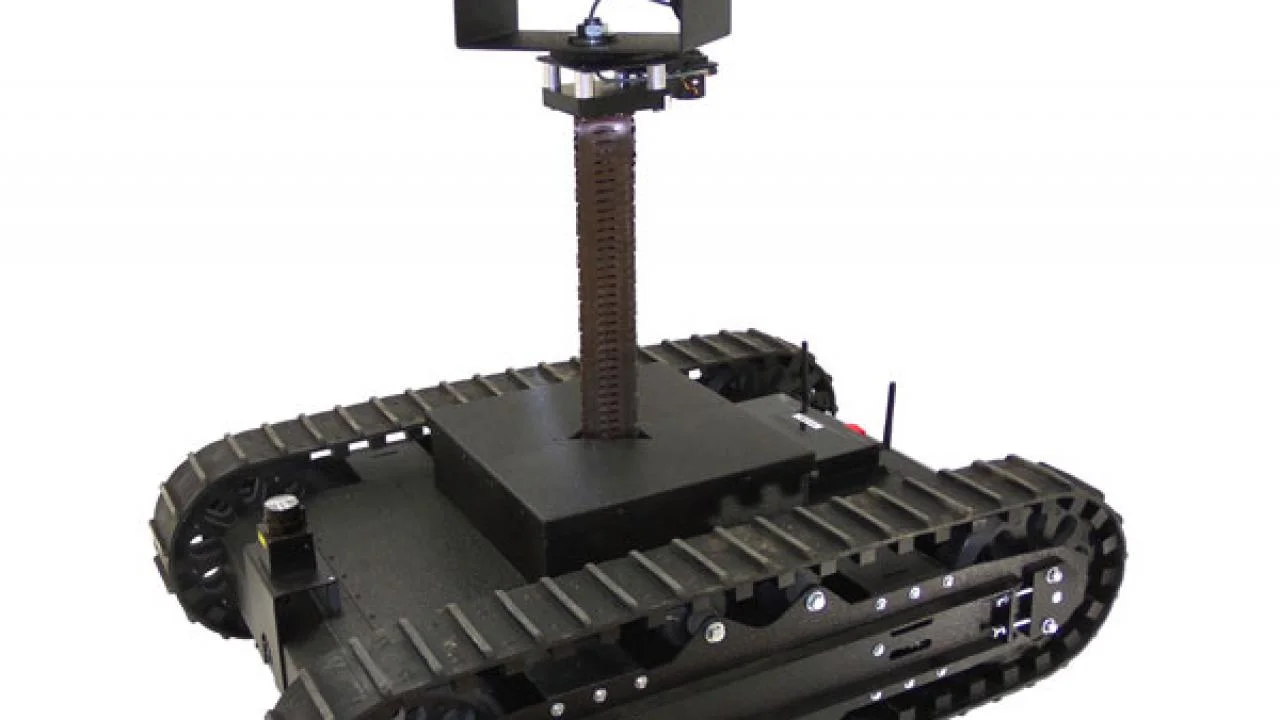
Zipper Mast robot
Characteristics
- Compact storage → folds into a small housing.
- Large extension → extends several times its stored size.
- Rigid & self-supporting → stable without external locks.
- Protected cabling → wires run inside the mast.
- Versatile applications → surveillance, inspection, communication, defense, disaster response, and exploration.
What is the Zipper Mast
The Zipper Mast is a telescoping mast system that uses three interlocked steel tapes (like tape‐measure style springs) that zip together as it extends. When collapsed, it fits into a small, compact housing. When extended, it gives a rigid, stable mast similar to what you’d get with other telescoping or rigid structures.
Features of Zipper Mast
- High extension ratio / compact stowage: The Zipper Mast can extend many times its collapsed height. Example: an 8 ft (≈2.5 m) mast (ZM8) that collapses to under 10 in (≈25 cm) high. Larger ones can reach 40+ ft with a still small collapsed size.
- Stability & rigidity: Once the tapes interlock (“zip”), they form a stable structure. No additional locking mechanism is required to maintain it in an extended position. It can hold its position under load, even when partially extended.
- Uniform cross-section: The diameter of the mast remains constant as it extends/collapses, unlike nested telescoping poles, where outer sections are thicker. This helps with weight distribution, reducing moment arms, and maintaining stability.
- Cable routing / protected wiring: Because of the design (spiraled coils, guiding spindle), wires/cables to sensors or cameras at the mast top can be run internally via the guiding spindle, protected during extension/retraction.
- Robust construction: The steel tapes are spring-tempered stainless steel, with special coatings to reduce wear. The guiding spindle is hardened. The drive motor (e.g., from Faulhaber) is small but rugged. Environmental protection, such as IP ratings, is addressed in some variants.
- Broad application: Zipper Mast is used in unmanned ground vehicles (UGVs), surveillance, communications, inspection (pipes, shafts, ventilation), police/emergency services, and civil defense. Also in harsh/hostile environments, possibly offshore or even for space applications.
What can the zipper mast robot do?
The Zipper Mast robot (or robots equipped with a ZipperMast system) can perform a wide range of tasks thanks to its compact, extendable, and rigid mast design.
What Zipper Mast Robots Can Do:
- Raise cameras and sensors for surveillance: Zipper Mast can extend cameras, LIDAR, thermal imagers, or night-vision sensors above obstacles. It can provide elevated viewpoints for reconnaissance, border patrol, or security.
- Enable communication and networking: Zipper Mast can deploy antennas, radio relays, or 5G/mesh network nodes from a mobile robot. It can improve line-of-sight for communication in urban or remote areas.
- Inspection and monitoring: Zipper Mast can extend into pipes, shafts, tunnels, or ventilation ducts where humans cannot enter. It can check infrastructure (bridges, industrial sites, hazardous areas).
- Disaster response and emergency use: Zipper Mast can allow search-and-rescue robots to lift cameras above rubble or into collapsed buildings. It can carry gas or radiation sensors into dangerous environments.
- Military and defense applications: Zipper Mast is mounted on unmanned ground vehicles (UGVs) for stealthy observation. It can extend optics or antennas while keeping the robot behind cover.
- Civil defense and law enforcement: Zipper Mast is used by police robots to peek over barriers, inspect suspicious packages, or monitor crowds safely.
- Scientific and exploration missions: Zipper Mast can collect environmental data (air quality, radiation, seismic monitoring). It has potential for use in space robotics, where compact storage and reliable deployment are critical.
Why It’s Useful
- Small footprint: Zipper Mast fits into compact robots but extends tall.
- Stable viewpoint: Zipper Mast holds sensors steady at height.
- Protected wiring: Zipper Mast keeps cables safe during repeated deployment.
- Versatile environments: Zipper Mast works on land, industrial sites, disaster zones, or potentially even offshore/space.
Zipper Mast Robot advantages
- Compact storage, large extension: Zipper Mast collapses into a very small housing but can extend many times its size (e.g., <25 cm collapsed → >2.5 m extended). It is ideal for mobile robots or drones with limited space.
- Rigid and self-supporting: Once the steel tapes interlock, the mast becomes stable and does not require external locking or guy wires. It holds sensors or cameras firmly, even when partially extended.
- Constant diameter: Unlike telescoping tubes that get thinner at the top, the Zipper Mast maintains the same cross-section along its height. Zipper Mast improves stability, reduces bending, and provides a more uniform load-bearing capacity.
- Protected cable management: Wires for cameras, antennas, or sensors can be routed inside the mast, shielded from mechanical stress or environmental damage.
- Durability: Zipper Mast is made of spring-tempered stainless steel with protective coatings, resistant to wear and harsh environments. It works in field robotics, defense, and even offshore conditions.
- Versatility of use: Zipper Mast supports applications in surveillance, inspection (tunnels, shafts), communications, law enforcement, military, disaster response, and potentially space exploration.
Disadvantages of Zipper Mast
- Limited resistance to side forces: Zipper Mast is very strong under vertical loads but more vulnerable to horizontal stresses (wind gusts, robot motion, uneven terrain).
- Mechanical complexity: The guiding spindle and interlocking tape design require precision manufacturing. Maintenance may be more demanding compared to simple telescopic poles.
- Load capacity limits: Zipper Mast can carry cameras, sensors, antennas — but heavy payloads reduce speed and stability. It is not suitable for very large or heavy instruments.
- Environmental challenges: While robust, extreme dust, ice, or debris can interfere with smooth “zipping” and unzipping.
- Cost: More advanced and specialized than basic telescopic masts, so the system is relatively expensive.
- Slender profile when extended: Tall, thin structure makes it susceptible to vibrations in windy or dynamic environments.
Limitations / Trade-Offs
- Though quite rigid once extended, the mast may still have limitations in horizontal loading (side forces) compared to truly rigid poles. The interlocked tapes are strong under compressive load (vertical), but side loads may cause more deflection.
- Speed of extension/retraction may depend on the motor torque and load (camera, sensors, etc.). Heavy loads slow things down.
- The complexity of the mechanism (guiding spindle, interlocking tapes, coatings) means manufacturing precision and maintenance are important.
- Potential vulnerability in very strong wind or dynamic loads because the mast is slender and long when extended.
You can follow Science Online on YouTube from this link: Science online
Sophia robot review, features, use, advantages and disadvantages
Top trending topics on Sophia robots and Can Sophia Destroy humans
Educational robotics, Robot teachers, Social robots review, features, advantages and drawbacks
Humanoid robots uses, risks, advantages and disadvantages