
5 Insane Personal AI Robots You’ll Want in Your Home in 2026! 🤖🏠
Personal AI robots in 2026 are moving beyond science fiction and becoming increasingly capable of interacting with people, understanding their surroundings, and performing useful tasks at home. From humanoid robots that can handle household chores to AI companions designed to keep people connected, these machines are changing what a smart home could look like.
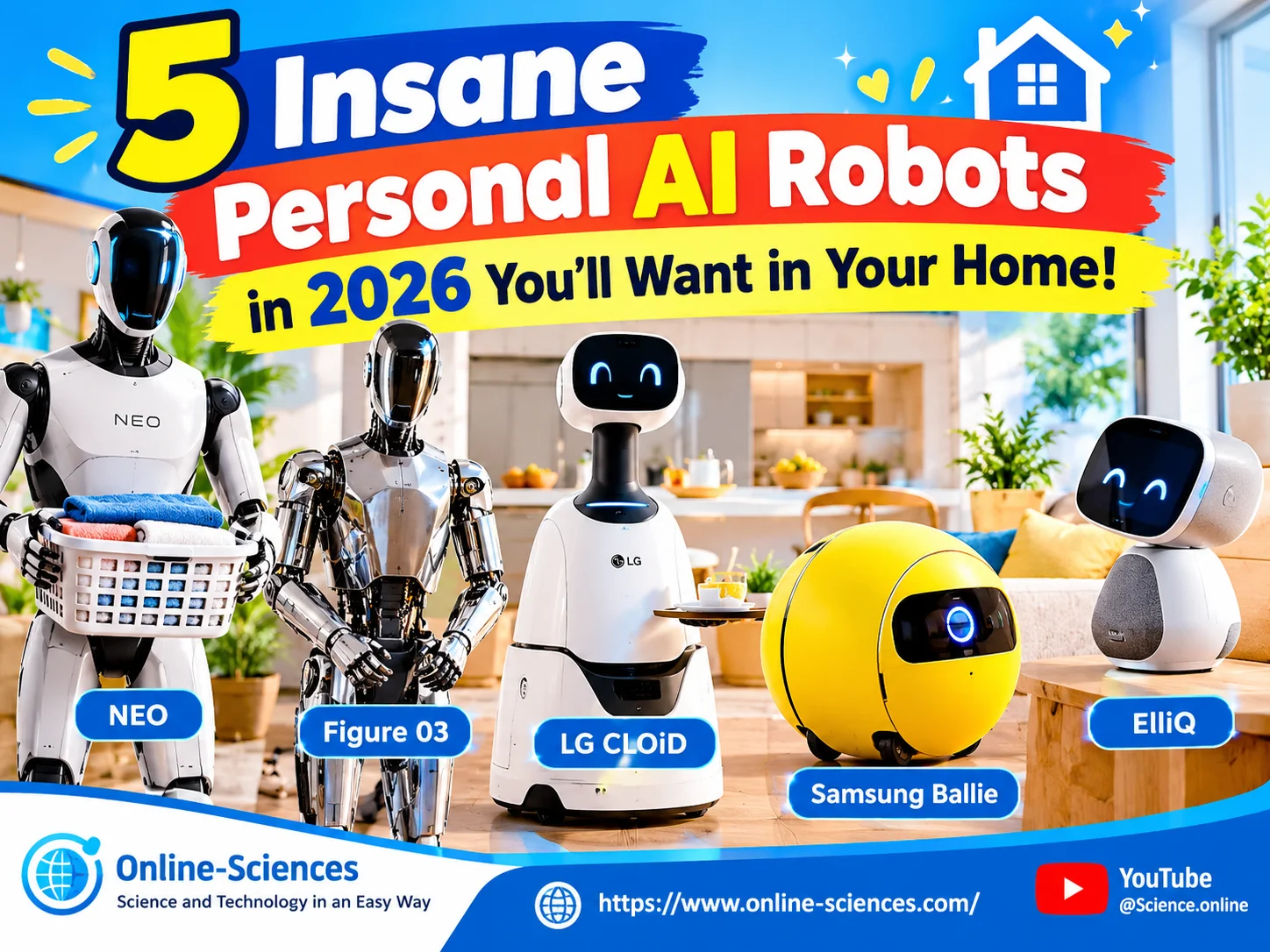
5 Insane Personal AI Robots in 2026
Personal AI robots in 2026
Personal AI robots in 2026 are bringing a new generation of intelligent machines into our homes, combining artificial intelligence, computer vision, natural-language interaction, and advanced robotics. From humanoid robots that can help with household chores to smart AI companions designed for entertainment and assistance, these futuristic robots are making the smart home more interactive, useful, and exciting than ever.
5 Insane Personal AI Robots in 2026
In 2026, several companies are developing robots that combine artificial intelligence, computer vision, natural-language interaction, advanced sensors, and physical manipulation. Here are five fascinating personal AI robots worth watching.
1. NEO Home Robot – Your AI Helper Around the House 🤖
NEO, developed by 1X, is one of the clearest examples of a humanoid robot specifically designed for home use. Unlike traditional robot vacuums or smart speakers, NEO is designed to move around a human environment and physically interact with objects. 1X says NEO can perform everyday chores, follow scheduled tasks, interact through natural conversation, navigate around the home, and even return to its charger automatically.
The robot uses Redwood AI, 1X’s vision-language model for learning and performing household tasks. It can understand visual information, spatial context, audio cues, and conversations, giving it a much broader role than a conventional smart-home device.
NEO is also designed with a soft body and safety-oriented construction for domestic environments. 1X lists a height of about 5’6″, a weight of 66 pounds, and the ability to lift more than 150 pounds.
The company announced that early consumer orders would begin shipping in 2026, with an Early Access price of $20,000 or a subscription option announced at $499 per month for later shipments. Why it’s exciting: NEO represents an AI assistant that doesn’t just talk to you—it can physically help around your home.
2. Figure 03 – A Humanoid Robot Designed for the Home
Figure 03 is another major step toward general-purpose home robots. The figure says its third-generation humanoid was designed specifically for the home and large-scale production. The company redesigned the robot‘s sensory system, hands, audio hardware, and body to make it better suited to everyday domestic environments.
Figure 03 is designed to perform household activities including laundry, cleaning, and doing dishes. Its Helix AI system allows the robot to perceive its environment and translate what it sees into physical actions.
The robot also includes several home-focused safety features. Its exterior uses soft materials, and the company says it has reduced mass and volume compared with the previous generation. Figure 03 can also recharge through an inductive charging system built into its feet.
One of the biggest developments in 2026 is Figure’s work on Helix 2.5, which the company introduced in September 2026. Figure says the system is designed to help humanoids generalize their abilities across unfamiliar homes instead of requiring every environment to be learned independently.
Why it’s exciting: Figure 03 is aiming at something extremely ambitious—a general-purpose humanoid that can understand and work in the unpredictable environment of a real home.
3. LG CLOiD – The AI Robot for a “Zero Labor Home”
LG is approaching home robotics through its LG CLOiD home robot. LG unveiled CLOiD at CES 2026 as part of its vision for a “Zero Labor Home.” The robot combines AI, vision-based technology, robotics, and LG’s connected-home ecosystem to tackle household activities.
LG demonstrated CLOiD performing tasks such as folding laundry and cooking-related activities, showing how a home robot could potentially interact with appliances and household objects.
The important concept here is Physical AI. Instead of AI being limited to generating text, images or voice responses, Physical AI allows intelligent systems to perceive the physical world and act within it. LG also positions CLOiD as an ambient care agent capable of reducing both physical and mental effort in the home.
The robot is particularly interesting because LG already has a large ecosystem of connected home appliances. Combining an intelligent robot with smart refrigerators, washing machines, televisions, and other devices could eventually create a home where different AI systems coordinate with one another.
Why it’s exciting: CLOiD could become part of a broader AI-powered ecosystem rather than operating as an isolated robot.
4. Samsung Ballie – A Rolling AI Home Companion
Samsung’s Ballie takes a very different approach from full-size humanoid robots. Ballie is a compact mobile AI companion designed to move around the home and interact with people and connected devices. Samsung announced a partnership with Google Cloud to bring Gemini capabilities to Ballie, enabling more natural conversations and personalized home assistance.
Samsung described functions including helping manage home environments, adjusting lighting, greeting people at the door, personalizing schedules, and setting reminders. This makes Ballie particularly interesting for people who don’t necessarily need a human-shaped robot carrying objects around the house.
Instead, Ballie represents another possible future: a small mobile AI companion that can follow you, understand your environment, communicate with you, and connect your smart home. Why it’s exciting: Ballie shows that the future of personal AI robots doesn’t necessarily have to look humanoid.
5. ElliQ – The AI Companion Built for the Home
Not every personal AI robot needs arms and legs. ElliQ, from Intuition Robotics, is designed primarily as an AI companion for older adults. It focuses on conversation, engagement, routines, entertainment, and staying connected with family and caregivers.
ElliQ can communicate through voice, help users maintain routines, provide activities, and facilitate connections with loved ones. The company says the device is designed specifically for adults aged 60 and older who may spend significant amounts of time alone.
It can also support caregivers through features that help families stay connected. ElliQ is not a medical device, and the company explicitly distinguishes its companion role from medical care. ElliQ demonstrates an important direction for AI robotics: companionship can be just as important as physical assistance.
Why it’s exciting: It shows how AI robots can become personalized companions rather than simply machines that perform chores.
What Can Personal AI Robots Do in 2026?
The capabilities of these robots vary considerably, but the broader trend is clear. Modern AI robots are being designed to combine several technologies:
- Computer vision to understand people and objects.
- Natural-language AI for conversations.
- Robotic manipulation for interacting with physical objects.
- Navigation around homes.
- Memory and personalization.
- Smart-home integration.
- Autonomous task execution.
- Remote assistance and supervision.
The biggest technological challenge is that homes are unpredictable. Objects can move, furniture changes, people behave differently, pets can appear unexpectedly, and every home has a different layout.
That is why 2026 is such an important year for personal robotics. Companies are increasingly trying to make robots capable of generalizing what they learn from one environment to another rather than programming every individual task manually. Figure’s Helix 2.5 work is one example of this direction.
Are Personal AI Robots Ready to Replace Humans?
Not yet. Today’s home robots remain limited by factors such as cost, autonomy, reliability, safety, battery life, and the complexity of real-world environments. Some products are available or entering early-access programs, while others remain demonstrations or development projects.
For example, NEO is entering early consumer deployment, while Figure 03 and LG CLOiD represent broader efforts toward general-purpose home robotics. The more realistic near-term vision is not a robot that completely replaces a human—but an AI-powered helper that handles repetitive tasks and gives people more time.
The Future of Personal AI Robots
The next generation of home robots could combine the conversational abilities of AI assistants with the physical capabilities of humanoid robotics.
Imagine telling your robot: “Please clean the kitchen, put the dishes away, start the laundry, and remind me about my meeting at 4 PM.”
The robot would need to understand the request, plan the tasks, recognize objects, navigate the home, manipulate items safely, and communicate with you if something unexpected happens.
That future is still developing, but NEO, Figure 03, LG CLOiD, Ballie and ElliQ demonstrate five different approaches to bringing AI into our physical lives. The most important change in 2026 is that AI is no longer limited to a screen. It is increasingly becoming physical, mobile, interactive, and capable of acting in the real world.
Frequently Asked Questions about personal AI robots
1. What are personal AI robots?
Personal AI robots are intelligent machines designed to interact with people and perform useful activities in homes or personal environments using AI, sensors, cameras, robotics, and natural-language technologies.
2. What is the most advanced home AI robot in 2026?
There is no single robot that can be considered the overall “most advanced” for every purpose. NEO and Figure 03 focus strongly on general-purpose physical household tasks, while Ballie and ElliQ emphasize companionship and smart-home interaction.
3. Can AI robots clean the house?
Some emerging humanoid robots are being developed to perform household chores. Figure 03, for example, is designed for tasks including cleaning, laundry, and dishes, while NEO is designed to automate everyday chores.
4. How much does a personal AI robot cost?
Prices vary significantly. 1X announced NEO Early Access at $20,000 and a $499-per-month subscription option for later shipments. Other robots may not yet have consumer pricing because they are still in development or demonstration stages.
5. Will home robots replace human workers?
They may automate some repetitive tasks, but current home robots still have significant technical and practical limitations. Their long-term impact on household work and employment will depend on reliability, cost, capabilities, and adoption.
6. Are humanoid robots safe for homes?
Companies developing home humanoids are adding safety-oriented hardware and software, but real-world home use remains challenging. Consumers should evaluate manufacturer safety information, supervision requirements, privacy policies, and actual deployment experience before purchasing.
7. Are AI home robots available in 2026?
Availability varies. NEO has entered early consumer deployment, while other robots discussed here have different levels of availability, from consumer products to demonstrations and development programs.
Final Takeaway
Personal AI robots 2026 are turning the smart home into something much more ambitious. The next smart-home device may not simply answer questions or control a light—it could actually move, see, understand, learn, and perform physical tasks.
From the humanoid NEO and Figure 03 to LG CLOiD, Samsung Ballie and ElliQ, these robots show that the future of AI may be something you don’t just use on a screen—you may actually live with it at home. 🤖🏠
You can follow Science Online on YouTube at this link: Science Online
🔥 Reachy Mini Has to Break Bad News to Microduck 🤖 You Won’t Expect What Happens Next! 🚀
🔥 Tesla Bot Gen 4 UPDATE 5000 Tasks As HOMEMAKER & Surgeon! Elon Musk SHOCKED Inside Optimus! 🤯
Boston Dynamics Atlas review, advantages and features, How does Atlas robot work?
Tesla robots (Optimus) review, use, advantages and disadvantages
Emo robot review, advantages, disadvantages, features and what can Emo do?
Advantages and disadvantages of using robots in our life
Artificial intelligence (AI) definition, advantages, disadvantages, features and applications
Robot teachers use, advantages and disadvantages
Sophia robot review, features, use, advantages and disadvantages
Vector robot review, advantages, disadvantages and specifications